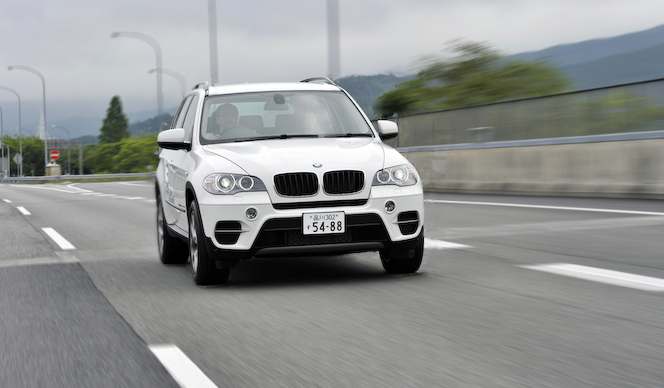
Test Drive: The BMW X5 Diesel
BMW X5 xDrive 35d BluePerformance |
BMW X5 xDrive35d BluePerformance
The Latest SUV Equipped with a Clean Diesel Engine
Test Drive: BMW X5 xDrive35d BluePerformance
In recent years, diesel engines have gained a reputation in the European automotive market for being clean and powerful. In Japan, however, the image of diesel as a villain, spewing black smoke, still lingers. Amidst this, BMW has finally introduced a diesel model to its core SUV lineup, the 'X5'. Automotive journalist Toshifumi Watanabe reports on what modern 'clean diesel' truly is, with his impressions of the 'X5 xDrive35d BluePerformance'.
Text by WATANABE Toshifumi
Photographs by KOGAHARA Mitomu
What Exactly is Clean Diesel?
As you know, European car manufacturers have widely adopted engine 'downsizing' as a strategy to improve environmental performance. The roots of this trend trace back to advancements in diesel engine environmental technology in the 1990s.
The 'common rail technology,' which atomizes diesel fuel under high pressure and precisely controls its injection, was first put into practical use in Japan. Combined with turbocharging, this technology optimizes combustion and increases output, forming the basis of the diesel engines now widely accepted in Europe. The development of downsizing gasoline engines, which use small-displacement direct-injection engines coupled with turbochargers to power large vehicles, also builds upon the technologies cultivated here.
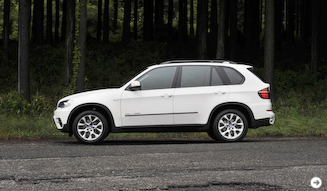
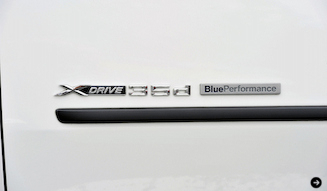
Meanwhile, Japan implemented strict exhaust gas regulations for diesel vehicles, triggered by an ordinance in Tokyo, and around the same time, hybrid cars emerged. Consequently, Japan took a different path than Europe. In essence, both paths were significantly influenced by local circumstances, and the debate over superiority in the broader business context may have become unproductive.The recently announced technical partnership between Toyota and BMWcan be seen as a testament to this.
Amidst this, BMW is actively pursuing the introduction of diesel engine models into the Japanese market, where the preconception of 'diesel equals bad' still persists. Following Mercedes-Benz, which led the way in imports, BMW introduced a diesel model to its SUV, the 'X5', this year. Rumors also suggest that a diesel model for the '3 Series,' their flagship model, might be added by the end of the year.
BMW X5 xDrive 35d BluePerformance |
BMW X5 xDrive35d BluePerformance
The Latest SUV Equipped with a Clean Diesel Engine
Test Drive: BMW X5 xDrive35d BluePerformance (2)
Nothing Out of the Ordinary
The X5, named 'xDrive 35d BluePerformance,' requires little in the way of special maintenance. While it might be slightly bothersome to have your fuel type confirmed at gas stations, the fuel filler cap has a green warning label, and the cap itself is clearly marked 'Diesel' to prevent misfuelling.
The AdBlue (urea) solution, used to clean exhaust gases, is housed in a unit within the engine bay, with a system designed to maintain optimal temperature using exhaust heat. This means no space is compromised in the luggage compartment. Furthermore, AdBlue needs refilling only every 20,000 km, so for average usage, dealership service during inspections or vehicle checks is more than sufficient.
Despite being a diesel, the 3-liter twin-power turbo engine, with its inline-six layout, is a hallmark of BMW. Its most striking feature is the smooth acceleration. While not quite on par with a gasoline engine, the noise and vibration are unobtrusive, and the characteristic diesel clatter is effectively suppressed in the practical driving range.
Even in the higher rev range, where diesels typically struggle, the engine pulls smoothly up to around 5,000 rpm without much sign of losing breath. This performance hints at BMW's engineering heritage, though the engine noise does become slightly more pronounced in that upper range.
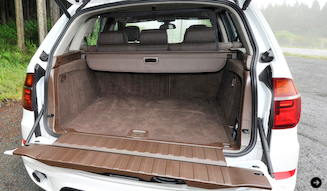
The sweet spot of a diesel engine lies in its abundant torque, which is available immediately from idle. Combined with a wide-ratio transmission, this torque band allows the vehicle to accelerate briskly without needing to rev the engine high – this is its value and its beauty. In reality, you'll find that you rarely need to venture beyond 4,000 rpm. This diesel engine, delivering 540 Nm of torque (equivalent to a 5-liter gasoline engine) at a mere 1,750 rpm, propels the large X5 with ease even below 2,000 rpm.
BMW X5 xDrive 35d BluePerformance |
BMW X5 xDrive35d BluePerformance
The Latest SUV Equipped with a Clean Diesel Engine
Test Drive: BMW X5 xDrive35d BluePerformance (3)
The Unique Appeal of Diesel
This abundant torque allows for lower cruising RPMs, leading to better fuel economy and a quieter cabin, while also providing effortless control over speed.—This is a major reason for the widespread adoption of diesel engines in Europe, where high-speed travel is prioritized. The X5 xDrive35d BluePerformance does not disappoint in this regard.
At 100 km/h, the cruising RPM is a mere 1,500. Smooth acceleration and deceleration from this speed can be managed simply by modulating the accelerator pedal. A forceful kick-down is only necessary for rapid acceleration, and in such cases, you'll quickly exceed the legal speed limit, so caution is advised.
In other words, speed control in the practical driving range, which most people will use, is seamless and highly functional. In this aspect, gasoline engines, which require higher revs to generate power, struggle to compete. Especially with a large and heavy SUV like the X5, the difference in drivability is stark.
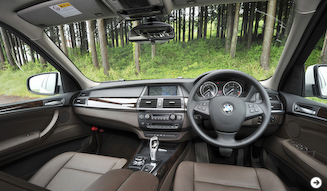
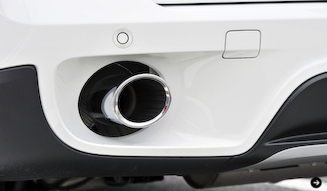
The engine is a crucial element in defining a car's character. From this perspective, with a diesel, the overall feeling tends towards relaxed cruising rather than spirited driving. Combined with the X5's chassis, which is set up for considerable on-road performance, there's a slight mismatch in terms of ride comfort.
However, considering the inherent purpose and characteristics of an SUV, the suitability of a diesel engine is undeniably superior to that of a gasoline engine. Therefore, if you were to buy an X5 today, this model is likely the only sensible choice, both in terms of character and running costs. Incidentally, the fuel economy of the test car, driven primarily for photography on highways, was 12.1 km/ℓ overall. Achieving this level of power and fuel efficiency with a gasoline engine would be a considerable challenge.
Given this, many users will likely be more interested in the diesel model of the recently redesigned '3 Series'.We plan to bring you a report from Europe on that topic soon.

BMW X5 xDrive 35d BluePerformance |
BMW X5 xDrive35d BluePerformance
Body | Length 4,860 × Width 1,935 × Height 1,775 mm
Wheelbase | 2,935 mm
Vehicle Weight | 2,220 kg
Engine | Inline 6-cylinder DOHC 24-valve Twin Power Turbo Diesel
Displacement | 2,992 cc
Max. Output | 180 kW (245 ps) / 4,000 rpm
Max. Torque | 540 Nm (55.1 kgm) / 1,750-3,000 rpm
Compression Ratio | 16.5
Front Suspension | Double wishbone coil spring
Rear Suspension | Integral arm coil spring
Drive | All-wheel drive
Transmission | 8-speed automatic
Tire Size (Front/Rear) | 255/50R19
Fuel Economy | 11.0 km/ℓ (JC08 mode)
Minimum Ground Clearance | 220 mm
Minimum Turning Radius | 6.4 m
Luggage Capacity | 620 liters / 1,750 liters (rear seats folded)
Price | ¥8,390,000