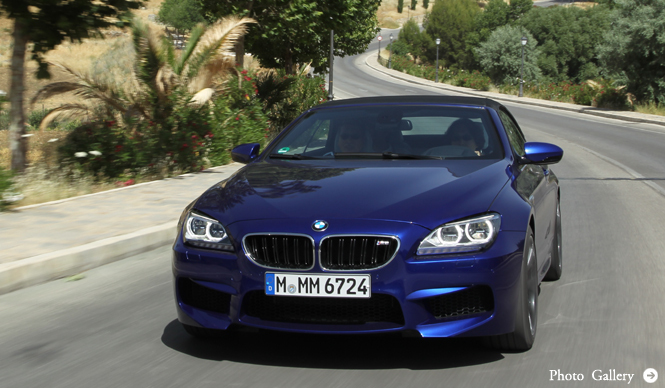
Test Drive the BMW M6: The Pinnacle of the Modernized 6 Series | BMW
BMW M6
The most powerful model of the modernized 6 Series
Test Drive: BMW M6
The "M6," tuned by M division, is based on BMW's luxury coupe, the 6 Series.Unveiled at the Geneva International Motor Show andSales began in Japan in AprilThe international test drive event for this model, which launched in Japan in April, was recently held in Spain. What kind of character does the current flagship M model possess? An impression by Yasuhisa Shimashita.
Text by YASUHISA SHIMASHITA
A 5 Series Coupe? No Way!
The "M6 Coupe & Convertible," arguably the flagship of BMW's M models, has undergone a full model change. Its fundamental structure remains the same as before, closely mirroring the differences between the "6 Series" and "5 Series." In essence, it's safe to say it's the coupe version of the "M5." However, after actually getting behind the wheel at a test drive event near Malaga, Spain, the impression it left was surprisingly different.
Of course, simply comparing the specifications would lead one to imagine there would be differences.
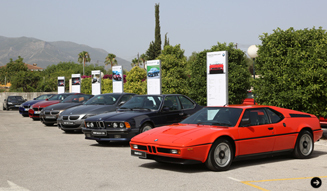
Looking at the specifications for the Japanese market, which have already been announced, the M6 Coupe measures 4,905mm in length, 1,900mm in width, and 1,375mm in height. Compared to the M5 sedan, it is 15mm shorter, 10mm wider, and 95mm lower. The wheelbase of 2,850mm is a reduction of 115mm.
The vehicle weight is 1,910kg, 70kg lighter than the M5. The CFRP (Carbon Fiber Reinforced Plastic) roof, adopted from the previous generation, also contributes to weight reduction, a unique feature of the M6. In fact, the roof panel alone weighs 3.7kg, less than half of what a steel roof would weigh. As the roof is the highest point of the car's body, this also lowers the center of gravity.
Furthermore, the CFRP itself has evolved; its thickness is reduced compared to the previous M6, and the center section is recessed. This undoubtedly contributes to increased rigidity and a further lowered center of gravity. Despite these improvements, the production time has also been reduced by about 20%. BMW, which actively adopts CFRP, produces these in its own factories.
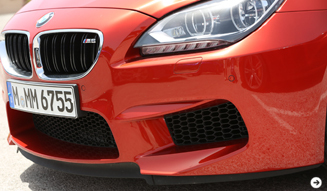
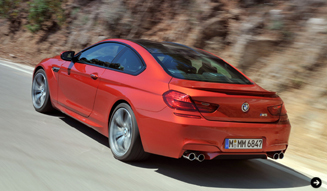
Other exterior features include not only the customary front and rear bumpers and exhaust system, but also dedicated front fenders made of thermoplastic. This is to accommodate the front track, which has been widened by 30mm. The standard tire size is 19 inches, with 20-inch wheels available as an option. A subtle detail is the placement of reflectors just below the rear combination lamps. While a minor detail, it interestingly enhances the sense of width.
BMW M6
The most powerful model of the modernized 6 Series
Test Drive: BMW M6 (2)
Engine with Notable Ease of Use
First, I settled into the dedicated sports seat inside the M6 Coupe and noticed that the steering wheel in front of me had been redesigned with a compact, round center pad and slender spokes. The design, different from the base model, is a mood-lifting detail, and along with the larger shift paddles, the operational feel is excellent.
As with the previous generation, various settings for the steering, damper, throttle response, and DSC intervention can be adjusted. These can be adjusted individually, and up to two preferred settings can be memorized and recalled using buttons on the steering wheel.
The engine, like the M5's, has been changed from the previous naturally aspirated 5.0-liter V10 to a twin-turbocharged 4.4-liter V8 direct-injection engine. While the maximum output of 560ps is significant, its characteristic feature is the maximum torque of 69.3kgm (680Nm) generated across a wide range from 1,500 to 5,750rpm. The transmission has also been updated from the 7-speed "SMG" single-clutch AT to the "M DCT" dual-clutch AT.
First, I started the car with all settings in the most subdued mode: "EFFICIENT" for the engine and "COMFORT" for the steering and dampers.
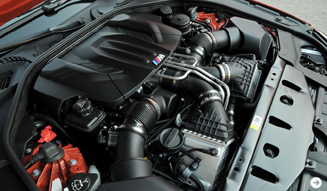
Unlike the previous V10 unit, which was incredibly precise yet constantly urged the driver to rev higher, this engine produces a deep, powerful sound. As the specifications suggest, torque is abundant from low RPMs, and there is virtually no lag in throttle response. The immediate impression is one of ease of use. The ride comfort is also supple. In fact, as the speed increases, it feels almost too bouncy, making one want to switch to "SPORT" mode.
The only complaint on public roads might be that... but this is an M6. The lack of a truly thrilling experience should perhaps be considered a complaint. Even when changing the steering and damper settings, there isn't a significant difference in that regard. It might be a luxurious problem to have.
BMW M6
The most powerful model of the modernized 6 Series
Test Drive: BMW M6 (3)
Onto the Circuit
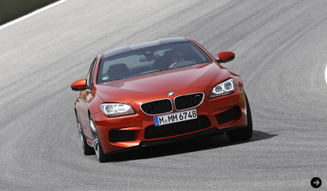
Its true capabilities are, as expected, unleashed on the circuit. With all modes set to "Sport+" and DSC set to "M Dynamic" mode, which raises the intervention threshold, I headed onto the track.
What stimulates the senses most is, after all, the engine. The sound, electronically enhanced by the sound module inside the cabin, increases in volume, and the low-end torque is so immense it feels like it's tearing at the road. The car surges forward powerfully due to its astonishingly high traction. The performance is more than adequate. As you rev it, the power increases, and in first and second gears, it reaches the 7,200rpm redline in an instant. The feeling of breaking through at high RPMs, even more so than the M5, is likely due to the lighter weight.
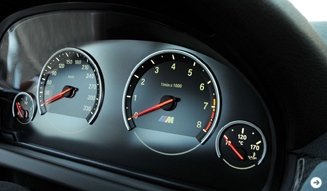
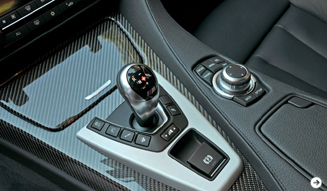
As I turned the steering wheel for the first corner, the nose pointed inwards quite nimbly, accompanied by a slightly larger-than-expected body roll. Or rather, it wanted to turn so much that the tail would easily slide out with just a slight over-application. The ambient temperature was a scorching 38 degrees Celsius that day, and the gearbox occasionally showed signs of overheating, so it's reasonable to assume the tires were also quite hot. Nevertheless, I was surprised. With a considerable angle of slip, the DSC (Dynamic Stability Control) would intervene, reducing throttle input and preventing the car from moving forward. For a skilled driver attacking the circuit, turning DSC off might actually be easier.
I also found the engine's response to be overly sensitive and jerky when set to "SPORT+". It demands very, very delicate operation of the right foot.
However, in fact,recalling my memory of driving the M5 on the same circuit last autumn,it's also true that I found the M6 to be overwhelmingly easier to drive. It feels like the center of gravity is low, and there's no sensation of the outer front wheel suddenly taking all the load and causing the car to nosedive. The shorter wheelbase also contributes to smoother turn-in. During cornering, the perceived inertial mass feels completely different, giving a strong sense of control.
While the acceleration also feels slightly sharper, the brakes are even more effective. In fact, the test car was equipped with the optional "M Carbon Ceramic Brakes" introduced with this M6, so their effect is undoubtedly significant. For a car weighing around two tons, these seem to be an essential option.
BMW M6
The most powerful model of the modernized 6 Series
Test Drive: BMW M6 (4)
Is the Convertible the Best Buy?
The M6 is undoubtedly a highly refined car – comfortable, exciting when pushed, and absolutely fast. However, on the circuit, just as I felt on public roads, the sense of thrill was somewhat muted. Compared to the previous generation's more nuanced dialogue with the car, both the chassis and powertrain feel somewhat coarse.
M division staff say that even users in this category are now a minority who focus on such aspects. But if that focus is lost, the very meaning of an M model becomes ambiguous, in a sense.
With these lingering thoughts, I test-drove the M6 Convertible the next day, and it was unexpectedly delightful. The body felt incredibly rigid, with no perceived shortcomings, and combined with the standard 19-inch tires, the ride comfort was exceptional. Yet, on winding roads, I didn't feel any lack of performance in the handling and greatly enjoyed the drive.
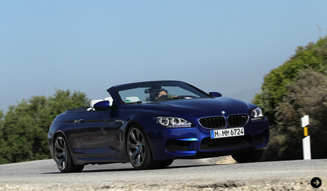
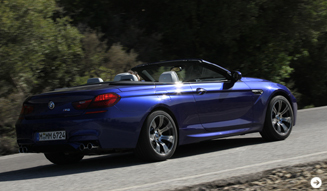
As a four-seater convertible, wind buffeting is not insignificant, but that's part of the charm. Holding the steering wheel, I thought that perhaps this might be the best buy among the new M6 models.
Perhaps the new M6 is simply that kind of car. While it boasts astonishing performance on the circuit as befits a model bearing the M name, it's more suited to enjoying a more relaxed sporty drive rather than relishing razor-sharp agility in such situations. Although I feel a slight sense of disappointment, it will undoubtedly be supported by its target audience. Especially since it's faster, easier to handle, and about 30% more fuel-efficient than its predecessor.
Nevertheless, I can't shake the desire for a slightly lighter, edgier, and more challenging model to be offered. It should be part of the brand's mission to meet the expectations of its enthusiastic fans.

BMW M6
Body Dimensions | 4,898 x 1,899 x 1,374mm
Wheelbase | 2,851mm
Track (Front/Rear) | 1,631 / 1,612mm
Ground Clearance | 106mm [107mm]
Weight | 1,850kg [1,980kg]
Cd Value | 0.32
Engine | 4,395cc V8 Twin-scroll Twin-turbo
(Equipped with VALVETRONIC, Double-Vanos, High Precision Direct Injection Technology)
Bore x Stroke | 88.3 x 89.0mm
Compression Ratio | 10:1
Max. Output | 412kW (560ps) / 6,000-7,000rpm
Max. Torque | 680Nm / 1,500-5,750rpm
Suspension (Front/Rear) | Double-wishbone, coil springs, stabilizer bar /
Multi-link, coil springs, stabilizer bar
Steering | Hydraulic rack-and-pinion power steering
Brakes | Ventilated drilled compound discs (Front diameter 400x36 / Rear diameter 396x24)
Tires Front/Rear | 265/40 R19 102Y / 295/35 R19 104Y
Max. Speed | 250km/h (305km/h with M Driver's Package)
0-100km/h Acceleration | 4.2 seconds [4.3 seconds]
Fuel Consumption | 9.9ℓ/100km [10.3ℓ/100km]
CO2 Emissions | 232g/km [239g/km]
Price | ¥16,950,000 [¥17,600,000]
*Figures in brackets are for the Convertible