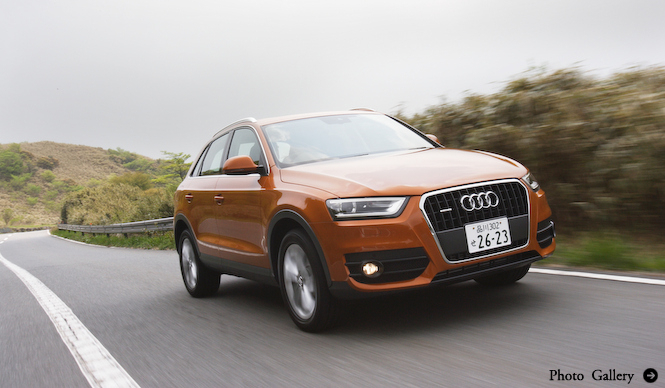
A Test Drive of the Audi Q3 | Audi
Audi Q3 2.0TFSI quattro 211PS | Audi Q3 2.0TFSI quattro 211PS
Test Drive: Audi Q3
Finally Introduced to Japan in May 2012The Audi "Q3" has finally been introduced to Japan. This is Audi's entry into the import premium compact SUV market. Automotive journalist Tatsuya Otani test drives the 211ps version of the 2.0TFSI quattro, which is being introduced first, in Hakone.
Text by OTANI Tatsuya
Photographs by ARAKAWA Masayuki
The Rise of the Compact SUV
"Isn't the boom over?"
This refers to the SUV market. However, according to Audi Japan's research, the premium SUV market in Japan continues to grow.
The origins of the SUV are said to be the Jeep "Wagoneer" and Ford "Bronco," both created in the 1960s. Following these, the "Range Rover" debuted in 1970, establishing the premium SUV category.
However, there is no doubt that the BMW "X5" released in 2000 created the trend for premium SUVs as we know them today. Spurred by this great success, rival manufacturers began launching competing models one after another. Volkswagen's "Touareg", Porsche's "Cayenne", Audi's "Q7", and Mercedes-Benz's "M-Class" are representative examples.
However, BMW then employed a clever strategy. While continuing to produce the X5, they launched the "X3", creating the premium SUV market one class below. This became a global hit, and once again, rival manufacturers followed suit. Volkswagen's "Tiguan", Audi's "Q5", and Mercedes-Benz's "GLK-Class" were born.
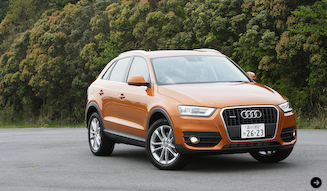
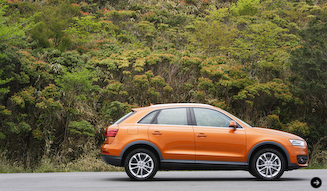
What happens twice happens thrice. BMW went a step further downmarket, launching the "X1". This also sold well. Naturally, rival manufacturers couldn't stand idly by. Audi was the first to make a move this time. In other words, the Q3 introduced here is a compact premium SUV destined to be the rival to the X1.
As mentioned at the beginning, the premium SUV market is growing. While the overall market size is expanding, a shift is occurring: the center of the market is moving to lower classes. Therefore, the current mainstream is the "X3 class," but as rivals in the "X1 class" emerge, it wouldn't be surprising if that class becomes the mainstream.
This makes sense. SUVs originated in America. It was in the vast "New World" with abundant oil resources that people embraced giant SUVs. However, in major urban areas of Europe and Asia, the size of an "X5 class" vehicle is somewhat too large. Therefore, it's plausible that the downward shift in SUV classes would have occurred naturally, even if BMW hadn't initiated it.
Audi Q3 2.0TFSI quattro 211PS | Audi Q3 2.0TFSI quattro 211PS
Test Drive: Audi Q3 (2)
SUV Presence in a Compact Package
The resulting Q3 has a body size that is about 24 cm shorter, nearly 7 cm narrower, and 5 cm lower than its larger sibling, the Q5, resulting in a compact size.
Despite its smaller exterior dimensions, the Q3, with its SUV-like presence, looks quite substantial. If the Q5 weren't next to it, you wouldn't guess it's a model from a class below; its stance is that dignified. This contrasts sharply with the BMW X1, which could easily be mistaken for a compact two-box car.
However, it would be problematic if the cabin were also cramped just because the exterior dimensions are smaller. In this regard, the Q3 improves space efficiency by adopting the transverse engine layout inherited from the A3. The cabin is surprisingly roomy and spacious for a compact size under 4.4 meters in length. It's truly styled like an SUV.
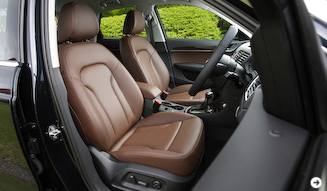
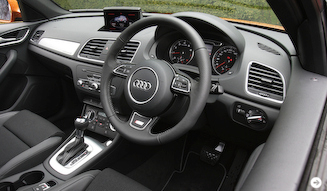
Meanwhile, the exterior and interior are consistently executed with Audi's renowned quality. The inherent elegance of the exterior and the high-quality feel of the interior are strong assets of the Q3.
The performance on the road also gave an impression consistent with the latest Audis. The 2.0-liter direct-injection turbo engine, producing 211ps, delivers robust torque from low to mid-range speeds. Combined with the "S tronic" dual-clutch gearbox, which shifts up rhythmically, it provides a brisk acceleration feel.
The ride comfort provided by the 235/50R18 "Pirelli Scorpion Verde" tires was also pleasant. The large air volume of the tires undoubtedly contributes to absorbing road impacts. Notably, even with the optional "S line package," the tire size remains 235/50R18. The suspension is a 20mm lower sport type, but no adverse effects on ride comfort were observed. This makes it an attractive option for fans of a "sporty look."
Audi Q3 2.0TFSI quattro 211PS | Audi Q3 2.0TFSI quattro 211PS
Test Drive: Audi Q3 (3)
Agile Handling
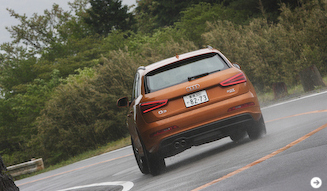
The handling is quite agile. Even at near-limit speeds, body roll is kept within a reassuring range, and the high center of gravity is not pronounced, allowing the driver to confidently enter corners. The responsiveness when changing direction is also acceptable for an SUV with a height of around 1.6 meters. It has surprisingly turned out to be an SUV that can be enjoyed on winding roads.
Although it rained heavily during the test drive, the full-time 4WD "quattro" system with its Haldex center differential maintained consistent steering characteristics by subtly varying the front-to-rear torque distribution even on slippery surfaces. While I had experienced the effectiveness of quattro on wet highways many times before, this was the first time I could drive on a heavily wet winding road with such confidence. In that sense, it can be said that I rediscovered the true value of quattro.
This center differential normally distributes 95 percent of the torque to the front and 5 percent to the rear. In demanding situations, it can automatically adjust the distribution anywhere between 0 and 100 percent front and rear.
The Audi Q3, initially launched with the 211ps specification for 4.79 million yen. Meanwhile, deliveries of the 170ps version (same engine type, but different software; priced at 4.09 million yen), announced at the same time, are scheduled to begin this autumn. The battle between the BMW X1 and the Audi Q3 in the import premium compact SUV market is certainly one to watch.

Audi Q3 2.0 TFSI quattro 211PS | Audi Q3 2.0 TFSI quattro 211PS
Body Dimensions | Length 4,385 x Width 1,830 x Height 1,615 mm
Wheelbase | 2,605 mm
Tread (Front/Rear) | 1,570 / 1,570 mm
Ground Clearance | 170 mm (150 mm with S line package)
Weight | 1,610 kg
Engine | Inline 4-cylinder DOHC Intercooler Turbo
Displacement | 1,984 cc
Max. Output | 155 kW (211ps) / 5,000-6,200 rpm
Max. Torque | 300 Nm / 1,800-4,900 rpm
Drivetrain | 4-Wheel Drive (quattro)
Suspension (Front) | MacPherson Strut
Suspension (Rear) | 4-Link
Tires | 235/50 18 inch
Transmission | 7-speed S tronic
0-100 km/h Acceleration | 6.9 seconds
Seating Capacity | 5 persons
Luggage Capacity | 463 liters (1,365 liters with rear seats folded, depth 1,632 mm)
Minimum Turning Radius | 5.7 m
Fuel Economy | 13.8 km/ℓ (10-15 mode) 12.6 km/ℓ (JC08 mode)
CO2 Emissions | 168 g/km (10-15 mode) 184 g/km (JC08 mode)
Price | 4.79 million yen


