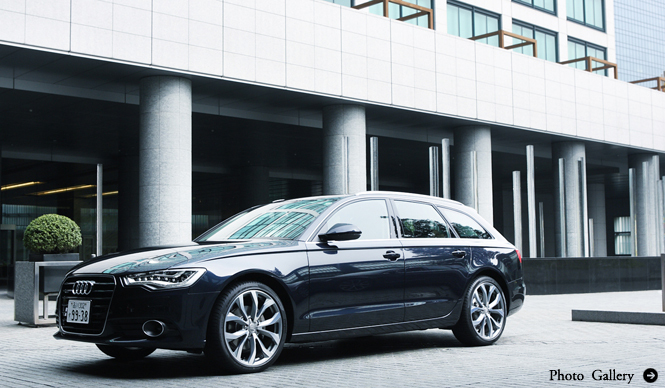
December 15, 2014
Test Drive: The Audi A6 Avant
Audi A6 Avant | The Audi A6 Avant
Test Drive: 2.8 FSI quattro and 3.0 TFSI quattro
We test-drove the Audi A6 Avant, which claims to be light and sporty. This premium upper-class station wagon felt genuinely nimble and proved to be a car that’s a joy to drive.
Text by OGAWA Fumio
Photographs by ARAKAWA Masayuki
“If it isn’t beautiful, it isn’t an Avant.”
“Audi A6 Avant” was introduced to the Japanese market in February 2012. Based on the “A6” which was released earlier, it is characterized by its expanded luggage capacity and the addition of a tailgate. The name "Avant" is traditional for Audi, appearing in the market since the "100" in 1976.
Why does Audi insist on the unique name "Avant" rather than calling it a station wagon?
As Audi itself comments, “If it isn’t beautiful, it isn’t an Avant,” the company opted for a stylish design by steeply raking the tailgate, even at the expense of some luggage capacity. This sets it apart from competitors' products. The very name "Audi," along with "quattro" and "Avant," are all Latin-derived names, reflecting the playful spirit of Audi, headquartered in southern Germany.
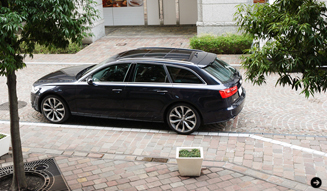
Two models are available in Japan: the 2.8 FSI quattro (¥6.4 million) and the 3.0 TFSI quattro (¥8.65 million). Both share common features: the "quattro" full-time four-wheel-drive system, an "ultra" body structure that combines aluminum and high-tensile steel for weight reduction, and downsizing engines that offer equivalent or greater torque than previous models despite reduced displacement.
Audi A6 Avant | The Audi A6 Avant
Test Drive: 2.8 FSI quattro and 3.0 TFSI quattro (2)
Easy to Drive – The 2.8-Liter Model
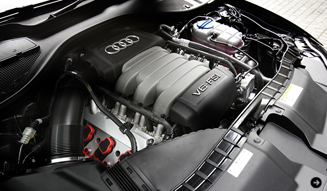
At the press test drive event, we were able to drive both models sequentially. First, we drove the 2.8-liter FSI model. It is equipped with a naturally aspirated, direct-injection V6 engine producing a maximum output of 150 kW (204 ps). This is combined with the quattro full-time 4WD system and a 7-speed dual-clutch transmission called S tronic. Let's start with our impressions of this car.
The 2.8 FSI quattro (¥6.4 million) is, in a word, well-executed. Here are the points we liked:
- Easy to drive
- Comfortable
- Easy to handle
Let's explain each point in detail. First, regarding ease of driving, this is due to the engine's characteristics. Although the maximum torque of 280 Nm is specified to be produced between 3,000 and 5,000 rpm, it is more powerful at low revs than the numbers suggest. It delivers ample torque even below 2,000 rpm, so the response to accelerator pedal input is quick and satisfying. While it's not an engine with forced induction, it's likely sufficient for everyday use.
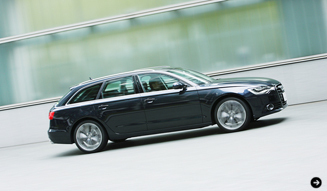
Despite its 4,940mm body length, it starts off well and feels agile. The doors are also notably light. Audi likely wants to emphasize its lightweight "ultra" body. However, the doors open and close with a satisfying sense of quality. This level of craftsmanship is truly noteworthy.
On the other hand, a minor drawback is the slightly excessive road noise transmitted into the cabin. This may be an inherent characteristic of a car with a large opening like a tailgate. Compared to a sedan, this is a point to consider. Users who prioritize quietness might find the sedan a better fit. Additionally, the steering feel lacks directness; the power assistance is heavy, making it feel light. However, the tire response is not sensitive around the neutral point, creating a slight disconnect. For most drivers, this tuning might actually reduce fatigue.
Audi A6 Avant | The Audi A6 Avant
Test Drive: 2.8 FSI quattro and 3.0 TFSI quattro (3)
Comfortable, Easy to Handle – The 2.8-Liter Model
The 2.8 FSI quattro excels in ride comfort. Although it's light, the body, weighing 1.8 tons, also contributes. It feels smooth and substantial, not flimsy, which is a good thing. The way it handles road imperfections, the so-called "inashi," is natural, and occupants experience virtually no jarring impacts.
The interior is functional, and the steering wheel, shift lever, and controls are of high quality. The combination of wood, leather, and chrome not only looks luxurious but also feels exquisite to the touch. They operate with a refined feel, subtly conveying a sense of luxury to the occupants.
The seats are also well-crafted. Even for Japanese occupants, who are typically lighter and less broad than their European or American counterparts, the seats provide a comfortable and supportive embrace. The craftsmanship is imbued with the concept of "Audi Quality." While it may lack the bold styling of a BMW, its logically structured design is also a distinct charm.
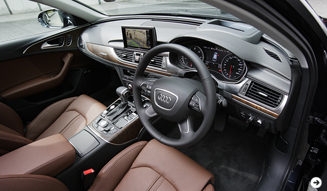
Ease of handling is a characteristic of the A6 Avant, not just the 2.8 FSI quattro. Looking at the numbers alone, the nearly 5-meter length and over 1.8-meter width are not small dimensions. However, this translates into a spacious interior, making it a suitable size for those seeking ample room. The steering has a relatively large turning radius, so maneuvering the car is unlikely to be a challenge.
Audi A6 Avant | The Audi A6 Avant
Test Drive: 2.8 FSI quattro and 3.0 TFSI quattro (4)
Sporty Handling – The 3.0-Liter Model
The more powerful 3.0 TFSI quattro (¥8.65 million) is equipped with a supercharged 3-liter V6 engine. It produces a maximum output of 228 kW (310 ps) and generates 440 Nm of torque from 2,900 rpm.
The differentiation from the 2.8 FSI quattro is not just in the numbers; its tuning is also sportier.
The steering has a heavier power-assist setting, and the suspension is firmer. This model is aimed at those who enjoy driving actively. As the engine revs up, you begin to feel the surge of torque from around 2,000 rpm, pushing the car forward with relentless acceleration – a unique kind of pleasure.
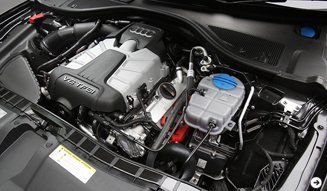
While not as extreme as Volkswagen's 1.4-liter forced induction, it's still impressive how the downsizing concept achieves ample power with an engine displacement under 3 liters. I recall an Audi engineer once explaining, in response to a question about adopting smaller displacements, that "engine displacement is also important in relation to the vehicle body; if it's too small, it places an unnecessary burden on the engine and affects fuel economy." This suggests that an engine with a slightly larger displacement, providing sufficient torque in the low-rev range, can be more fuel-efficient.
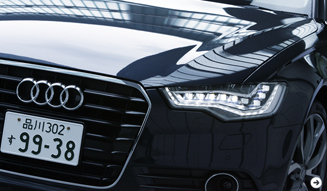
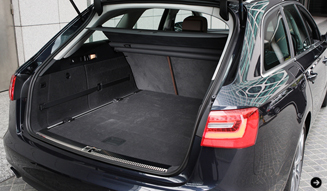
Cars with large bodies often have a slight delay when starting from a standstill, even with ample low-end torque, but the A6 Avant impressively avoids this. Is this the benefit of the lightweight "ultra" chassis, which combines aluminum with high and ultra-high tensile steel? Despite its substantial size, it can be maneuvered with a sense of agility. Driving enthusiasts will surely find pleasure in this. The engineering effectively fulfills its purpose. This is where Audi's motto, "Vorsprung durch Technik" (Advancement through Technology), truly shines.
Audi once explained that the Avant is not a car for carrying luggage, but rather a car for people who have appropriate luggage. In other words, it is a car for those who lead enviable lives.