LEXUS CT200h | Lexus CT200h: Test Drive
LEXUS CT200h | Lexus CT200h
A Hybrid Compact Car Breaking New Ground (1)
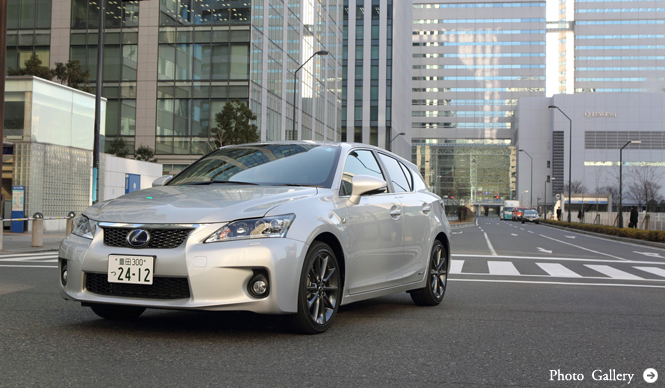
LexusFrom Lexus comes the "CT200h," a luxury hatchback equipped with a hybrid system. Its strengths lie in its fuel efficiency and handling.
By Fumio OgawaPhotos by Masayuki Arakawa
The Privilege of a Hybrid in the C-Segment
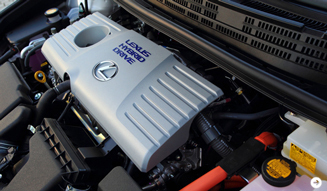
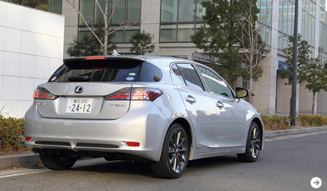
Lexus CT200hThe Lexus CT200h features a powertrain that combines a 1.8-liter gasoline engine with Toyota's proprietary THS-II hybrid system. While retaining Lexus' signature exterior design, the interior utilizes premium materials. The model aims to capture a new market, targeting demographics such as empty nesters.
There are likely many people who think, "I don't need a large car, but I want a compact car with a certain level of quality." This model can be seen as catering to that market. Its expected competitors include the Audi A3 and BMW 1 Series. The CT200h's unique advantage might be its hybrid system, which excels in city driving fuel economy.
In addition to the base grade, the CT200h lineup includes three versions: the sporty "F SPORT" (4.05 million yen), "Version L" (4.30 million yen), and "Version C" (3.70 million yen). Among these, only the F SPORT is equipped with exclusive suspension tuning for enhanced sporty performance.
The segment to which the CT200h belongs is known in the industry as "C Premium." In the "C-Segment," which primarily consists of mid-size sedans, Lexus' market research indicates that car purchase priorities are, in order: style, price, value for money, and interior space.
Balancing Agility and Ride Comfort
In contrast, for the "C Premium" segment where the CT200h is positioned, style remains the top priority, followed by driving performance, safety, and packaging (such as a spacious interior within a compact exterior). Therefore, the development team stated, "We aimed to achieve both agility and ride comfort."
The base chassis issimilar to the Lexus HS, but "the rigidity of the front and rear suspension members has been increased, the suspension towers reinforced with braces (improving torsional rigidity), and the number of spot welds reviewed to ensure rigidity in openings such as the doors." The strut tower bar on the suspension employs performance dampers jointly developed with Yamaha. This aims to improve the body's response to steering inputs while reducing vibration and noise.
Upon driving, the steering indeed feels sporty, and the car reacts quickly to inputs even around the center point, with the nose turning sharply when the wheel is turned. The steering feel in recent Toyota and Lexus models is noteworthy. However, some might find it too heavy in balance with the overall steering weight.
It is equipped with a drive mode select system that can be chosen via a dial. Selecting Sport mode increases the motor's voltage (power output) and improves the responsiveness to steering inputs. In fact, switching between Normal and Sport modes while driving reveals a clear difference. The Sport mode compensates for the sluggishness felt during intermediate acceleration in Normal mode.
LEXUS CT200h | Lexus CT200h
A Hybrid Compact Car Breaking New Ground (2)
EV Mode Available for City Driving
The F SPORT, Version L, and Version C all share a similar ride quality. The F SPORT is not exceptionally sporty; some might even find the Version L sportier. The difference lies in the agility at the limit," stated the development team. "However, few drivers will likely reach that limit." Even within the F SPORT trim, the character differs significantly from that of theIS 350.
The F SPORT's ride is not overly stiff. The differences in cornering behavior, such as the compression of the rear suspension, are subtle and would likely go unnoticed unless one is paying very close attention during a comparison drive. Choosing based on exterior or interior preferences should not lead to a wrong decision.

The CT200h's transmission is an electronically controlled continuously variable transmission (e-CVT). However, by selecting the S mode on the gear selector, one can use the paddle shifters on the steering wheel to engage one of six fixed gear ratios. While the engine feels somewhat underpowered below 3,000 rpm, it comes alive above 4,000 rpm, offering an enjoyable driving experience. The electric motor also assists during this time, but one might wonder if a turbocharged engine would be more suitable for pure performance driving.
It also features an EV mode, allowing for electric-only driving at low speeds in urban areas. While the driving is quiet, it smoothly propels the 1.4-ton vehicle. Pressing the accelerator pedal harder awakens the gasoline engine. From then on, the acceleration is smooth, and the regenerative braking system operates with fine control when lifting off the accelerator or applying the brakes.
The ride quality has a slightly firm feel, particularly noticeable on uneven road surfaces at higher speeds. The steering is well-damped, effectively isolating the driver from jarring shocks that could lead to a cheap feel, yet road surface information is transmitted to the feet. This tendency is especially pronounced with the 17-inch tires; the 16-inch tires available on the Version C offer a softer ride.
Functional Seats with Built-in Seat Heaters
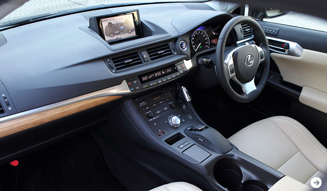
The dashboard design, with its clean and strong lines, evokes a sense of sophistication, reminiscent of models like theAudi A7. Wood trim accents the interior beautifully. A variety of wood finishes, from light to dark tones, are available, and owners can even replace them themselves, which is an interesting concept.
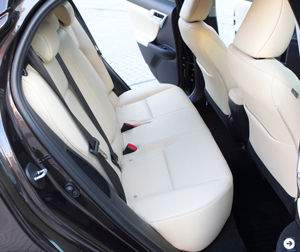
The seat cushions are slightly short in length, but the overall seating comfort is good. The upper body is well-supported, and the seat surface provides good grip. Seat upholstery options include leather and fabric. Both the fabric seats in the various versions and the leather seats in the Version L feature built-in heaters. Many people who prefer a softer seat would appreciate a heater, especially in winter. This is a welcome feature.
It's evident that considerable effort has been put into the chassis. However, perhaps as a result of prioritizing fuel efficiency, the hybrid powertrain seems to conflict with the goal of "fun." This creates a somewhat disjointed impression. Looking at European rivals, even with gasoline engines, they achieve better real-world fuel economy through refined control technology and efficient transmissions. Similar advancements should be possible.
The CT200h feels as though it incorporates a bit too much of what Lexus currently offers.
There is undoubtedly a market for a high-quality hatchback. It would be a pleasure for car enthusiasts if a premium product were offered for this segment. The concept of the CT as a luxury hatchback is sound. Is it too much to ask for a gasoline engine version?

LEXUS CT200h | Lexus CT200h
Body | Length 4,320 x Width 1,765 x Height 1,450mm
Wheelbase | 2,600mm
Vehicle Weight | 1,380kg
Engine | 1.8-liter DOHC Inline 4-cylinder 16-valve VVT-i (Atkinson cycle)
Max. Output (Engine) | 73 kW (99 ps) / 5,200 rpm
Max. Torque (Engine) | 142 Nm (14.5 kgm) / 4,000 rpm
Max. Output (Motor) | 60 kW (82 ps)
Max. Torque (Motor) | 207 Nm (21.1 kgm)
System Max. Output | 100 kW (136 ps)
Transmission | Electronically Controlled Continuously Variable Transmission
Battery | Nickel-metal hydride battery
10-15 Mode Fuel Economy | 34.0 km/ℓ
10-15 Mode CO2 Emissions | 68 g/km
Drivetrain | 2WD (FF)
Seating Capacity | 5 people
Price | From 3.55 million yen