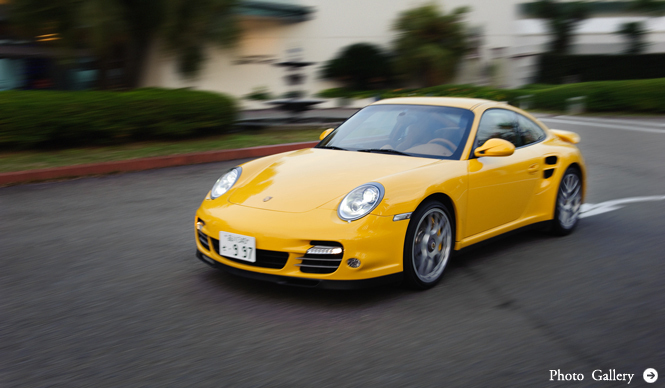
PORSCHE 911 turbo S Test Drive
PORSCHE 911 TURBO S
The Enduring Allure of the Exemplary Sports Car (1)
The "911 Turbo S" boasts a 530ps engine, 30ps higher than the "911 Turbo," and features a full-time 4WD system.PorscheThe most powerful sports model remains.
Text by Fumio OgawaPhotos by Hirotaka Shimizu
Equipped with a Potent 3.8-Liter Engine
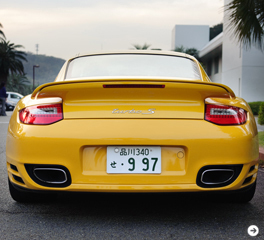
The ultimate version of the 911 Turbo, the "S" model, is the Porsche 911 Turbo S.
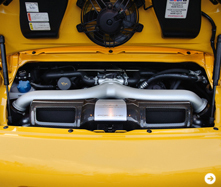
While the 3.8-liter displacement is the same, various engine components have been enhanced, and the turbocharger boost pressure has been increased by approximately 0.2 bar to 1.2 bar. It is exceptionally powerful.
In the past, the "Porsche 911 Turbo" was a benchmark sports car, perhaps even a "super" sports car. Nowadays, with rivals increasing, the question is, what is the unique appeal of the 911 Turbo? That is the greatest point of interest.
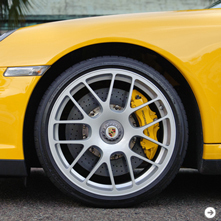
The exterior isn't just the body width, which is 40mm larger than the standard 911. The widely flared fenders house large-diameter, ultra-low-profile 19-inch tires with a center-lock system, similar to race cars, and aerodynamic parts on various body sections, all contributing to its imposing presence.
The Stable Yet Agile "S" Driving Experience
However, as it doesn't deviate from the "911" idiom, those accustomed to highly aggressive sports car aesthetics might find it somewhat understated.
But once you start driving, you'll quickly realize the "Turbo S" name is well-earned. The 3.8-liter flat-six engine mounted at the rear produces a maximum output of 390kW (530ps) at 6,250-6,750rpm and a maximum torque of 700Nm at 2,100-4,250rpm. This power is distributed to all four tires via a 7-speed dual-clutch transmission. It's a system that allows for stable high-speed driving.
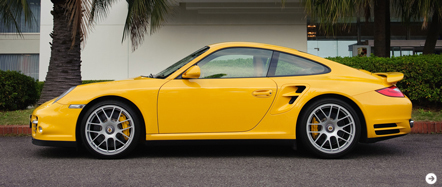
The appeal of the 911 Turbo (S) lies in its highly refined handling and ride comfort, making it hard to believe it possesses such immense power. While many ultra-high-performance sports cars intentionally retain a degree of edginess in their handling or engine power delivery, making them slightly challenging to drive, the 911 Turbo (S) prioritizes ease of operation, making it accessible even to novice drivers.
The Porsche Torque Vectoring, standard on the 911 Turbo S, is a system that electronically controls torque distribution to the rear wheels and applies braking to individual wheels based on the car's behavior, stabilizing cornering and assisting in faster, safer corner exits.
PORSCHE 911 TURBO S
The Enduring Allure of the Exemplary Sports Car (2)
Exhilarating Acceleration Performance
On the other hand, the 911 Turbo S also offers a superb experience for the driver who seeks it. The 911 Turbo S features a rare combination: a direct and responsive steering, a firm suspension, and an engine that continues to accelerate relentlessly, all with a satisfying heft. While the high-boost turbo engine doesn't have the distinct, abrupt surge of power of older turbochargers, it accelerates the car forward with a natural, insistent force.
The 6-cylinder engine incorporates technologies such as Direct Fuel Injection (DFI), Variable Turbine Geometry (VTG), VarioCam Plus, and an expansion intake manifold. The fact that it accelerates from 0 to 100 km/h in just 3.3 seconds is easily understandable. It's truly exhilarating acceleration.
The Exemplary Braking System of a Sports Car
Simultaneously,PorscheCeramic Composite Brakes (PCCB) provide powerful deceleration. It's easy to go fast; the challenge is stopping. This is often said in sports car development, but a super sports car must have superior braking systems above all others. The 911 Turbo S is an excellent example of this. The smooth pedal feel and the gradual build-up of deceleration G-force, as if adhering to the road, are consistently remarkable.
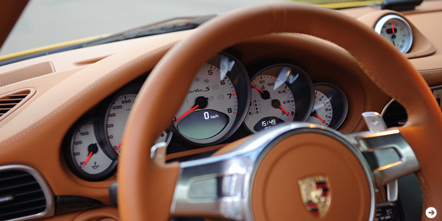
The three-spoke sports steering wheel is equipped with paddle shifters for gear changes. Particularly noteworthy is the adoption of race car shift logic: pulling the right paddle shifts up, and pulling the left paddle shifts down. This is the ultimate combination for experiencing the endlessly revving engine.
The first-generation 911 Turbo, produced from 1975 to 1988, offered a quality feel approximately twice that of the standard 911, not only in terms of speed and braking performance but also in body rigidity and overall construction. This tradition has been consistently carried forward. Despite the passing of generations and the emergence of many rivals, its appeal has never diminished. I am convinced this is the 911 Turbo's greatest characteristic.
PORSCHE 911 TURBO S
Body|Length 4,450×Width 1,850×Height 1,300mm
Engine|3.8-liter Flat-six
Max Output|390kW (530ps) / 6,250-6,750rpm
Max Torque|700Nm / 2,100-4,250rpm
Drivetrain|Full-time 4WD
Transmission|7-speed Dual-clutch
Fuel Economy|11.4ℓ/100km
CO2 Emissions|268g/km
*Fuel economy and CO2 emissions are based on European data.
Price|¥23,650,000