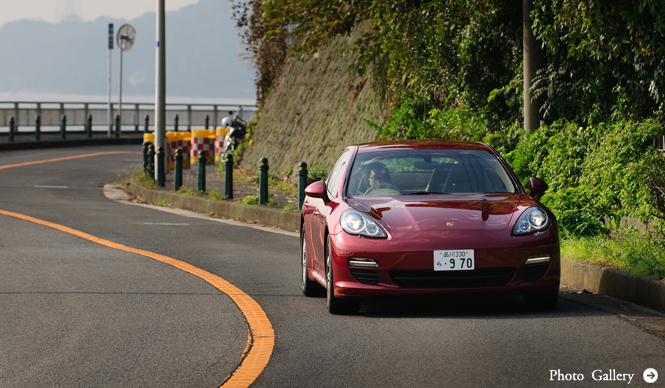
PORSCHE Panamera | Porsche Panamera Test Drive
PORSCHE Panamera
A Luxurious Four-Door Saloon with a V6 Engine (1)
Porsche has added a V6-powered model to the Panamera lineup. We bring you a test drive report of this luxurious four-door saloon, noted for its agile handling.
By Fumio OgawaPhotos by Hirotaka Shimizu
Two Fewer Cylinders: Porsche's Stance Towards the Market
The Porsche Panamera is a four-door saloon that launched in Japan in 2009. Until now, it was equipped with high-performance, large-displacement engines: a 4.8-liter V8 and its turbocharged variant. A 3.6-liter V6-powered model has now been added. These are called the "Panamera" (from ¥10.21 million) and "Panamera 4" (from ¥10.96 million).
The new V6 model has two fewer cylinders than the V8 engines in the previous Panamera S, Panamera 4S, and Panamera Turbo. While the V8 has a displacement of 4806cc, the V6 has 3604cc. The V6 produces 300ps compared to the V8's 400ps, and its maximum torque is 400Nm versus the V8's 500Nm. This difference results in a price gap of approximately ¥3.5 million.
Porsche is a sports car manufacturer with the 911 at its pinnacle, but it also demonstrates a flexible approach to market demands, including environmental and comfort performance. The introduction of the Panamera, following the Cayenne SUV, is a manifestation of this strategy. The adoption of a V6 engine with improved fuel efficiency proves that Porsche respects market principles by providing what users desire.
The Panamera's V6 shares many commonalities with the base V8. It uses a dry-sump lubrication system, which lowers the center of gravity. The engine block and cylinder heads are made of aluminum, and the pistons are also cast aluminum.
It features a variable intake manifold, variable valve timing and lift system called VarioCam Plus, and a direct fuel injection system. Additionally, models equipped with the PDK (dual-clutch transmission) include an engine auto start/stop function for idling.
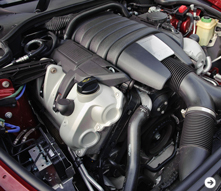
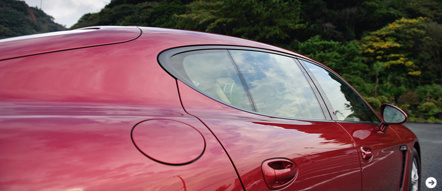
An Engine Room Worth Seeing
The main shared features with the Panamera S are as follows:
• PDK (Dual-Clutch System)
• Porsche Traction Management (PTM) *4WD models only
• Porsche Stability Management (PSM)
• Six-piston front and four-piston rear brake calipers with 360mm front and 330mm rear brake discs
In contrast, the Panamera and Panamera 4 have the following exclusive equipment:
• Engine management system for the V6
• Availability of a 6-speed manual transmission model
• 18-inch exclusive alloy wheels
• Black brake calipers
• Porsche Active Suspension Management system available as an option
• Adaptive air suspension available as an option
• Luggage capacity of 445 liters (432 liters for V8 models)
• Matte black finish side window trim
• Single-tube twin exhaust tailpipe
Looking into the engine bay, one is surprised by the large space created between the radiator and the engine, a result of having two fewer cylinders. Visually, it's clear that the front of the car feels lighter. The appearance, with its substantial aluminum block finish, is impressive. Along with the thick drive belts leading to each gear, it's an engine room that car enthusiasts will find worth a look.
PORSCHE PANAMERA
A Luxurious Four-Door Saloon with a V6 Engine (2)
Surprisingly Light Steering Feel
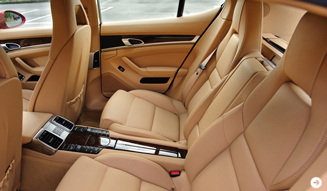
The car driven was the rear-wheel-drive "Panamera" (¥10.96 million) equipped with the PDK. From the moment it started moving, the impression was one of agility. Everything felt so light that it was astonishing – "This Panamera is this light!" The steering feel itself was so light it was disorienting, considering the moderate weight expected of a sports car. The interior felt no different from the V8 model, yet it felt like a different car entirely.
Although the vehicle weighs over 1,800kg, numerically not exactly light, it doesn't feel that way due to its brisk acceleration. The 3.6-liter V6, which produces its maximum output of 300ps at 6,200rpm, accelerates without hesitation.
The enjoyment that comes when entering the torque band from around 3,000rpm is truly what you'd expect from a sports car manufacturer. With maximum torque of 400Nm generated at 3,750rpm, acceleration is strong. It's not violent acceleration, but it offers the pleasure of an engine that enjoys being revved. It feels sufficiently capable with the V6. The suspension is also supple, absorbing road imperfections well, making for a comfortable ride.
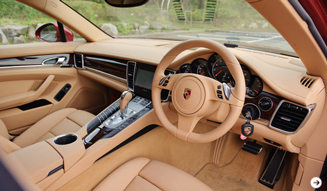
Are There Still Minor Issues with Shifting?
The lightness of the steering feel, surprisingly, becomes familiar quickly. Thanks to the engine's well-managed torque delivery, one can come to accept this characteristic of the smooth-running V6 model. It suggests that the market's needs aren't solely focused on a sense of heft.
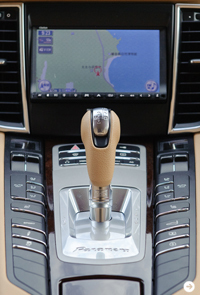
The dual-clutch system aims to combine the comfort of an automatic transmission with the directness of a manual by using two clutches. It has become widely adopted, particularly in German cars, in recent years. Porsche also uses it in the 911.
However, personally, I find it somewhat jarring. The engagement can feel abrupt, and it doesn't quite feel like a refined system. This was also the case with the Panamera. It becomes jerky, especially during frequent gear changes or when maneuvering back and forth between forward and reverse, due to torque fluctuations. This remains a point of disappointment.
PORSCHE PANAMERA
Body | Length 4,970 x Width 1,930 x Height 1,420mm
Wheelbase | 2,920mm
Engine | 3.6-liter V6 engine
Max. Output | 220kW (300ps)
Max. Torque | 400Nm / 3,750rpm
Transmission | 7-speed PDK
Top Speed | 259 km/h
0-100 km/h Acceleration | 6.3 seconds
*6.1 seconds with Sport Chrono Package
Fuel Economy | 7.6 km/l
Price | ¥10.96 million