Series: Michiko Fujiwara, June 2013 | Contemplating a Simple Way of Life Through Food
June 2013 | Food as the Foundation for a Simple Life and a Satisfying Sense of Fulfillment
Contemplating a Simple Way of Life Through Food
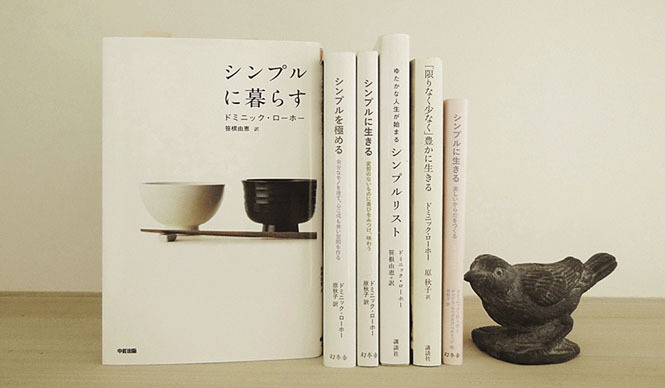
Lately, I've been engrossed in a particular set of books. They are the works of Dominique Loreau, who advocates for a simple way of life. Her books have been such bestsellers that they seem to be published in numerous countries, not just in Japan. A 'simple way of life' has long been my aspiration, but the reason I've become so captivated by her books now is...—.
Photographs & Text by Michiko Fujiwara
The Reason I Was Drawn to the Word "Simple"
Although Dominique Loreau's bestselling book, "Simply Live" (Gentoshya), was published in 2010, and several of her other works followed in Japan, I only discovered her this month. I happened to wander into a bookstore, and my eyes were immediately caught by the word "simple" in the title. So, it was the title, rather than the content, that first drew me in, and there's a reason for that.
It's because, starting last month, I've been diligently scanning and organizing documents, papers, and clippings into an app called "Evernote." Thanks to this, my desk drawers and bookshelves are now sparse and tidy! Just as I was experiencing a resurgence of my "Danshari" (decluttering) fervor, exclaiming, "How wonderfully satisfying it is to have nothing superfluous!", I came across Loreau's books. Incidentally, the beauty of Evernote is that when you log in with your account, you can view the same content on all your devices. This means you can see everything you've imported identically on your PC, iPad, or smartphone. Plus, it's incredibly convenient because you don't have to carry various documents around or search for them, wondering, "Where did I put that document?" (Ah, I can almost hear some of you saying, "I already knew that...".)
A Consistent Philosophy of Simplicity, from Managing Possessions to Life Itself
I wrote about "Danshari"in my series in November 2010,which is a method of organization that reveals one's way of life through decluttering. And that is precisely what Dominique Loreau advocates. However, Loreau's "simple living" books go further, offering more thorough, concrete, and detailed know-how for achieving ultimate simplicity. They cover a wide range, from "things" like furniture, tableware, books, and clothes, to the mental aspect.
What truly opened my eyes was a chapter in her book, "Living Simply" (Chukei Publishing), titled "A Simple Life is Based on Food." Frankly, many books advocating a "simple way of life" are published, and their content often overlaps. But that's natural, as the fundamental truth is singular. What sets Loreau's books apart with a distinct "aroma" might be her background: having lived in Japan for 30 years, practiced Zen meditation, and studied ink painting and art, she has a deep understanding of Japanese spiritual culture. This is likely why her approach to simplicity and its level of austerity resonate so deeply with me as a Japanese person. Furthermore, her philosophy of simplicity is unwavering and consistent, from how she deals with possessions to her overall way of life. It's this very persuasiveness that likely causes so many people to connect with her ideas.
What Does "A Simple Life is Based on Food" Mean?
Now, what is this philosophy of simple eating that so impressed me? First, it's about "relearning how to eat and regaining our ability to feel full." We often hear phrases like, "What you want to eat is what your body needs," but these are words spoken by those who already possess such abilities. If someone like me, who still eats out of "desire," were to follow that advice, I would undoubtedly gravitate towards junk food and an insatiable "more, more" approach to eating. It's said that we lose the ability to stop eating when we're full after the age of three. Moreover, humans are the only creatures that instinctively don't know when to stop eating. This makes sense; therefore, we must use our intellect, rather than relying solely on instinct, to guide our eating.
Alternatively, "To increase freedom, it is important to be able to exercise self-control." This is something I can attest to from experience. For example, someone who eats 120% of what they desire might feel starved if they only have food for 70% of their usual intake, experiencing frustration at wanting more. However, for someone who consciously eats only 70% regularly, even having only 60% of their usual food supply would feel comfortable, and the self-control exercised would lead to a greater sense of satisfaction.
The statement, "Never forget that self-control can lead to new pleasures," is precisely true. If you live a life where you indulge in whatever you like, as much as you like, and do whatever you like, your desire for those things will inevitably increase. Even if you feel momentarily satisfied, a short while later, you'll want more... In other words, despite being "full," you'll constantly feel unfulfilled. Just as we don't know when to stop eating, our desires become boundless if we cannot control them. Therefore, cultivating the ability to exercise self-control is crucial.
Good Meals in Smaller Portions Are the Foundation of a Simple Life
This book contains many practical methods for controlling food cravings, but what struck me were the phrases "The less you eat, the more deeply you can savor" and "Eat elegantly" or "Eat with refinement." I strongly felt the idea of savoring more deeply the less I ate during a period of fasting. Also, when I consciously tried to eat with elegance and refinement, I certainly lost the urge to overeat, and strangely, my mood and demeanor became more feminine. The book concludes with, "Good meals in smaller portions are the foundation of a simple life," implying that food leads to a simple way of life, which in turn forms the basis of a life filled with a pleasant sense of satisfaction.
Hmm, I aspire to reach that state of mind, but for now, I'll try to incorporate these practices gradually into my daily routine and make them habitual, little by little!
