February 2, 2015
Series: Michiko Fujiwara | January 2013: Aiming for 'U-Ta-Shi' in Life!
January 2013 | The process of learning something new and the journey of life are similar
Aim for a life of 'U-TA-SHI'!
Happy New Year. I look forward to your continued support this year.
May 2013 be a wonderful year for all of you!
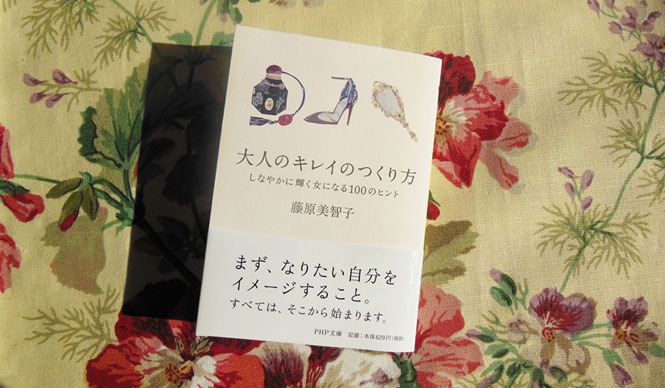
To start the new year, I'd like to announce my new book, "The Way to Adult Beauty" (PHP Bunko), published on the 7th of this month! This is a paperback edition of my 2002 book, "77 Lessons for Beauty" (PHP Institute), which has been significantly revised and expanded with 23 new chapters.
Photographs&Text by FUJIWARA Michiko
100 Maxims Divided into 6 Parts
The book is structured as a two-page spread, with a maxim on the right page and a supplementary explanation in a "conversational style" on the left. For example, the right page might say: "PrideThe important thing in work is to have pride. It's not pride directed at others, but pride in yourself." The left page would then explain: "The ability to ask yourself, 'Is this really good enough?' is crucial. Those who cannot have this kind of pride in themselves are unlikely to succeed in anything."
Other examples include: "Words and RealityWhen you say it out loud, reality begins to shift." or "The Path to BeautyThose who know how to make themselves look beautiful can become beautiful." The maxims are divided into six parts—finding your individuality, work, aesthetics, makeup and skincare, fashion and interior design, and mind and body—totaling 100 items. Additionally, the book includes five essays, revised and expanded from my previous magazine series in "Vingt Ans" (Hearst Fujingaho), which is now out of print.
Reflections from My Mid-40s, Still Clinging to My 30s Mindset
Incidentally, my first book, "77 Lessons for Beauty," was a compilation of thoughts and ideas from my 30s. Rereading it for this new book, I was struck by how much people's core essence remains unchanged. Yet, at the same time, I could see my earnestness and dedication from that time, which made me feel both a little embarrassed and affectionately nostalgic.
I was in my mid-40s when I actually wrote these new chapters. This suggests I was still carrying my 30s mindset. Now, ten years later, feeling that mix of embarrassment and affection for that past self might indicate that I've gained a certain adult composure in the interim. Things that once required intense effort can now be done with ease and a sense of余裕 (yoyu -余裕), allowing me to feel fondness for my former self.
Lately, I've come to realize that this is one of the joys of aging: things gradually become easier. This applies to ourselves, our relationships, our work, and our way of life. What once involved much deliberation and struggle in our youth can now be done effortlessly. For instance, when learning yoga, in the beginning, you struggle to hold a pose and experience muscle soreness. But with continued practice, you gradually release unnecessary tension and can perform poses with ease. The process of learning something new and the journey of life feel quite similar.
To be clear, becoming at ease doesn't mean becoming careless or sloppy. It means that through accumulated experience and wisdom, you understand what the "just right" balance is, and things become easier. Of course, I'm aware that from the perspective of those older than me, I'm still "not there yet." But this is purely from my own standard, not in comparison to others.
A Life of Joy, Fun, and Happiness!
──As I pondered these thoughts at the start of the year, my goal for this year emerged. It's to consciously live each day with the idea I added to my new book, as the 100th point: "Life is 'U-TA-SHI'Life is joyful, fun, and happy──This phrase will be my guiding star.
Previously, "Life is 'U-TA-SHI'" was more of a wish – something I hoped to achieve someday. Now, it's about actively embracing it. These things become possible through our own consciousness. Do we focus on dissatisfaction or joy? Boredom or fun? Unhappiness or happiness? In every moment, we decide which perspective to take. Of course, there are many situations, like accidents or unavoidable circumstances, where this isn't possible. But our daily lives aren't dictated by the words or actions of others or by external situations. Faced with the same situation, some people get angry, while others don't mind. If we have a choice, it's only natural to prefer a life that is joyful, fun, and happy. That's why I decided to keep "Life is 'U-TA-SHI'" in my heart at all times.
That said, it's barely been a month since I made this resolution, and I still find myself forgetting "U-TA-SHI" and getting frustrated, thinking, "Oh, for goodness sake!" What's written on the left page, you ask? You'll have to pick up the book and read it for yourself!