March 18, 2015
Ryuji Kagami x Kaori Nakano: 2008 Special Dialogue (3)
Ryuji Kagami x Kaori Nakano: 2008 SPECIAL TALK (3/4)
The Realm Beyond Computers
Text by Kaori NakanoPhoto by Jamandfix
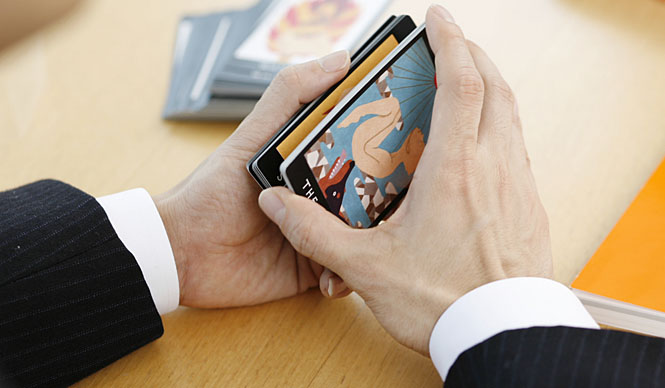
Enjoying Tarot Cards
NakanoYour book, "Soulful Tarot," comes with a beautiful deck. You mentioned that encountering tarot at age 10 was your gateway into this world. What was it about tarot that captivated you so deeply?
KagamiWhile tarot is generally thought of as a divination tool, it was originally created purely for games, or even gambling.
NakanoReally!?
KagamiThe cards that would become the prototype for playing cards entered Europe from the Islamic world in the 14th century, and then evolved into both playing cards and tarot. In 15th-century Milan, someone invented the idea of adding picture cards, which became the prototype for tarot.
NakanoSo it has a long history. How many cards are there in total?
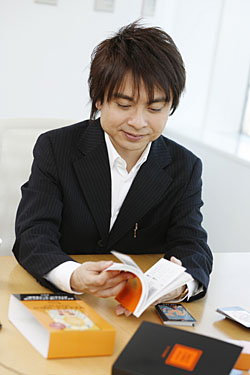
Ryuji Kagami
KagamiThe standard deck has 78 cards. At that time, it was very fashionable to illustrate abstract concepts like justice or temperance.
NakanoWas it so that people who couldn't read could understand?
KagamiNot at all. The users were aristocrats. They added attributes and engaged in a kind of intellectual game.
NakanoWhen you say attributes, in art, it's like Zeus having a thunderbolt or Eros having a bow and arrow – their specific possessions. Do tarot cards have those too?
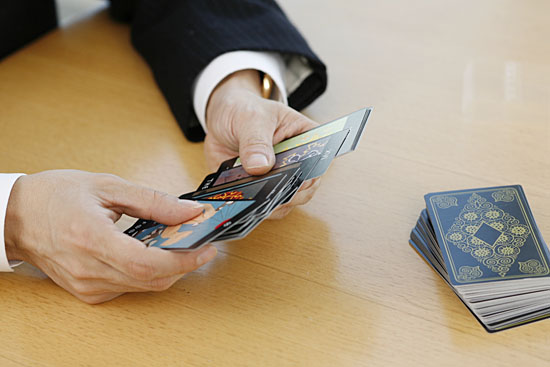
KagamiFor example, 'Justice' might hold scales and a sword. It was a game of how to expand one's imagination. Around the time of Napoleon's expedition, an Egyptian craze swept through Paris, and the theory of tarot's Egyptian origins emerged, leading to its rapid cardification. In the 19th century, occultists in Britain and France developed tarot as a tool for divination.
NakanoActually, I find myself doing online tarot readings without even realizing it (laughs). You choose two cards, and they tell you something, right? Whether it's good or bad, there's a sense of satisfaction in being told something. What is that feeling?
KagamiPerhaps it's because you feel a connection between external influences and your own life. Tarot, where meaning is born from imagination, can be thought of as a device or tool that connects the outer world with your inner self.

What is "Divinatory Thinking"?
NakanoIs it that we have a universal human need for meaning that resonates deeply, something that can't be explained away by rational, real-world logic? Did the creators of tarot know this?
KagamiI call that feeling "divinatory thinking."
NakanoDivinatory thinking! (Note: After the talk, I immediately bought Kagami's book, "Live Smart with 'Divinatory Thinking'" (Kawade Shobo Shinsha), and read it. It clearly explains the concept of divination and how to engage with it properly.)
KagamiI believe it's installed very deeply within human cognition and brain function. Shinichi Nakazawa calls it "fluid intelligence." It's also the ability to connect things through similarity, the power of metaphor.
NakanoIn literature, that's called analogy, isn't it? Is divining by breaking a stick and going right if the right side is longer also part of that?
KagamiDeciding to go right if the right side is longer, or left if the left side is longer, is a one-to-one correspondence. A computer can do that. It's different from, say, seeing a turtle shell as resembling a dog, and then thinking that because dogs are loyal, loyalty is important. The idea of "like" or "as if" is something a computer's binary system cannot replicate.
NakanoSo, the interpretation of "like" or analogy is something only humans can do. In the sense of a realm beyond computers, is divination perhaps the last remaining human domain?
KagamiI consider it a grand delusion of connection (laughs). The intelligence required to construct such grand delusions is profoundly human, and I believe it's deeply installed in our brains.

NakanoEven looking at the same turtle shell, the interpretation can differ depending on the person. Someone from a culture that eats dogs might see the turtle shell as resembling a dog and interpret it as an omen of a feast.
KagamiWhile it might seem entirely arbitrary or culturally dependent, it's not entirely so. Colors, sounds, fire, earth – these elements have common associative patterns across humanity. Jung called this the archetype.
NakanoMeaning "original form."
KagamiI feel that the thought process of divination is connected to this network of associative relationships shared by humanity.
The Link Between the Unconscious and Astrology
NakanoJung was the one who proposed that at the bottom of the unconscious lies the collective unconscious, wasn't he? When you say "my inner self connected to the outside," does that also refer to the unconscious?
KagamiBefore Jung, divination was linked to "past lives," and it even evolved into esoteric astrology, which interpreted the karma of souls from past lives.
NakanoTalking about past lives does sound a bit dubious, doesn't it?
KagamiIndeed (laughs). It was at the beginning of the 20th century that occult elements were removed, and it became linked to Jung's concept of the unconscious. Instead of "past lives," it became "the unconscious."
NakanoWhen you mention the unconscious, it feels somewhat more plausible.
KagamiUnderstanding the unconscious is painful, and we tend to look away from it. Psychological terms related to the unconscious were then linked to the traditional imagery of the stars.
NakanoWhat do you mean?
KagamiFor example, the image of "limitation" or "death" associated with Saturn can be linked to Jung's concept of the "shadow" – the parts of ourselves we don't want to see. But that very shadow, when confronted, can become a source of immense strength.
NakanoIt's truly an interpretation game. An intellectual stretch, wouldn't you say?
KagamiHowever, I believe the peak of this era of the mind has passed. Currently, there's a movement to return to traditional astrology. It's a somewhat fatalistic form of astrology that faded away at the end of the 17th century, but there's a growing effort to revive it by carefully studying and applying its original rules.
NakanoSo the methods of astrology also change with the times. Conversely, by looking at the ideas associated with astrology, we can glimpse the contours of the dominant thought patterns of each era. It would be a shame to view it solely through the lens of whether it "works" or not. I never realized it was so intellectual!
A New Year's Gift from Ryuji Kagami!Applications closed on Friday, February 15, 2008.
Winners of the signed copy giveaway of Ryuji Kagami's "Soulful Tarot" (Sowa Publishing) will be notified by mail.
Thank you for your many applications. (OPENERS Editorial Department)
Photography cooperation: CyberBird Inc.
Ryuji Kagami Official Website: http://www.ryuji.tv/
Ryuji Kagami's Love Astrology (Mobile Site)
i-mode: Menu/Search → Fortune Telling/Diagnosis → Western Astrology → ★Ryuji Kagami★
EZweb: Search by Category → Fortune Telling/Quizzes → Western Astrology → ★Ryuji Kagami★
Yahoo! Keitai: Menu List → Fortune Telling/Psychology → Tarot/Astrology → ★Ryuji Kagami★