March 26, 2015
HUBLOT | Developing a New 18k Gold Alloy
HUBLOT
HUBLOT Develops New 18K Gold Alloy
Metal or Ceramic?
Gold with Astonishing Hardness
Is Hublot striving to become a complete manufacture? It has established its own ceramic production, created in-house calibers, and now has even developed its own case material.
Text by parametric
Harder Than Steel, Vickers Hardness 1000
One might think that platinum, gold (yellow, white, or pink), stainless steel, or titanium would suffice for watch cases, but the watch industry apparently disagrees. Brands are constantly exploring various metals for use in watch cases.
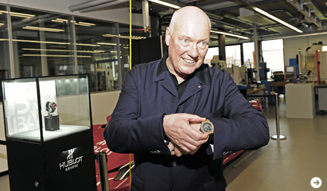
Take Hublot, for instance. In 2003, a year before Jean-Claude Biver took over as CEO, the brand released a watch in tantalum. As you know, they have been actively using ceramic since the Big Bang. Since then, they have also introduced watches in tantalum and zirconium.
Beyond Hublot, many watch brands are experimenting with unusual materials, such as Harry Winston's zirconium alloy, Richard Mille's ALUSIC, and Parmigiani Fleurier's palladium.
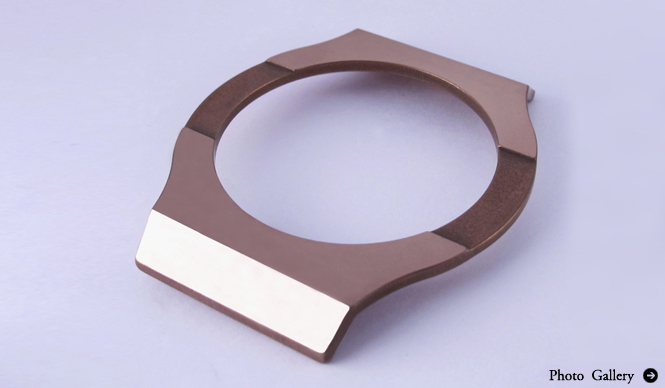
The upper case, crafted from "Magic Gold." Judging by the photos, its color appears close to pink gold. Its metallic sheen suggests it is not ceramic.
While some of these metals are entirely unfamiliar, rare metals offer benefits like superior corrosion resistance or reduced allergenicity. However, it's questionable whether users truly benefit from them. Can their value truly justify the cost? Given that most are limited editions, one might argue they do... Amidst this, the new alloy "Magic Gold" announced by Hublot at the end of last year is a particularly intriguing new material.
This material is an ultra-hard gold, born from approximately three years of joint research between Hublot and Professor Andreas Mortensen at EPFL (Swiss Federal Institute of Technology Lausanne). It is created by infusing porous boron carbide ceramic with gold melted under high pressure and temperature, filling the ceramic's pores and fusing the two materials. (Boron carbide ceramic is reportedly used in control rods for nuclear reactors.)
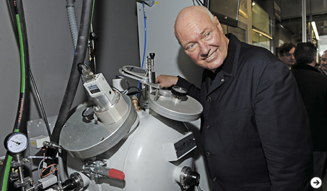
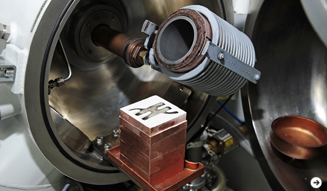
The vacuum melting furnace and Mr. Biver. This machine is used to lightly mix the 24-carat gold in air before it is poured into the pores of the boron carbide.
Its hardness is exceptionally high, meaning it is highly resistant to scratches. While slightly lower than conventional ceramic, its Vickers hardness is approximately 1000, just below that of sapphire crystal. For comparison, standard 18K gold has a Vickers hardness of around 400, and stainless steel used in watches is around 600. Although the documentation refers to this as a new alloy, or a new metal, the description of its manufacturing process suggests it might be "gold ceramic."
Magic Gold contains 75 percent gold by weight, making it 18K gold. While the specific gravity of ceramic and pure gold (24K) differs significantly, leading to a large difference in volume, the weight ratio is 75 percent pure gold to 25 percent ceramic. It has been certified as 18K by Switzerland's Central Office for Precious Metals Control and is currently pending patent approval. We eagerly await seeing the hallmark.
Unlike conventional 18K gold products, which are alloyed with silver or copper, Magic Gold may only come in one color: a deep golden hue. The official unveiling for the watch is scheduled for Baselworld. We look forward to seeing its finished texture and appearance.