
December 25, 2025
The Sound of F#: Accutron's Tuning Fork Watch Revives 66 Years After Its Debut
BULOVA | ACCUTRON
Accutron, which revolutionized watchmaking history in 1960 as the world's first electronic tuning-fork watch. Its iconic model will be re-released in January 2026, after 66 years. Ten years in the making... The biggest hurdle was manufacturing the ultra-fine gears with 400 teeth etched onto a diameter of just 3.6mm, a feat impossible without Citizen's latest technology. We bring you the story of technology and passion, as told by Michael Benavente, Managing Director of BULOVA.
Text by Takashi Tsuchida
What Exactly is a Tuning-Fork Watch? A Revolution That Overturned 300 Years of Horological Convention
Mechanical wristwatches tick using a regulating mechanism called a balance wheel. This system accurately measures time by repeating regular oscillations like a pendulum. However, the typical vibration of a balance wheel is 3-4Hz.
The tuning fork used in Accutron vibrates at 360Hz. The stability of this electronically controlled vibration achieved accuracy far surpassing the mechanical oscillations of a balance wheel. For reference, even in mechanical movements considered high-frequency, 5Hz is generally the maximum, making the tuning fork's 360Hz a movement 72 times greater. The resulting astonishing accuracy, with a daily error of less than 2 seconds, was an unprecedented realm for conventional mechanical wristwatches.

In 1960, Accutron succeeded in replacing the regulating mechanism known as the "balance wheel," which had reigned as the heart of watches for approximately 300 years, with a tuning fork. This marked the birth of the world's first electronic tuning-fork wristwatch.
"Without the invention of the tuning fork, the invention of the quartz watch 10 years later likely wouldn't have happened," Michael asserts. Its exceptional accuracy would eventually lead Accutron beyond Earth.

NASA adopted Accutron technology for 46 missions. Notably, during the Gemini program, all astronauts wore Accutrons, and the watches were also incorporated into the spacecraft's cockpit panels. In an era of intense space race competition, this small tuning-fork watch was an unsung hero that guided humanity to the moon.

A 10-Year Dream Since Becoming BULOVA Managing Director
When Michael became BULOVA's Managing Director in 2015, he harbored a strong desire.
"Accutron is a critically important brand for the entire watch industry. Yet, it wasn't being properly managed. I felt I had to do something about it."
In fact, the Accutron tuning-fork watch was briefly revived once in 2010. However, it was a limited edition of only 1,000 pieces, more of a fan service akin to prototype production. Consequently, a sustainable production system could not be established, and it ended there. The turning point came around the end of 2020 to early 2021, when the Citizen team in Tokyo finally took action.
But why is reviving the tuning-fork watch so difficult? Let us introduce one answer: a crucial component called the index wheel.


The tuning fork vibrates at an ultra-high speed of 360Hz per second. This incredibly fast and fine vibration, almost invisible, needs to be converted into rotational motion to move the watch hands. This conversion is handled by a gear called the index wheel. Specifically, a thin plate attached to the tuning fork pushes this gear precisely one tooth at a time, 360 times per second, without the slightest deviation.
The manufacturing precision of this component holds the key to producing tuning-fork watches.
"If you look through a loupe, you'll see a rotating gear. This is the index wheel," Benavente explains, holding the actual part. The teeth are barely visible to the naked eye, and only through a loupe can the existence of the minute gear be faintly confirmed.
Its specifications are beyond extraordinary. The diameter is a mere 3.6mm. On this tiny circumference, 400 teeth are etched. Each tooth measures just 20 microns. Considering that a human hair is about 80 microns thick, this means each tooth is one-fourth the diameter of a human hair.
"They were making these back then too, but our engineers' honest feeling is, 'We don't really know how they did it.'"
How were these ultra-fine components manufactured 60 years ago? The technology is not recorded, and it remains a mystery today. Even as of 2010, the technology to stably and continuously mass-produce them did not exist anywhere in the world.
The breakthrough came with a state-of-the-art LIGA (Lithography, Electroplating, Molding) process, a modern additive manufacturing technique. Unlike conventional subtractive machining, this technology achieves ultra-fine shapes by layering materials.
"Around 2010, only a limited number of high-end watch manufacturers were adopting it, and it wasn't used for the tuning-fork watch released at that time. It's thanks to this technology that we could finally achieve it this time," says Michael. Furthermore, by employing modern new materials, durability and stability have dramatically improved. Using materials that didn't exist 60 years ago ensures a quality that can withstand long-term use.
The index wheel, rotating rapidly at the 3 o'clock position. It's not actually rotating continuously, but rather advancing 360 teeth per second, appearing to move constantly due to its high speed.
A Strong Bond That Existed 54 Years Ago, Connecting America and Japan
The connection between Bulova and Citizen actually dates back 55 years. In 1970, the two companies established a joint venture, "BULOVA-CITIZEN," in Japan. At that time, Bulova granted Citizen the patent for its tuning-fork watch technology, which was then introduced to the Japanese market under the name "Hi-Sonic." Thus, for over half a century, the two companies have been linked through tuning-fork watches.
This long history of partnership, Citizen's proud development resources and manufacturing technology, and the presence of Citizen's skilled artisans who meticulously assemble each watch by hand—all these elements combined have made the full-scale revival of the tuning-fork watch possible.

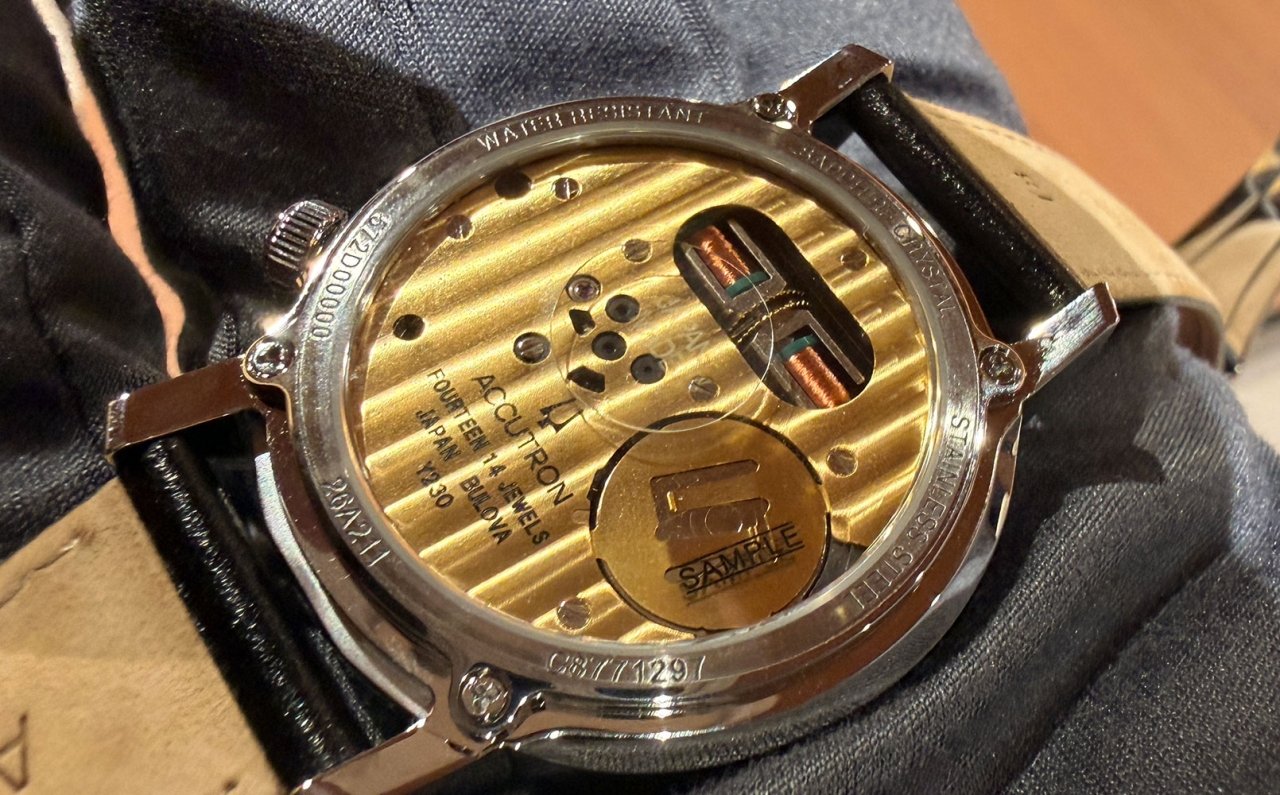
The design of the revived Accutron is almost identical to the original released in 1960. Incidentally, the skeletonized "Space View" specification was initially not a product, but a promotional item created by the sales department to explain the tuning-fork movement.
In today's increasingly digital world, young generations are intentionally listening to music on vinyl and seeking a tangible, analog experience. The tuning-fork watch, with its physical vibrations and mechanical timekeeping, resonates precisely with this trend. Michael states:
"Swiss luxury watches are considered artisanal, but this craftsmanship isn't exclusive to Switzerland. Creating this single Accutron watch requires far more effort and expertise than it takes for one artisan to craft a watch in a year."

Accutron Tuning Fork Space View 314
Ref. 26A211, Tuning-fork movement, stainless steel case (diameter 39mm, thickness 13.4mm), cowhide strap, 3 ATM water resistance. ¥990,000 (tax included).
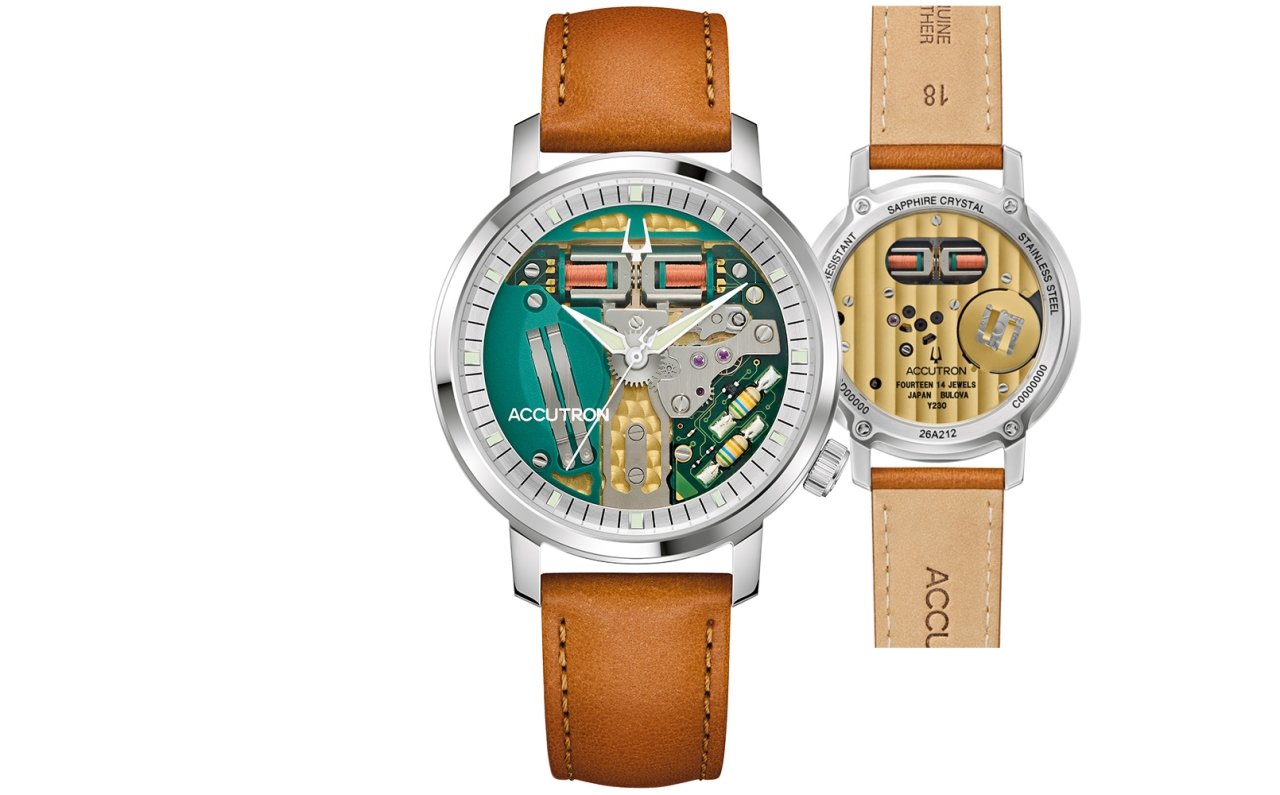
Accutron Tuning Fork Space View 314
Ref. 26A212, Tuning-fork movement, stainless steel case (diameter 39mm, thickness 13.4mm), cowhide strap, 3 ATM water resistance. ¥990,000 (tax included).

Accutron Tuning Fork Space View 314
Ref. 26A213, Tuning-fork movement, titanium case (diameter 39mm, thickness 13.2mm), cowhide strap, 3 ATM water resistance. ¥1,023,000 (tax included).
*All scheduled for release in late January 2026. Limited release at 3 stores (CITIZEN FLAGSHIP STORE TOKYO / CITIZEN FLAGSHIP STORE OSAKA / BULOVA Official Online Store)
Inquiries
BULOVA Consultation Service
Tel. 0570-03-1390 Hours: 9:30 AM - 5:30 PM (Weekdays, excluding holidays)