July 21, 2015
Series | Japanese Watchmaker in Switzerland Vol. 3: Jun Uematsu at Girard-Perregaux
Series Vol. 3 | Jun Uematsu
A Watchmaker at the Swiss Complication Brand "Girard-Perregaux" (1)
Girard-Perregaux is a brand headquartered in La Chaux-de-Fonds, the mecca of the Swiss watchmaking industry. Since its founding in 1791, it has produced numerous complex mechanical models, such as the Three Bridges Tourbillon. A Japanese watchmaker was also active at this long-established watch brand. Jun Uematsu joined Girard-Perregaux in 2013 and is responsible for assembling complex mechanical watches. How did he find his way to this place?
Photographs & Text by SANO PERRET Tomoko
An Encounter with a Watchmaker on TV
La Chaux-de-Fonds, located near the Swiss-French border, is a UNESCO World Heritage city of watchmaking. As a watchmaking city, urban planning began in the 19th century, and it is said that workshops once lined the sunny north-facing slope.
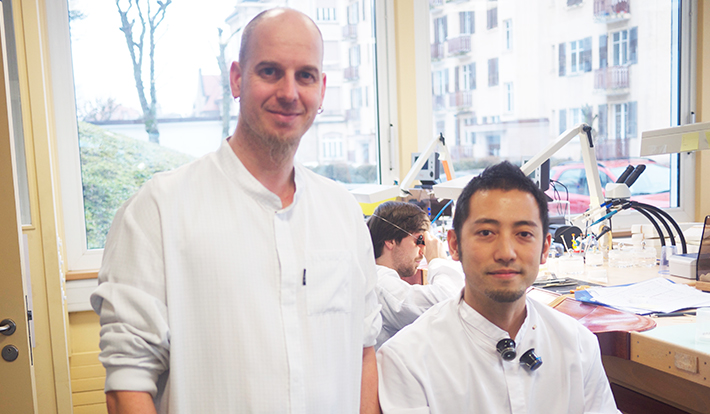
Girard-Perregaux is located up this north-facing slope. The company building faces the main street, so the interior of the workshop is clearly visible from outside the windows. Jun Uematsu is involved in the assembly and repair of complex watches here.
Uematsu's interest in watchmaking was sparked by a TV program. The 2002 NHK documentary "The Microcosm of Independent Watchmakers" was a groundbreaking endeavor for its time, capturing the intricate Swiss mechanical watches with high-definition imagery. Independent watchmakers Antoine Preziuso and Philippe Dufour appeared, tracing the production process of mechanical wristwatches through interviews.
He saw the rebroadcast of this program during his fourth year in the Department of Information and Electronics Engineering at Hokkaido University, a time when he was contemplating whether to proceed to graduate school. It was a period when he only had a vague desire to "make something with his own hands."
Series Vol. 3 | Jun Uematsu
A Watchmaker at the Swiss Complication Brand "Girard-Perregaux" (2)
France, then Switzerland. "I really do love mechanical watches."
Just then, images of intricate watch parts filled the TV screen. Côtes de Genève, perlage, and many other beautiful components. "To think that mere pieces of metal could become so beautiful," Uematsu was captivated. In an instant, he fell head over heels for mechanical watches.
This was the catalyst for Uematsu's decision to pursue a career as a watchmaker. Most parents would be in a panic if their son, an elite university student, decided to abandon everything and go to Switzerland. However, Uematsu's parents readily agreed, saying, "If you're going to pursue that path, prepare yourself thoroughly."
He investigated how to become a watchmaker, researching through the internet, the Swiss watch association, and by writing to every watchmaking school. Among them, only the watchmaking school in Le Locle responded positively. They indicated that it was possible to apply even as a Japanese national.
To prepare for the entrance exams, he first decided to move to France in January 2006 to study French. He underwent six months of French language training in Annecy, France. The following June, he successfully passed the entrance exams for the watchmaking school in Le Locle, Switzerland, which had a pass rate of only one-third. The entrance examination subjects were French, mathematics, and a test of manual dexterity.
"What surprised me upon entering was that we could immediately start working with watches. In Japan, it's usually the case that you learn the theory first and then move on to practical application."
These were the candid thoughts of Uematsu, who had never touched a watch movement before. He began his watchmaking studies from scratch and, three years later in 2009, proudly obtained his watchmaker's certification.
Series Vol. 3 | Jun Uematsu
A Watchmaker at the Swiss Complication Brand "Girard-Perregaux" (3)
Studying Complicated Mechanisms Again at a Swiss Watchmaking School
2009, the year Uematsu graduated from watchmaking school, was immediately after the Lehman Shock. Finding employment was extremely difficult. Most watch manufacturers were holding back on hiring new employees. Amidst this climate, a Swiss man who ran a watch shop in America invited him, saying, "Would you like to come for training in watch after-sales service at my shop?" Fortunately, as he was born in America, Uematsu had no issues with a work visa and decided to move to the U.S. in August 2009. He ended up repairing watches at the shop in Lincoln, Nebraska, until April of the following year.
He describes the experience of diligently repairing watches brought in by American customers as very valuable. At the same time, he keenly felt that his existing knowledge was insufficient for complex watch repairs.
As Uematsu boarded the plane back to Switzerland after his nine-month training, he had already decided on his next step. He intended to return to the watchmaking school in Le Locle and enroll in the Complicated Watch and Restoration course.
He reapplied to the watchmaking school and passed the entirely practical entrance examination. His student life in Le Locle began once more. The Complicated Watch and Restoration course was a stark contrast to the general course, requiring students to conduct their own research, devise their own methods, and execute tasks for set assignments. While offering a high degree of freedom, it led to days of battling with himself.
For his graduation project, he chose to restore a pocket watch with a 15-minute repeater (a complex mechanism that strikes bells using a mechanism activated by levers and buttons), believed to have been manufactured in the 1820s and signed by a watchmaker named "Poudra." He submitted the restored watch along with a five-centimeter-thick report written in French, and finally received his coveted certification.
Hired by Girard-Perregaux
After graduating from watchmaking school, he joined his dream Swiss watch manufacturer, Girard-Perregaux, in November 2013. A year and a half has passed since then. Uematsu says he has learned important lessons from two models here: the "Girard-Perregaux 1966 Tourbillon" and the "Girard-Perregaux 1966," which he worked on first.
The "Girard-Perregaux 1966 Tourbillon" has an enormous number of parts, and because the material is soft 18-karat gold, it must be assembled with extreme care to avoid scratches. Normally, assembling a tourbillon is never entrusted to a new employee. This is because it is a pinnacle mechanism that not only requires high technical skill but also historical knowledge and experience. The sense of accomplishment he felt upon completing the assembly of this tourbillon for the first time was unlike anything he had ever experienced.
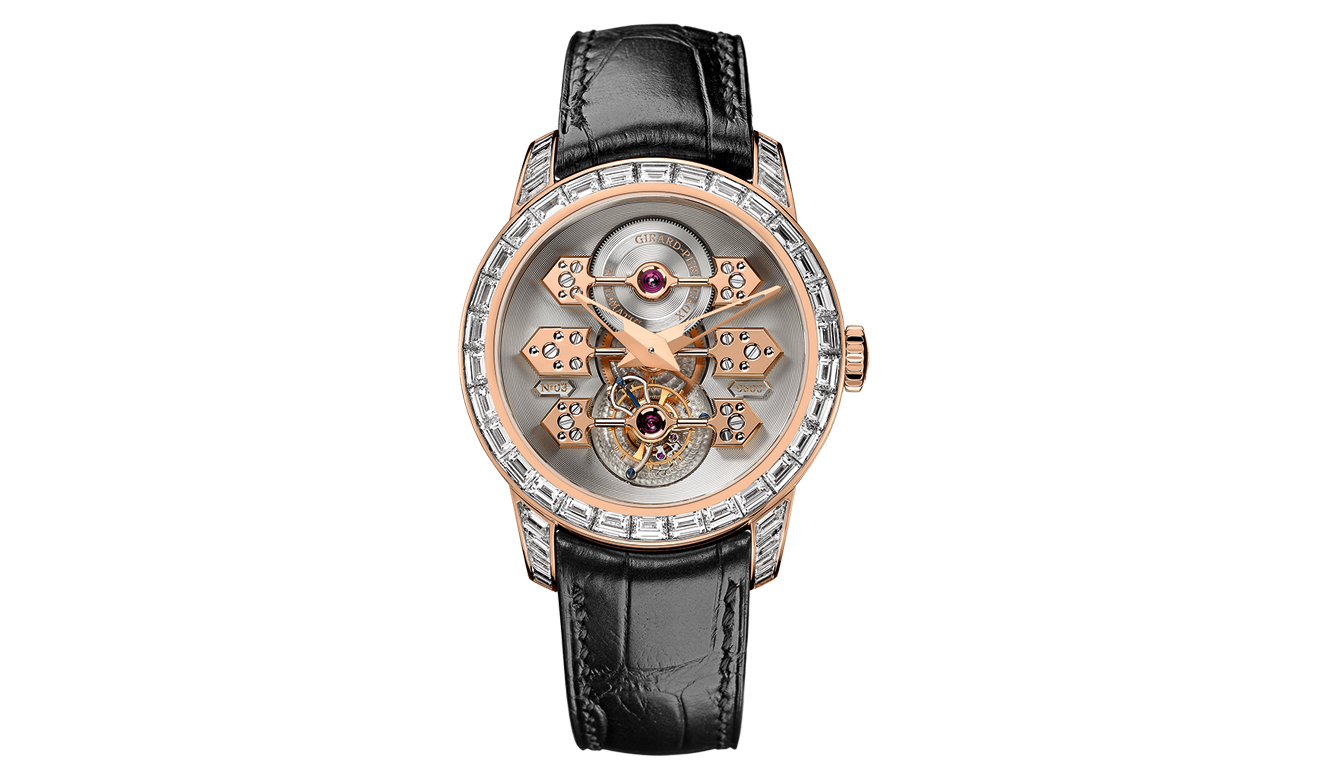
Girard-Perregaux 1966 Three Gold
Case | Pink Gold
Diameter | 41mm
Movement | Automatic (GP09600-0022)
Power Reserve | 48 hours
Functions | Tourbillon
Strap | Alligator
Water Resistance | 30m
Price | 42,184,800 JPY
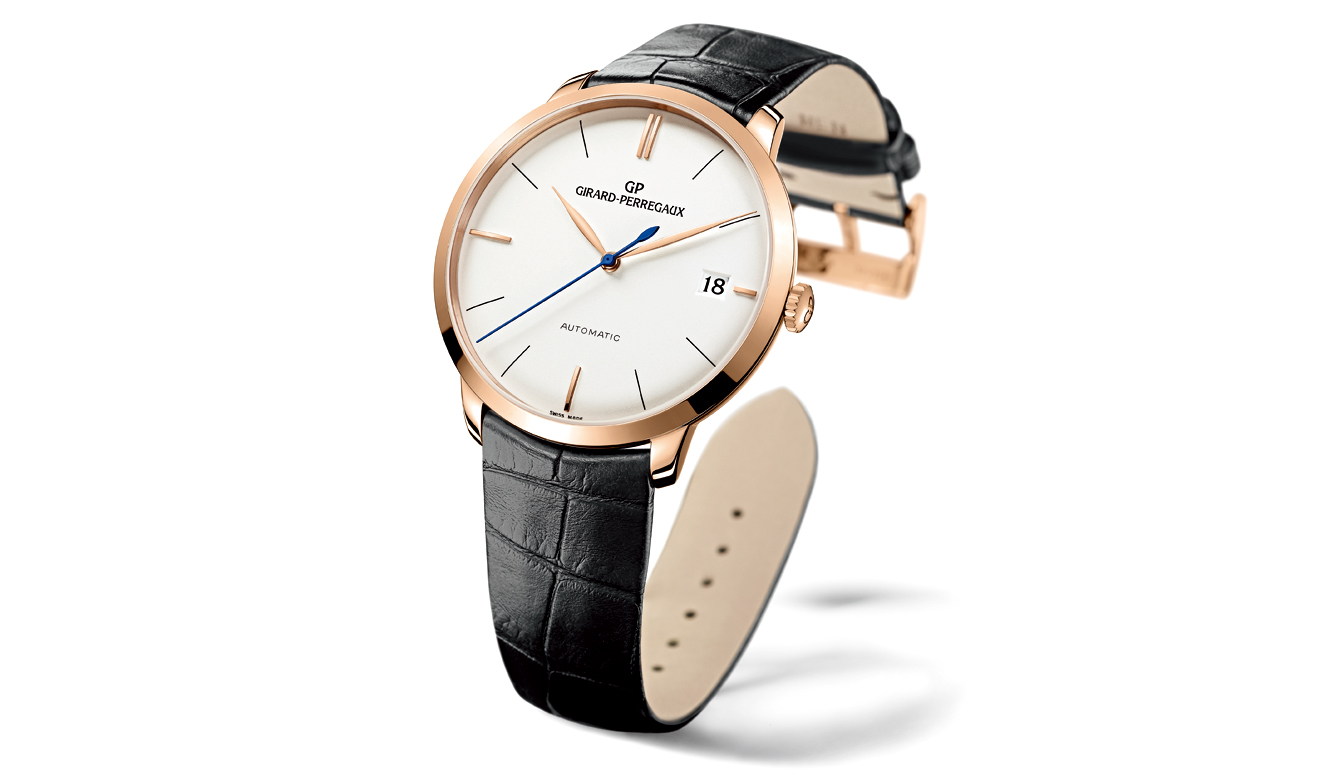
Girard-Perregaux 1966
Case | Pink Gold
Diameter | 41mm
Movement | Automatic (GP01800-0004)
Functions | Date display
Strap | Alligator
Water Resistance | 30m
Price | 1,846,800 JPY
The other watch is the "Girard-Perregaux 1966." This is a simple model with a date display and two hands, reminiscent of old pocket watches. While as a watchmaker he was often drawn to watches with complex mechanisms, he finds a sense of satisfaction, as if touching the historical roots of Girard-Perregaux's timepieces, when he sees the meticulously finished parts harmoniously housed within a beautifully proportioned case. Through these two watches, he feels he has re-learned the brand's spirit of relentless pursuit of innovation and dedication of immense time.
"In the workshop, new challenges arise almost daily. How to find the optimal solution for these problems depends on the watchmaker's skill. Of course, communication with colleagues is also important. I am truly fortunate to be surrounded by such talented colleagues. By sharing the challenges we each face, our knowledge and experience multiply exponentially."
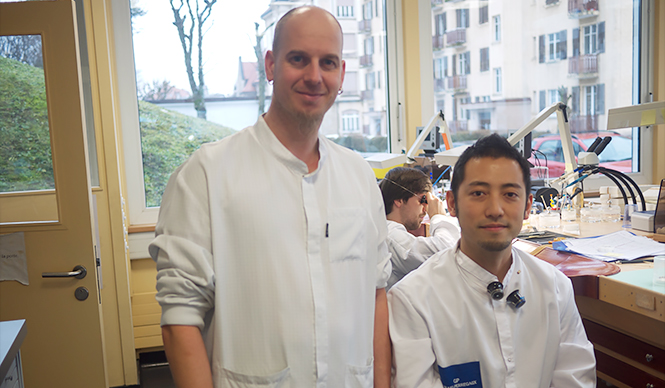
Mathieu, Head of Complicated Mechanisms, and Uematsu
"Anyone who decides to become a watchmaker must have started because they love watches. I don't think anyone starts without a genuine passion. In my case, the awe I felt when I first encountered watches on TV has carried me this far. If there are people aspiring to be watchmakers, I hope they will cherish that initial feeling."
For a watchmaker, high technical skill is certainly necessary. However, perhaps even more essential is a deep love and passion for watches, like Uematsu's.
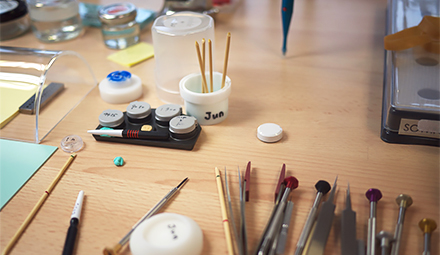
Uematsu's workspace at Girard-Perregaux
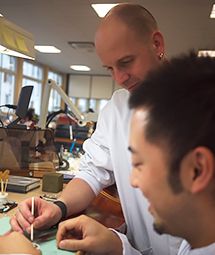
Uematsu emphasizes the importance of communication with colleagues for watchmakers.
Inquiries
Girard-Perregaux / Sowind Japan
Tel. 03-5211-1791
http://www.girard-perregaux.com/