July 28, 2015
Yasuhiro Mihara | Japanese Monozukuri, Vol. 5: TASAKI Jewelry (Part 3)
MIHARAYASUHIRO × HUSAM × TASAKI
Part 5: TASAKI Jewelry (3)
Fashion designer Yasuhiro Mihara visits Japan's proud factories and artisans, creating new wonders unique to Japan in the groundbreaking serialized project "MEANING MADE IN JAPAN MIHARAYASUHIRO," or MMM for short. This installment features TASAKI, a comprehensive jewelry manufacturer. A titan of the Japanese jewelry world, TASAKI collaborated with Mihara Yasuhiro and Husam el Odeh on men's jewelry, unveiled in the Spring/Summer 2010 collection to great acclaim. In this first part, we asked Mihara about his reasons for choosing TASAKI to create the men's jewelry he envisioned, and his passionate commitment to the project.
Text by Kotaro HosomuraPhotos by Kaoru Mizobe (HAWK EYE WORKS)

Captivated by the Origin of TASAKI Pearls
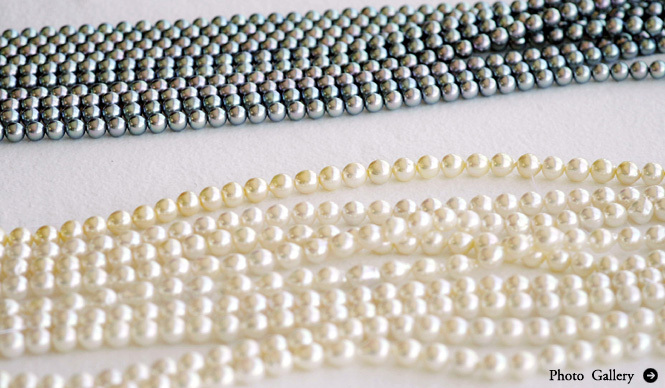
Founder Shunsaku Tasaki began processing and selling cultured pearls in 1954. The company was incorporated in 1959. Even today, as a comprehensive jewelry manufacturer, it remains one of Japan's leading pearl producers, processors, and sellers. The OPENERS team began their tour of the pearl division, guided by Tomoyuki Oifuke, who is in charge of pearls in the Pearl Processing Department.
Pearls are broadly categorized by the type of shell: Mabé, Akoya, South Sea, Black Pearl, and Freshwater. Each has a different cultivation method. Mabé and Akoya pearls are primarily cultivated in Japan. While Akoya pearl cultivation is also active in China and Vietnam, TASAKI uses almost exclusively Japanese-sourced pearls. For South Sea pearls, cultivation occurs in the South Pacific, Indonesia, and the Philippines. Black pearls are cultivated in small quantities in Tonga, but mostly in Tahiti. Freshwater pearls are partially cultivated in Japan's Lake Kasumigaura, but the majority are from China.
For Akoya, Black Pearl, and South Sea pearls, a nucleus is inserted into the shell's mantle, and the pearl forms as the nacre layers are secreted. The DNA in the mantle tissue, which generates the nacre itself, is the primary factor determining the pearl's color. While they emit a beautiful luster, you can think of the mantle's color being reflected in the pearl. In essence, the more beautiful the rainbow colors of the nacre, the better the pearl. For Akoya, Black Pearl, and South Sea pearls, a piece of mantle tissue, 1-2mm smaller than the desired pearl, is cut out, and a nucleus is inserted into the pearl along with this DNA.
Most Mabé pearls are produced at the Amami cultivation farm. Unlike other types, Mabé pearls are created by attaching a nucleus directly to the shell and building up nacre layers.
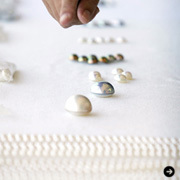
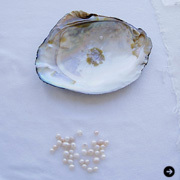
For perfectly round pearls, larger sizes like 30mm are extremely rare and expensive. Generally, the industry favors perfectly round pearls with uniformly consistent nacre layers. While color control is difficult, size and shape offer more flexibility. Various shapes exist, including drop shapes and irregular baroque pearls.
Pearls considered 'waste' in the round-pearl-centric industry may sometimes be used as unique, one-of-a-kind pieces if they are large and exceptionally beautiful. For South Sea pearls, white is considered the best quality, and for the precious Black Pearls, the peacock color, reminiscent of peacock feathers, is considered the ultimate hue.
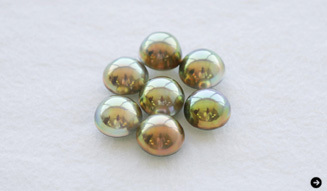
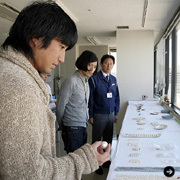
Moving further into the pearl selection area, TASAKI's high-quality pearls are meticulously sorted by the eyes and hands of artisans, as shown in the photo below. They are categorized by shape, color, luster, size, and blemishes. There are reportedly five to six grades for blemishes alone. When all factors are considered, there are hundreds of classifications. Selected pearls are then transformed into necklaces. Two strong polyethylene threads are passed through 0.7mm holes drilled in the pearls and secured one by one with knots, referred to as 'nuts.' If threaded directly, the string would not be flexible. By incorporating knots, various types of arrangements can be created. This method prevents the pearls from scattering if the string breaks and, while appearing simple, requires highly advanced and precise skill.
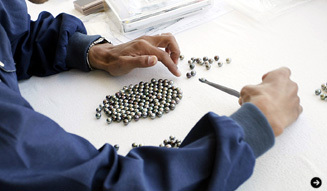
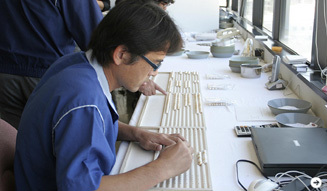
"The artisans flick the pearls with tweezers, and their hand movements alone are incredible," Mihara recounts. "When stringing them, they use slightly larger, more beautiful pearls in the center, and when they said, 'We arrange smaller pearls towards the ends to make it look natural,' I agreed, but honestly, I couldn't tell the difference (laughs). That's how precise it is."
It is said that one can become proficient in pearl selection after about five years of dedicated practice. Mihara posed this question to an artisan:
"As you become accustomed to it, do you start to notice even slight differences?" The response was:
"Yes, because that is my job."
This profound dedication to perfecting specialized skills is evident. Artisans like these at TASAKI systematically and silently carry out their work day after day.
"It's amazing how sensitive you become. It truly is the work of an artisan. Seeing all this, I realized that jewelry is not just about using precious gems and metals. It's about adding further beauty through the artisan's skill and honed intuition, making it something truly valuable to own."
The captivating beauty of TASAKI pearls is the result of this comprehensive manufacturing prowess. Naturally, Mihara has also created models for this "men's jewelry" collection that incorporate pearls.
An astonishing development awaits in the next installment! The hint is Tomoki Tsushima. Stay tuned!
