Yasuhiro Mihara | Japanese Craftsmanship Vol. 5: TASAKI Jewelry (2)
MIHARAYASUHIRO × HUSAM × TASAKI
Part 5: TASAKI Jewelry (2)
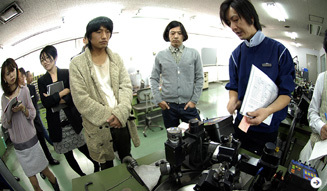
Yasunhiro Mihara revisited the Kobe headquarters to reconfirm TASAKI's craftsmanship and check on the sample completion. He was accompanied by Husam and Tomoki Yushin, a fashion director who was impressed by Mihara's collection. What is the profound power of TASAKI experienced by global creators? This time, we delve into the diamond processing technology, a privilege of being the only DTC Sightholder in Japan.
Text by Kotaro HosomuraPhotos by Kaoru Mizobe (HAWK EYE WORKS)

The Pinnacle of TASAKI's Diamond Technology
This was Mihara's third visit to TASAKI, but he had something he'd kept in his heart for this series. Before touring the factory, he spoke with quiet passion.
"I believe it's a disadvantage for TASAKI to be perceived the same as other jewelers. While they handle everything from pearls and gemstones like diamonds to precious metals like platinum and gold, their strength lies in fostering talent and maintaining in-house control over the entire process. The artisan world faces succession issues, but they have consistently addressed this."
"In other words, amidst a trend that has favored profit-driven business models, many companies have neglected and lost their true assets like people and skills. TASAKI, however, has preserved these. Their diamond cutting, pearl cultivation, and processing involve rigorous training and refinement, and the artisans respond with precision. What kind of company is Tasaki Pearl? While often discussed for its pearls, I wanted to convey that the 'core lies elsewhere.'"
Tasaki Pearl is the only DTC Sightholder in Japan. This means it is the sole company in Japan that directly receives rough diamond supplies from the DTC (Diamond Trading Company). Furthermore, witnessing the processing of rough diamonds is a rare experience. Mr. Satoru Tamura, from the Diamond Processing Department, Material Processing Section, Diamond Division, guided the group through the diamond processing steps.
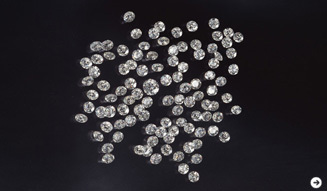
① First is the "windowing" process. If the rough diamond is cloudy, this involves polishing small sections of the surface in several places to make inclusions more visible.
② During "marking," we observed a 1.128-carat rough diamond. The basic crystal structure of a diamond is an octahedron, formed by eight triangular faces. After meticulous individual checks, the stone is typically cleaved into two triangles. In this case, the position of inclusions and the shape of the rough stone are carefully considered to determine the cleavage point, and a slit line is drawn with a laser marker.
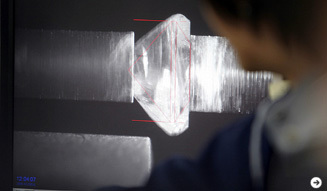
The marking location on the rough diamond is determined on a computer screen.
③ "Sawing." The marked rough diamond is cut with a thin copper blade (0.09mm) rotating at high speed, coated with a mixture of diamond powder and olive or castor oil. Since diamond is the hardest natural substance, it can only be processed by diamond itself. Cutting a 1-carat rough stone takes about 4 hours. This process is less like cutting with a knife and more like grinding away the thickness of the blade.
④ "Bruting." The newly cut, angular rough stone is mounted on a machine and rotated against another diamond, shaping its outer perimeter into a round form.
⑤ "Polishing." The rough stone is attached to a dop, a device for holding stones, and after determining the polishing direction, it is pressed against a cast iron disc called a scaife for polishing.
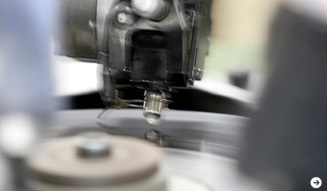
⑥ The rough polishing is collectively called "blocking." This uses automatic or semi-automatic iron polishing machines. For surface finishing, polishing the diamond against a rotating plate creates lines parallel to the rotation. These are not scratches but "polish lines," which are considered a negative point during grading. It is said to be good when these are not visible under a 10x loupe. Here, polishing continues until they are no longer discernible. The shape is formed with a total of 16 triangular facets: 8 on the crown and 8 on the pavilion. Each facet is angled and slightly offset to create a three-dimensional finish. Vick's VapoRub is used as a lubricant – another piece of artisan wisdom.
⑦ "Re-bruting (Girdle Finishing)." After blocking, the stone's girdle is finished to create a perfectly round shape.
"Achieving a perfect roundness requires the specialized eye and sense of an artisan. Also, all polished facets are of the same size. The 'excellent' angle setting is a meticulous task, invisible to the naked eye and only discernible under a microscope, designed to reflect all light. This is achieved through the artisan's honed, absolute intuition, allowing no room for error down to the micron. It's incredible how they find 'value' in these invisible aspects," says Mihara.
⑧ Subsequently, "pavilion side finishing."
⑨ "Girdle facet finishing."
⑩ "Crown side finishing," meticulously polishing each facet. The final step is "boiling" in sulfuric acid for cleaning.
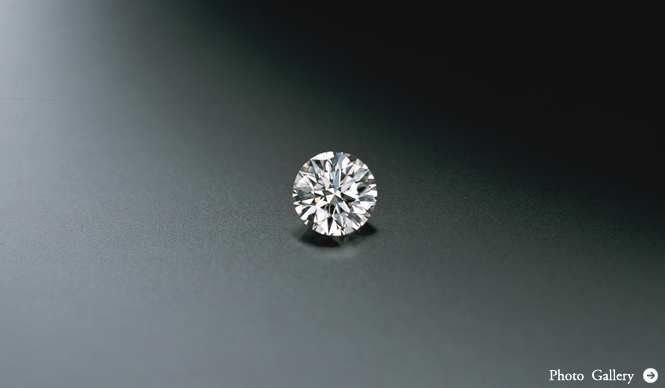
"TASAKI's standards are even stricter than the GIA's criteria in America. Excellent cut has three axes: polish, symmetry, and proportion, where 'very good' is considered good. However, TASAKI achieves the highest grade, 'Triple Excellent,' meeting all these criteria. This is the overwhelming technical prowess that led us to choose TASAKI."
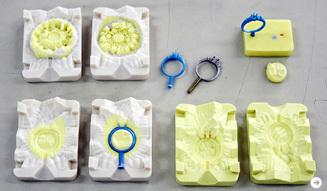
Rubber molds for forming metal. A divine skill to cut shapes while predicting.
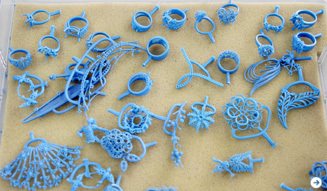
Wax models created from the rubber molds. These are used for metal casting.
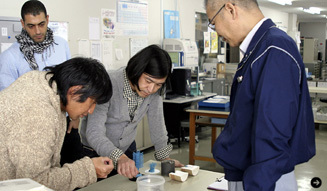
Mihara, Yushin, and Husam were all keenly interested.
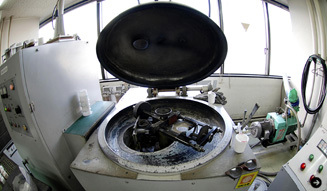
An electric furnace for melting and shaping platinum at high temperatures.
After this, they observed all processes, from rubber mold creation, firing and casting, wax modeling, and metalworking with platinum to the finishing touches. The group was stunned by the exquisite craftsmanship, such as the pursuit of precision in setting diamonds with four prongs.
"It's so precise that it's imperceptible even under a loupe. The level of craftsmanship is that meticulous, and their dedication to such a high standard is astounding."
Next time, we will explore the essence of pearls, the origin of TASAKI. What impact did this factory tour have on Japan's leading designers and stylists?

The creations of MIHARAYASUHIRO × HUSAM are born from TASAKI's technology.
