April 3, 2015
Forevermark | Kundo Koyama Shares His Diamond Story
Forevermark | Kundo Koyama on Diamond Stories
Kundo Koyama on Diamond Stories
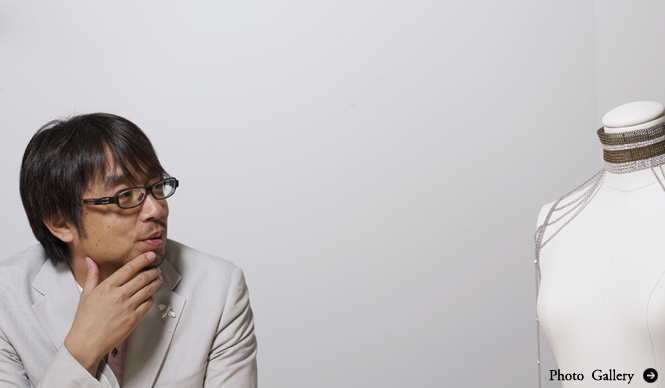
Screenwriter Kundo Koyama continues to captivate us with his imaginative works. From the Forevermark Precious Collection, he chose a piece designed by Satomi Yamamoto.
Photo: Kenta Yoshizawa
A Design That Enhances the Neckline with a Touch of Japanese Elegance
The "Forevermark Precious Collection" features diamond jewelry born from a collaboration with 11 creators. This time, screenwriter Kundo Koyama selected a striking piece from the collection. His choice was "Ambivalence," designed by Japanese fashion designer Satomi Yamamoto.
"It's surprisingly large," Koyama murmured, holding "Ambivalence" for the first time. This jewelry is designed to beautifully accentuate the décolletage. Inspired by Japanese armor, it is an elaborate piece where even the asymmetrical chain lengths have been meticulously calculated. Koyama remarked that upon first seeing it, he thought, "It's incredibly elegant, a design that feels both novel and familiar."
"Of all the pieces in the collection, it felt the most sensual. Adorning a woman's neck is incredibly alluring. While tiaras are common, this style could easily become a classic. It would suit someone with beautiful skin, particularly Japanese women, I think. A design that enhances the neckline evokes a sense of Japanese beauty, reminiscent of a kimono-clad beauty."
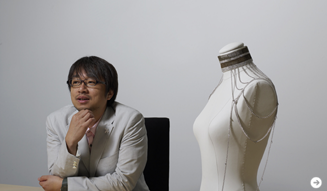
Kundo Koyama.
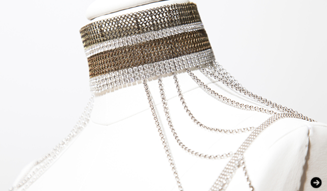
"Ambivalence" by Satomi Yamamoto, selected by Koyama.
The Allure of Diamonds Beyond Convention
Adding brilliance to Satomi Yamamoto's creation are Forevermark Diamonds. These are not just diamonds of exceptional quality, but also carry an unprecedented promise: guaranteeing every step from mine to consumer. This assurance is marked on the diamond in a way invisible to the naked eye. Koyama, who constantly embraces new ways of enjoying life without being bound by convention, was intrigued by Forevermark's new value proposition.
"I believe diamonds have traditionally been guaranteed solely by brand name. For instance, if told in a department store that something is of the same quality as a certain brand, one might wonder if there's an issue with circulation if it doesn't bear that brand name. Having a mark that guarantees authenticity would offer peace of mind, I think."

A large diamond adorns the pendant at the end of the chain that drapes from the shoulder.

A catalog of Forevermark Diamonds. The page design, with elements clustered in the corners of the spread, signifies the rarity of these gems.
Subtle Ways to Enjoy Jewelry That Embodies Dreams
Koyama also has his own way of appreciating diamond adornments. For example, he finds joy in a subtle touch, like a single diamond discreetly placed on the side of a watch, unseen from the outside. He prefers an understated style, where the diamond is a personal secret. Hearing about Forevermark, with its invisible icon and rich backstory, Koyama mused that men are drawn to the narrative behind objects, suggesting that a theme of "jewelry to gift" could be interesting, sparking his imagination.
"A diamond that doesn't sparkle but is known only to oneself would be truly wonderful." On this day, Koyama wore a small, bee-motif diamond pin subtly on his lapel. He purchased this diamond jewelry with thoughts of an upcoming film production themed around bees. For Koyama, diamonds are gems that represent "luxury, permanence, and clarity." He shared numerous ideas, such as the intriguing notion of placing a single diamond in a glass of wine to mark an anniversary. Whether a single stone or a piece whose magnificent sparkle is deliberately understated, diamonds, which have symbolized bonds and glory throughout history, undoubtedly convey the giver's sentiments. As Kundo Koyama handled Forevermark Diamonds, his rich imagination revealed new possibilities for these precious gems.
Profile
Kundo Koyama
Born in Kumamoto Prefecture in 1964. Graduated from Nihon University College of Art. Representative of "N35" and "Orange and Partners." Gained recognition for his work on "The Humiliation of Canossa" as a broadcast writer, and subsequently worked on numerous popular programs such as "Iron Chef," "World Heritage," and "Tokyo Wonder Hotel." In 2003, he received the International Emmy Award for "Torisetsu" (TV Asahi). His books include "Zuihitsu Isshoku Nyukon" (Pia), "Film" (Kodansha), "Hints for Not Thinking" (Gentosha), and "Try Saying You Want to Kiss Me" (Chikura Shobo). In 2008, the film "Departures," for which he wrote the screenplay, garnered international acclaim and won the Grand Prix at the 32nd Montreal World Film Festival. His activities span a wide range, from hotel consulting to product development and location production.
activities span a wide range.