January 22, 2015
HUBLOT | Breathing New Life into the "Antikythera Mechanism"
HUBLOT│HUBLOT
An Homage to the Oldest Astronomical Computer
A Watch That Breathes New Life into the "Antikythera Mechanism"
The Antikythera Mechanism, created in the ancient Greek and Roman eras, could accurately determine the positions of the sun and moon, as well as predict eclipses, earning it the title of the "oldest astronomical computer." HUBLOT has downsized this intricate mechanism and created a timepiece that breathes new dimensions of time into it.
By Tomomi Yanaka
The "Antikythera Mechanism" Transmits Ancient Advanced Technology
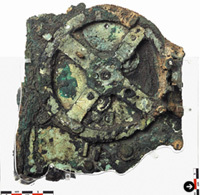
Discovered in 1901 within a shipwreck off the coast of Antikythera in the Aegean Sea, the Antikythera Mechanism is an astronomical computer believed to have been crafted around the 2nd century BCE. It indicated the cycles of the sun, moon, and planets in ancient Greece, and is said to have even featured a dial for the dates of the ancient Olympic Games.
The mechanism, housed in a 33x18 cm case, was found with only 82 parts, including small components. Recent X-ray scans have revealed countless gear trains invisible to the naked eye, along with inscriptions in ancient Greek. Dubbed the "oldest computer," it is a precious artifact that testifies to the high level of skill possessed by ancient scholars and engineers.
The Story Behind the Timepiece's Creation, Available on YouTube
As a tribute to this legendary masterpiece, HUBLOT decided to create a wristwatch that not only tells time, a function the original Antikythera Mechanism lacked, but is also smaller in scale. A team comprising renowned archaeologists, epigraphists, and historians of mechanical engineering, led by Mathias Buttet, HUBLOT's Manufacturing and R&D Director, partnered with watchmakers to bring this project to fruition.
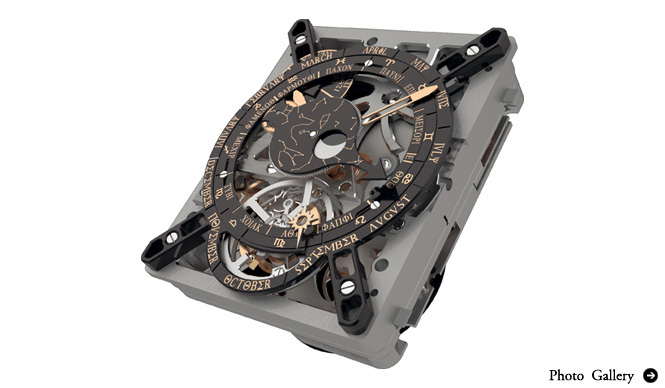
HUBLOT faced the challenge of not only miniaturizing the original 33x18 cm mechanism to a few square centimeters but also housing it within a double-sided display case, mirroring the original. Furthermore, to recreate the celestial cycles, they developed non-circular telescopic hands capable of pointing to spiral discs of varying diameters. This allowed for a complete reproduction of the original mechanism while ensuring both precision and excellent legibility.
The front of the movement, faithfully recreating the Antikythera Mechanism, displays the ancient Olympic calendar for each city, the Egyptian calendar, the sun's position in the zodiac, the moon's phase and position in the ecliptic, and the sidereal year. The reverse side shows the Callippic, Metonic, Saros, and Triple Saros cycles, just as on the original Antikythera Mechanism.
This movement was first unveiled at the exhibition "Antikythera: The Mystery Machine Revealed Across Time" at the Musée des Arts et Métiers in Paris this October, generating significant buzz. It will also be presented at Baselworld, the world's largest watch trade show, in Switzerland next March, after which it will be permanently displayed at the Musée des Arts et Métiers, which contributed to deciphering the watch's mechanism.
This is a timeless collaboration between the great mechanism left by ancient Greece and HUBLOT's modern technology. We invite you to watch the video on YouTube that chronicles the story behind the creation of this timepiece. (www.youtube.com/user/antikythera2012/)
HUBLOT Japan
Tel. 03-3434-3002