
March 25, 2015
MIKIMOTO | A Close Look at Every Step of Jewelry Creation! The Art of Craftsmanship Paves the Way for the Future
A World of Creativity: A Close Look at the Creation Process
Master Craftsmanship Paves the Way for the Future (1)
In 1893, Kokichi Mikimoto became the first in the world to successfully cultivate pearls, earning him the title "Pearl King." His groundbreaking invention and his aspiration to "adorn women around the world with pearls" continue to inspire MIKIMOTO. This year marks the 120th anniversary of the pearl cultivation success that began the company's storied history. To delve into the essence of MIKIMOTO quality, a source of Japanese pride on the global stage, OPENERS was granted exclusive access behind the scenes. We followed the journey of a single piece of jewelry from its initial hand-drawn design to its final completion.
Photographs by JAMANDFIXText by FUJITA Mayu(OPENERS)
The Master Craftsmanship Behind MIKIMOTO Quality
MIKIMOTO's unwavering commitment to the quality of its materials, including pearls, stems from the relentless pursuit that defined its founder, Kokichi Mikimoto. This uncompromising rigor and pride in offering only the finest are the foundations of the trust the brand commands worldwide. This ethos extends to its technical expertise. Since the establishment of the "Mikimoto Metalworking Factory" in 1907, Japan's first dedicated jewelry manufacturing facility, the company has overcome numerous challenges, including two world wars and the Great Kanto Earthquake. The artisanal skills passed down through generations, never once interrupted, are a crucial factor supporting MIKIMOTO.
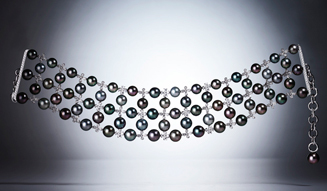
This is not limited to luxurious, one-of-a-kindHaute Joailleriebut can also be found in bridal and everyday jewelry. The globally recognized MIKIMOTO quality is underpinned by a "craftsman's spirit" that allows no compromise, regardless of the product range. OPENERS gained an inside look at MIKIMOTO's creation process, documenting the journey from a hand-drawn design to the finished piece.
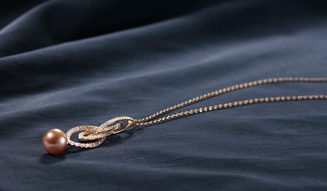
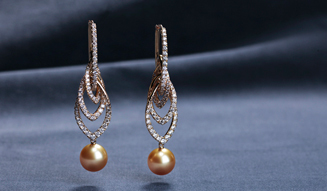
The piece we focused on is a pendant from the "A World of Creativity" collection, designed by Japanese designer Masumi Anzai. This collection is truly unique within MIKIMOTO; each season, centered around the theme of "a planet teeming with life-giving water – Earth," designs are selected through a competition among designers based at MIKIMOTO locations worldwide. This background explains the collection's distinctive, free-spirited, and inspiring designs.
The theme of this captivating design, where the brilliance of diamonds flows in graceful curves and a large pearl sways invitingly, is "Flame." Ms. Anzai explained that she envisioned the gentle, flickering flame of a candle rather than a raging inferno. She aimed to express the mystery and vitality of nature through the golden pearl and diamonds. A key feature is its structure, allowing it to sway smoothly with every movement.

Designer Masumi Anzai
"I'm inspired by the gentle flicker of a candle flame, rather than a blazing fire. The design relies on its movement, so while sketching, I often gazed at the flame of an alcohol lamp in the design studio to imagine its sway. While 'A World of Creativity' is a distinctive collection for MIKIMOTO, I always strive to create challenging designs without compromising the brand's essence. I want to offer a fresh surprise that breaks away from the traditional, perhaps somewhat intimidating, image customers have of MIKIMOTO."
Simply looking at the finished piece, one might focus solely on its design. However, this delicate piece of jewelry was constructed with meticulous precision, evident in its smoothly swaying structure, the way the metal gracefully curves and connects, and the precise angles at which the diamonds are set to always face forward.
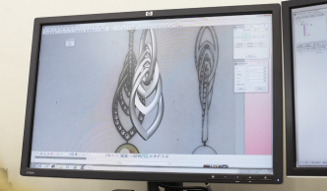
The design blueprints are created using a CAD system, implemented 12 years ago. While MIKIMOTO also employs traditional techniques like "Ippin Saiku," where every part is finished by hand from a metal sheet, the company strategically uses different methods depending on the product's characteristics. CAD is particularly suited for jewelry with complex structures and for pieces requiring extreme precision, such as earrings designed for perfect symmetry.
"The moment I saw the design sketch, I knew this wouldn't be straightforward (laughs). Pieces with this kind of movement are challenging, so I braced myself for a long process to translate it into CAD (laughs). Based on the hand-drawn sketch, I calculate achievable values for diamond size and placement, prong dimensions, and the angles of curves and twists. Inevitably, slight deviations occur at each stage. The key is anticipating these deviations. Insufficient precision here will impact subsequent steps. The most rewarding moment is when the entire process flows smoothly towards completion without any hitches."
A World of Creativity: A Close Look at the Creation Process
Master Craftsmanship Paves the Way for the Future (2)
Presenting a Challenge is What Truly Fulfills a Craftsman
The creation process begins with detailed discussions between the designer and the artisans responsible for each stage, facilitated by the design sketch. For the designer, this is often the "first hurdle." Ms. Anzai herself recalls struggling initially with the rigorous scrutiny of the seasoned craftspeople.
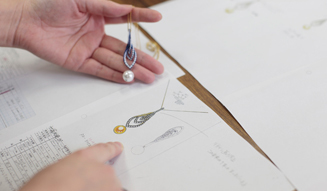

"It was finished in five minutes (laughs). Actually, in the original design, the twisted part was straighter, and the spacing between the components was tighter. But they immediately determined that shape was impossible to create in reality (laughs)! So, I redrew it while simulating the movement with a model."
While delicate jewelry designs are currently trending, pursuing design alone can compromise durability. MIKIMOTO's craftsmanship, of course, does not permit this. This leads to intense discussions between designers and artisans. Masayuki Kojibayashi states that presenting a craftsman with an seemingly impossible challenge is precisely what makes the work fulfilling.

Seasoned Craftsman Masayuki Kojibayashi
"With this pendant, I focused on how to make it appear intricate, particularly in the arrangement of stones and the seamless form. Nowadays, we can specify diamond sizes down to 0.1 millimeters, allowing for beautiful gradations. Initially, everyone said it would be impossible to assemble, but that only fueled my desire to find a way to make it feasible through design ingenuity (laughs). I find great satisfaction in devising novel solutions to balance design and functionality."
Based on the blueprints, which are finalized only after gaining the approval of both the designer and all involved artisans, the jewelry parts are created. This particular piece was made using "lost-wax casting," a method where molten metal is poured into a mold (made of plaster) to form the shape. The resulting metal pieces undergo various production stages, culminating in "Ishi-dome," the meticulous setting of the diamonds. This is an incredibly precise task.
The "Suridashi-tsume" Stone Setting Technique: A Test of a Craftsman's Skill
This pendant, in particular, features slender metalwork and diamonds nearly the same size as the metal's width to create the illusion of a line formed by the stones. The "Suridashi-tsume" technique is used to secure these gems. Typically, stones are held by prongs on four sides. However, with "Suridashi-tsume," the metal itself is shaped into prongs, embedding the stone so that the surface remains flat. By minimizing the visible metal, this technique maximizes the brilliance of the stones.
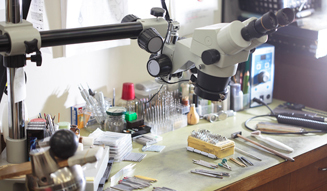
The metal is secured on a "yani-dai" (a base made of pine resin), and under a microscope, the artisan carefully shapes a small hole, pre-made in the metal, to match the diamond's size, meticulously embedding each stone. It's a task that makes one's hands tremble just watching. Peering through the microscope reveals a micro-world demanding absolute precision, filled with an almost palpable tension. Craftsman Hinotsugu Kurosawa explains that stone setting requires delicate micro-adjustments with exquisite control of force.
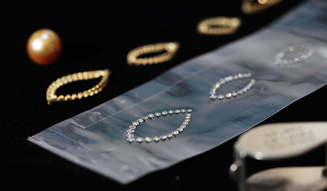
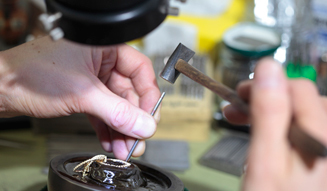
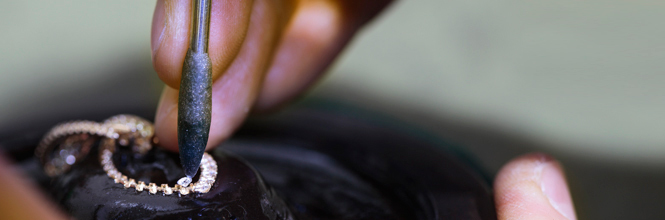
"I repeatedly make fine adjustments while considering the overall piece, ensuring the cut orientation and top surface height of the stones are aligned, and that the prongs are finished precisely along the metal's outline without overextending. The twisted sections are the most challenging in this case. After setting the stones, I finish by smoothing the corners of the prongs and lightly polishing the metal between the stones to enhance their luster. It's so intricate you might not notice it (laughs). But that extra touch makes a significant difference in the overall brilliance."
A World of Creativity: A Close Look at the Creation Process
Master Craftsmanship Paves the Way for the Future (3)
Creation Continues to Expand Alongside Tradition
Finally, the completed parts are assembled to form a single piece of jewelry. This stage is crucial for ensuring the smooth, fluid movement of the piece. For this pendant, "soldering," where parts are joined by melting and fusing metal of the same type, was used. This method not only results in a more aesthetically pleasing finish but also enhances durability.
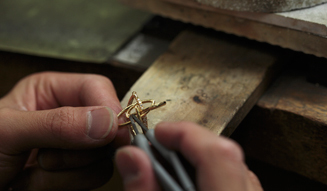
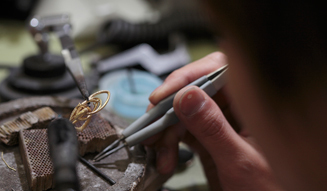
Soldering involves working close to the melting point of metals – 960°C for sterling silver, 1070°C for gold, and 1800°C for platinum – making it a hazardous process. It also requires delicate heat control to avoid melting the surrounding metal. Amidst the tension, the process involves carefully checking the overall balance, the fluidity of movement, and whether the piece rests correctly facing forward when stationary.
Once the jewelry takes its final form, it is polished vigorously with a high-speed polishing machine. This requires intense concentration, as a momentary lapse could lead to injury. Finally, using a loupe in addition to the naked eye, every detail is meticulously inspected for scratches or areas missed during polishing. MIKIMOTO's stringent quality standards demand a flawless, smooth, and beautiful finish from every angle.
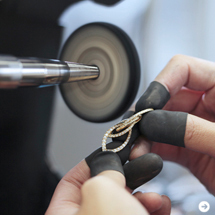
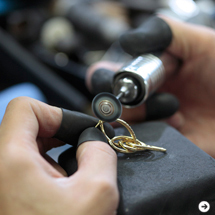
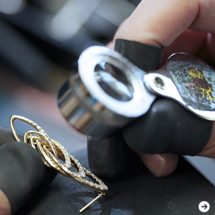
This polishing technique relies heavily on tactile sensation and cannot be taught through words; it requires dedicated practice. Consequently, the difference in the finish between experienced artisans and younger ones is striking. The unique skills honed over time are a cornerstone of MIKIMOTO's jewelry quality.
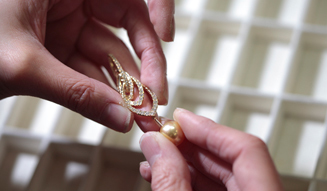
The final step is "Tama-dome," the setting of the pearl. A hole is drilled two-thirds of the way into the center of the large golden pearl, the centerpiece of the design, and a post is inserted. The pearl is set so that its most beautiful side faces forward. Since there is no adhesive that can perfectly bond pearls and metal, the tip of the post is intentionally given a slight texture to "bite" into the pearl, ensuring a secure fit. This is a task that demands meticulous care.
The creation of a single piece of jewelry involves a multitude of people, and their rigorous approach to each other's work was truly impressive. In this era of mass production, MIKIMOTO places the utmost value on the warmth and passion of human touch. It felt like a genuine encounter with the true value of MIKIMOTO quality, which transcends mere design or material excellence. What was also surprising was the presence of many young artisans, alongside the young designer, Ms. Anzai. Many of those we spoke with were in their thirties, and some were as young as 26. With careers ranging from 8 to 15 years, they have mastered all the necessary processes and are considered "fully-fledged" artisans. The legacy of skilled craftsmanship is being passed down effectively to the next generation.
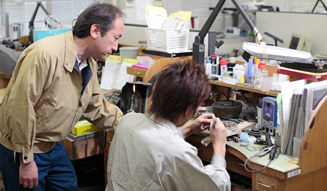
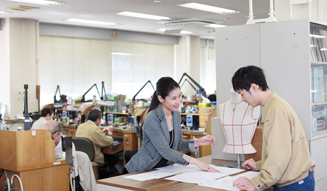
To meet the fresh sensibilities of young designers like Ms. Anzai, artisans continuously explore new techniques. Thus, MIKIMOTO's creations do not remain static but evolve over time. This year, the brand celebrates 120 years since the invention of cultured pearls, a history built on successive steps of "innovation" that continue to shape its future.
MIKIMOTO Customer Service Center
Tel. 03-5550-5678
http://www.mikimoto.com/jp/