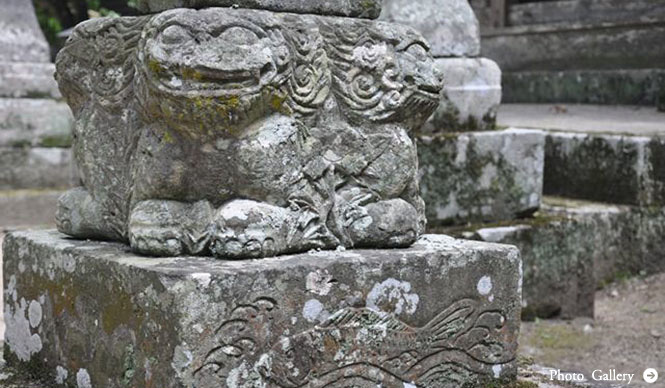
Series: Yūichi Tsukada | Tactile Botany: Part 14, A Journey Through Kyushu, Bridging the Old Tanabata
Land of Fire, Land of Water, Land of Green
Part 14: A Journey Through Kyushu Around the Old Lunar Tanabata (1)
While primarily referring to Kumamoto Prefecture, Kyushu as a whole is dotted with volcanoes. From Aso, the symbol of the "Land of Fire," to Sakurajima, Unzen, Unshigai, Kirishima, Kujusan, and Yufudake, it's a land of volcanoes. Yet, upon visiting, I found it to be as much a "Land of Water" as it is of fire. And by extension, a "Land of Green."
Text and photos by Yuji Tsukada (Representative, Onshitsu Inc.)
NAGASU
Five months after the earthquake, the Nebuta festivals of Aomori, the Tanabata of Sendai, and the Akita Kanto festival were all held. Nebuta and Kanto share the same roots as Tanabata. With the addition of music and dance, they became associated with certain events, syncretized, and shaped by the climate, temperament, and era into something unique. They evolved into "furyu" (elegant, refined). In times of great disaster, they served to ward off and wash away the impurities. It may be that the greater the sorrow, the more extravagant and flamboyant these celebrations became, especially when life was harsh.
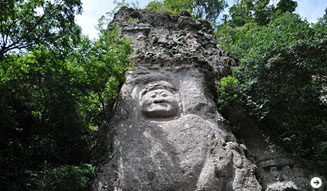
Rock-cut Buddhist Statues
Festivals are important. They reaffirm the bonds of community. For the disaster-stricken areas, it must have been a time to make vows while simultaneously grappling with hearts about to burst with sorrow and overflowing tears, and the gaping void left in their souls. I can only imagine.
Originally, Tanabata was also a day to begin preparations for Obon.
This year, the old lunar Tanabata fell on August 6th (Saturday). As I traveled through Kyushu, I saw families everywhere weeding and washing their ancestors' graves. They also lit welcoming fires. At home, gardens were meticulously tended. Ancestral altars were likely set up. The preparations to welcome the souls of ancestors were being carried out as usual.
One of the maids at the hot spring inn where I stayed mentioned to her colleagues that she had forgotten to boil the taro. The maid who heard her said, "That's bad." "Please forgive me this year, ancestors," she prayed, clasping her hands. It was a nostalgic exchange I hadn't heard in a long time.
Land of Fire, Land of Water, Land of Green
Part 14: A Journey Through Kyushu Around the Old Lunar Tanabata (2)
LAND OF WATER
From Oita Airport, I toured the Kunisaki Peninsula and headed to a hot spring in Kusu. Along the way, I stopped at shrines that caught my eye to pay my respects. Many ancient deities resided there, with rich variations. There were gods of rice, like the Toshi no Kami, Yasaka shrines and Hachiman shrines, the Pure Land Buddhism of the Heian period, countless Niō statues, rock-cut Buddhas, and esoteric Buddhist figures—a coexistence of many Asian influences.
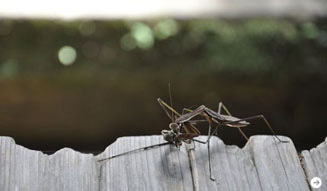
Fuki-ji Temple: Praying Mantis and Moss
Old shrines and temples, like the sacred sites of Ryukyu, are filled with unseen power and are each beautiful. Within a single sacred precinct, multiple deities are enshrined, with small shrines lined up. Behind the main hall, there was always a protected, quiet sanctuary.
Perhaps due to the rainy and cloudy weather caused by the typhoon, I felt the "Land of Water" Kyushu especially from the second day onwards. Wherever I went, I felt drawn to water deities.
Rice paddies, beginning to sprout ears of grain, filled every gap in the mountain valleys, presenting a beautiful terraced landscape. Abundant water made this scenery possible. The rice swayed gently in the wind, rejoicing in the rain. Dragonflies flew low, just brushing the tips of the leaves, and swallows cut through the wind like cutters. Drops of rain gathered, forming streams, which then became countless rivers flowing into the gorges.
“every tear is waterfall”—I am reminded of a song by a certain band. Volcanic activity must have also created the steep, deep gorges, and the beautiful water likely emerged from groundwater filtered by lava meeting hard bedrock.
Land of Fire, Land of Water, Land of Green
Part 14: A Journey Through Kyushu Around the Old Lunar Tanabata (3)
TO THE SPRINGS
At Ama-no-Iwato Shrine in Takachiho, famous for the legend of Ama-no-Iwato, there was also a continuously gushing spring. The Takachiho Gorge is also very deep. A pantheon of the heavens. With clouds forming layers, it is truly a divine land. According to the Kojiki, the gods burst into laughter at the sexual dance of Ame-no-Uzume, which piqued Amaterasu Omikami's curiosity, and light was restored to the world. "Warau" (to laugh) shares a root with "waru" (to break). Laughter has the power to break through darkness. In the Kojiki, "warau" is written as "sakau" (to bloom), which is also related to "saku" (to tear).
From Ama-no-Iwato Shrine, I headed towards Takachiho Shrine. Just after leaving Ama-no-Iwato Shrine, I noticed a small torii gate standing between rice fields. I stopped the car and descended the path leading to the valley. Such altars built on cliffs are also common in Okinawa.
The deep gorge had become a muddy torrent, collecting the rain. It was a windy day with occasional shafts of light, creating sharp contrasts of light and shadow. A small shrine perched on the cliff enshrined "Seoritsuhime." The name of this deity appears in the Oharai Kotoba (Great Purification Incantation) for the Nagoshi no Harae ritual, making her an indispensable goddess for cleansing impurities. She might be a version of "Tanabata-tsume" or "Tanabata-tsume."
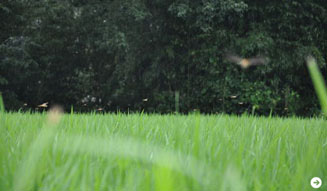
Dragonflies and Rice Fields
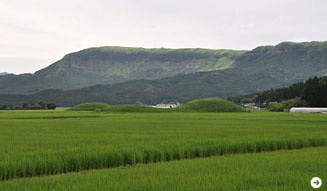
Nakatomi Kofun Cluster
Aso boasts one of the world's largest calderas. Water springs forth from the volcanic foothills everywhere. These numerous sources irrigate the fields. Among them, I was drawn to "Yamabuki Spring," the name of which evokes the fountain of youth. How many years has this water, gushing at a rate of 30 tons per minute, been flowing?
A spring where yamabuki flowers would be in full bloom in season. Following the stream deeper in. It was breathtakingly beautiful.
My reflection in the water was clearer than my actual self. Which is the real one? If you know the story of "The Golden Axe and the Silver Axe," you might expect a goddess to appear if you drop something... Yamabuki also refers to gold. Light spills from the lush greenery, shimmering on the mirror-like water surface, creating countless points of light.
A short distance down from Yamabuki Spring, in a village, lies "Oto Shrine." It seems related to "Otohime," the princess who lived in Ryugu Castle and fell in love with Urashima Taro. This small village nestled in the mountains, with rice fields spreading out like fans. "Oto Shrine," situated on a small rise. Perhaps it signifies the marital relationship between the sea and the mountains, related to Otohime, Ototanabata, and more, which is intriguing. One of the shrines enshrined a white jewel-like stone.
Land of Fire, Land of Water, Land of Green
Part 14: A Journey Through Kyushu Around the Old Lunar Tanabata (4)
LAND OF FIRE, LAND OF WATER
I saw many symmetries in Kyushu's climate and topography: mountain people and sea people, gods of fire and gods of water. But fundamentally, mountains are also sources of water, places that hold plants and store water, and where clouds form. Considering that they contain magma, the fire within, and that these elements are inseparable for a mountain, it's not a matter of which is which, but rather, like the harmony of yin and yang, there likely exists an infinite space between light and darkness, brightness and dimness, hare and ke, rough spirits and gentle spirits, male and female.
Perhaps that is why there are "eight million" deities. Gods of fire and gods of water may have simply been different names for the same deity.
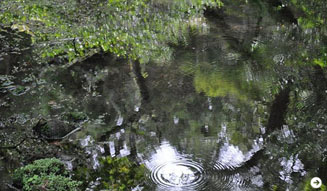
Yamabuki Spring
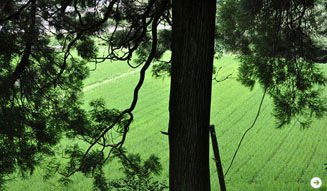
Oto Shrine
An old man, who claimed to be a tea server I met at the Gion Festival in Kyoto last year, told me that "kami" also refers to "ka" (fire) and "mi" (water). This was at Yasaka Shrine.
At that time, he gave me a safety pin. He said, "You're quite loose."
I still don't know what I should tighten, close, or squeeze. Although it's certain that something is loose. If I meet him again, he'll probably give me another safety pin.