
INTERVIEW | Guillaume Gallienne on Directing, Scripting, and Starring in 'Me, Myself and Mum'
INTERVIEW | A Masterpiece That Swept France With Laughter and Tears
The Film 'Me, Myself and Mum'
An Interview with Director, Screenwriter, and Star Guillaume Gallienne (Part 1)
A boy, raised as a girl by his mother and universally believed to be gay, embarks on a journey to explore his sexuality after his first love ends in heartbreak. This astonishing true story was adapted for the stage in 2008, becoming a huge hit. Five years later, it returns as a film. 'Me, Myself and Mum,' which drew 3 million viewers and swept the César Awards (the French Oscars) this year with five wins, is that film. The man who brilliantly juggled four roles—director, screenwriter, and both Guillaume and his mother—is Guillaume Gallienne. OPENERS sat down with him, hailed as a new standard-bearer in French cinema, for an interview. He spoke candidly about the path to making the film and the secrets to portraying two characters.
Photographs (interview) by JAMANDFIXText by TANAKA Junko (OPENERS)
An Offer That Changed My Life
—What inspired you to adapt this autobiographical story for the stage and then for film?
Honestly, I wanted to make a film from the start. But until recently, I was a completely unknown actor, so I thought it would be difficult to raise the funds for a film. The story is set in a wealthy bourgeois family. To make it believable, money was the first thing I needed.
It was then that Olivier Meyer approached me. He's the artistic director of a theater called 'l’Ouest Parisien' in Boulogne, a suburb of Paris. He called me the day after seeing me perform at the Comédie-Française. He said, 'I want to give Guillaume Gallienne a blank check.' When I asked, 'What do you mean by a blank check?' he replied, 'Just do the play you want, the way you want to do it.'

—That's an incredible offer, isn't it?
Absolutely. So, when it came to deciding what kind of play to create, I didn't hesitate to use my own experiences as the subject. It was a project I had been nurturing for years... the story of a boy with a confused sexuality, who was thought to be a girl or gay, forging his own destiny through various adventures. I always thought it would be best depicted in a film, but I was overjoyed to have the opportunity to bring this story to life in any form. So, we decided to start with a stage play.
—How did you structure the stage play?
Many characters appear in this story. I set it up with 52 characters for the stage, but it was a one-man show...
—You mean you played all 52 characters yourself?
That's right (laughs). But in a one-man show, I couldn't fully portray the key aspect of the story—Guillaume falling into a state of shock whenever something happened. Also, switching between so many characters was incredibly hectic. I didn't have the luxury of developing each one in detail.
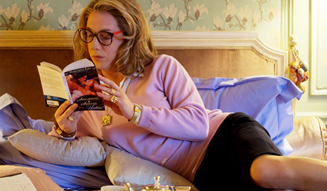
For example, the father on stage was almost non-existent. But in the film, through camera work and how scenes were presented, I was able to give him a presence, even without major scenes. The same applies to the mother. Thanks to the film, I was finally able to restore her kindness and grace, which I couldn't fully convey on stage.
What I wanted to depict wasn't a common truth, but my own truth. In other words, it's okay for it to be subjective. Like in Proust's 'In Search of Lost Time,' I wanted to jump from childhood to the present, from one place to another. I also wanted to move back and forth between male and female roles. I didn't want to follow his life in a documentary style; I wanted to portray it strictly as a fictional film.
—How did the audience react to the play?
The reaction was overwhelmingly positive. Initially, we were scheduled for only 12 performances at Olivier Meyer's theater. But word of mouth spread rapidly, leading to a rerun at the prestigious Théâtre de l'Athénée in Paris, and then another rerun after winning the Molière Award for theater. I think it's safe to say it was a great success. The laughter from the audience was tremendous, and the number of people who visited my dressing room after the show was astonishing. I thought, 'Maybe we can do more with this.' What about adapting it into a film?
I also felt a sense of accomplishment from performing the one-man show. When you perform the same piece alone for a long time, you naturally start to refine it, making it too perfect. It becomes a 'result' of extensive practice, rather than a 'work in progress.' While practice is essential for creating anything, once you've mastered it, you have to let it go. I'm only interested in things that are in progress.
INTERVIEW | A Masterpiece That Swept France With Laughter and Tears
The Film 'Me, Myself and Mum'
An Interview with Director, Screenwriter, and Star Guillaume Gallienne (Part 2)
Mum in the Morning, Guillaume in the Afternoon
—What do you think is the difference between theater and film?
In film, you have to completely surrender yourself. It's about trusting the director and following their lead. You have far less control than in theater. For instance, you don't know how the camera is filming you, or which parts will be cut during editing. As an actor, you have no control over those aspects. In theater, you rehearse with the director beforehand, but once the curtain rises and you're on stage, you're on your own. Ultimately, you have to trust yourself to perform. That's the difference.
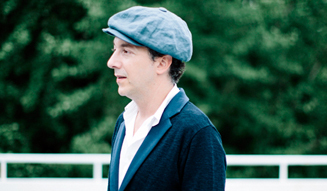
Also, I think theater demands a more athletic sensibility. On performance nights, you prepare your body from the moment you wake up to be in the best condition. When you have consecutive performances, it feels like a live show every night. Film, on the other hand, is like a continuous live performance for two months, surrounded by other cast and crew. Personally, I find film more exhausting.
—Were there any challenges in adapting the play for film?
No, quite the opposite. The fact that this story only existed on stage was frustrating for me. There were many things I could do in the film that I couldn't on stage. For example, the setting of a wealthy bourgeois family. The interior design, the mother's clothing, the flowers by the fireplace, the photographs... French people have a certain cliché in mind when they hear 'wealthy bourgeois family,' but I couldn't show those details at all on stage.
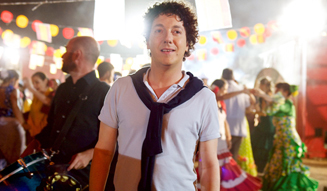
The film also features many other clichés. When I went to study Spanish in Spain, I was sent to an ugly town, just like in the movies. So, to escape reality, I told myself, 'This is Pedro Almodóvar's world,' and comforted myself. That's why the Spanish part is depicted in the style of an Almodóvar film. I also cast someone who resembled Carmen Maura (a frequent collaborator in Almodóvar's films) as my host mother, Paqui. For the English part, I imagined James Ivory and depicted it in the style of an Ivory film. These are my own personal clichés.
—How was your experience directing for the first time?
The preparation and the shooting itself were very enjoyable. However, the editing afterwards was challenging. There were so many possibilities that it was hard to choose, to be honest. It was a painstaking process. Directing while acting? Actually, Claude Mathieu, who directed the stage version, also came to the film set. She directed me while watching the monitor. So, she was my 'accomplice' in my directorial debut. I'm already thinking about my second film, planning to make a movie based on a true story that happened to a female friend of mine.
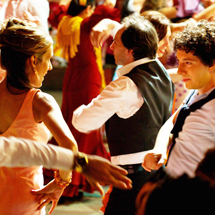
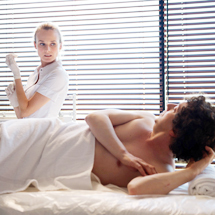
—You played two roles in this film: yourself (Guillaume) and your mother (Mum). How did you switch between them?
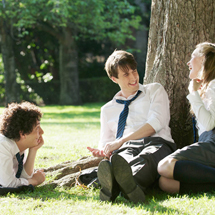
People often ask, 'Wasn't it confusing?' But for me, it wasn't a problem at all. I would play the mother in the morning and Guillaume in the afternoon. However, the staff around me seemed bewildered, especially when I was playing the mother. I wouldn't show my face to the staff until I was 100% immersed in the role of the mother. I didn't want them to think it was just a costume. I never felt like I was in costume; I was embodying my mother completely.
She was my greatest model and inspiration as a child, as I tried to behave like a girl. Gradually, I adopted her voice, her mannerisms, her gestures. I wasn't effeminate; I became her. That was my first acting experience, and I rehearsed it for 15 years.
But then Claude told me, 'Do you understand why everyone is confused?' 'When you're fully embodying the mother in the morning, you're dictatorial as a director, saying 'Do this, do that.' But in the afternoon, you suddenly appear as a naive 15-year-old boy.' When I heard that, I thought, 'You're right' (laughs).
—What did your mother say after watching the film?
She said the film moved her more than the play. She and I have always shared a sense of humor. She laughed uncontrollably, saying I was just like her in my gaze, my small gestures, even my eccentric expressions.
—Were you not apprehensive about exposing yourself so openly?
No.'Yves Saint Laurent'Playing Pierre Bergé in 'Yves Saint Laurent' or playing 'Le Dindon' (The Turkey/Fool) at the Comédie-Française felt like exposing myself even more. But watching the finished film was a strange experience. It's rare, but it felt like reliving my life on screen. But that's not so bad. I exist to tell my own story.
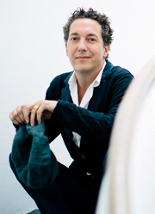
Guillaume Gallienne
Born in Neuilly-sur-Seine, a suburb of Paris, France, in 1972. The third of four sons, he was raised by a businessman father and a mother with aristocratic lineage. At 19, he decided to pursue acting and enrolled in the Florent drama school. Since 2005, he has been a regular member of the national theater company 'Comédie-Française.' While gaining recognition for his talent in numerous stage productions, he also became known as the host of a popular TV show. His film credits include Sofia Coppola's 'Marie Antoinette' (2006) and 'Sagan' (2008). More recently, his nuanced portrayal of Pierre Bergé, Saint Laurent's lifelong partner in business and life, in 'Yves Saint Laurent' (2014) earned him high praise. This film, based on his own experiences, became a massive hit in France, surpassing 3 million viewers. It also garnered significant attention at this year's César Awards (the French Oscars), winning five major awards, including Best Film and Best Actor, beating out strong competition.
'Me, Myself and Mum'
Opening Saturday, September 27th, at Shinjuku Musashinokan and other theaters nationwide.
Directed, Written, and Starring: Guillaume Gallienne
Starring: André Marcon, Françoise Fabian, Diane Kruger, Reda Kateb, and others
Distribution: Cetera International
2013 / France, Belgium / 87 min / Original Title: 'Les garçons et Guillaume, à table!'
http://www.cetera.co.jp/merci/
© 2013 LGM FILMS, RECTANGLE PRODUCTIONS, DON’T BE SHY PRODUCTIONS, GAUMONT, FRANCE 3 CINEMA, NEXUS FACTORY AND UFILM