
INTERVIEW | Director Shuichi Okita on his film 'The Great Passage'
INTERVIEW | A Universal Coming-of-Age Story Beyond Time
Shuichi Okita, Director of the Film 'A Story of Yonosuke': An Interview (Part 1)
Joy at meeting, laughter, and then... Based on the novel by Shuichi Yoshida, 'A Story of Yonosuke' depicts 18-year-old Yonosuke entering university, the people whose lives he touches, and those who, 16 years later, fondly recall their memories of him. Now, it has been made into a film. The director is Shuichi Okita, a rising talent who gained acclaim for 'The Chef of South Polar' and 'Wood Job!'. Okita, who laughs and says, "I was only in the fifth grade back in 1987, when the story is primarily set," shares his thoughts on this work. He discusses the film, which opens on Saturday, February 23rd.
Text by Itaru Tashiro
Photographs (portrait) by JAMANDFIX
Two rising stars co-star
The story begins when the protagonist, Yonosuke, moves from Nagasaki to Tokyo to attend university. He is played by Kengo Kora, a talented young actor. Kora, also from Kyushu, has collaborated with Okita on three previous films. He is someone Okita knows well.
"After finishing the novel, I thought he really seemed like Kora-kun. He had a similar experience of moving to Tokyo from Kyushu and could speak with a natural dialect. I felt he would understand Yonosuke's feelings well. This time, I thought, 'Let's give him the lead role he's always wanted,' and went for it (laughs)."
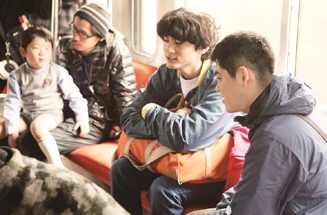
"Yonosuke is an ordinary young man with no particular quirks. He experiences things that anyone might, and has ordinary emotions. The basic story is about him entering university, meeting various people, and the passage of one year. So, I didn't want Kora-kun to take any specific actions towards anyone; we talked about him acting naturally within the given environment and setting. He's 18, young, and at that age, you don't think about 'dying someday.' The setting is 1987, but he doesn't need to be conscious of living in that era. As Kora-kun also said, young people today don't consciously think, 'It's 2013' as they live their lives."
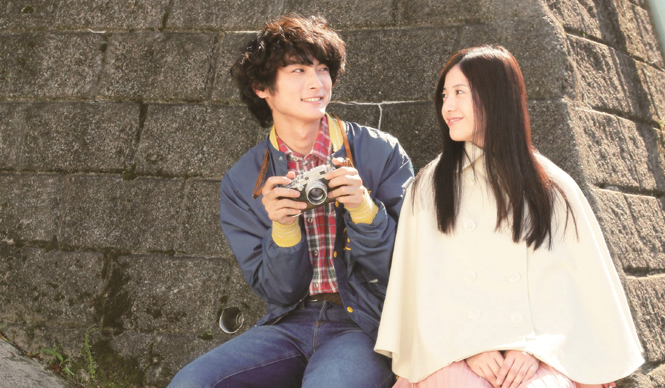
Yuriko Yoshitaka plays Yoshiko Yoza, the daughter of a wealthy family who falls in love with Yonosuke.
"Yoshiko is somewhat eccentric, a rather cartoonish character. When a real person plays her, there are many aspects that can feel unrealistic, and Yoshitaka-san was careful about how to strike that balance. However, at her core, she's just an ordinary 18-year-old girl. I explained to her that her way of speaking and certain behaviors are just a bit different from ordinary people because of her privileged background. Beyond that, like Kora-kun, I encouraged Yoshitaka-san to really flesh out the character as much as she could."
1987 was the height of Japan's bubble economy. Many cultural elements familiar to those who lived through that era make an appearance. The meticulous details used to depict the period also make this film special.
"I wanted to be truthful, using authentic items from 1987, even down to the smallest props. Although I was only in fifth grade then and didn't know much, I worked with staff who remembered the era to recreate the details. But I surprisingly remember some things myself, like the AXIA posters of Yuki Saito, or 5/8 chips (laughs). I was also careful with the clothing and hairstyles to ensure they fit the 1987 setting."

©2013 'A Story of Yonosuke' Production Committee
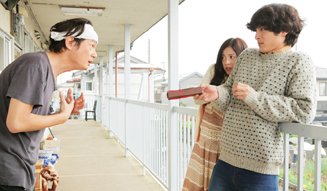
"However, the location shooting was challenging. I heard that back then, university students would meet at Shimokitazawa station and eat at Italian restaurants, but the station area now has many things that shouldn't be visible from that era. We couldn't film in Shimokitazawa, and finding Italian restaurants with the same interior and furnishings as back then was difficult. So, in the film, I deliberately set the scene in a chaotic part of town where Yoshiko wouldn't normally go, having her eat a large American burger with her hands for the first time. I thought that having them eat something that reveals their true selves would make the intention of their first date, where Yoshiko and Yonosuke connect, clearer. Balancing how much to stick to authenticity and where to adapt and express things was the most difficult part of portraying the 80s."
INTERVIEW | A Universal Coming-of-Age Story Beyond Time
Shuichi Okita, Director of the Film 'A Story of Yonosuke': An Interview (Part 2)
A universal "youth" that everyone can relate to
While meticulous about details, Okita's main effort was to express a universal youth that everyone can relate to. He aimed to create a film that would resonate with audiences even those unfamiliar with the 1980s.
"As I mentioned earlier, when talking with Kora-kun, I strongly focused on making it a work that would be relevant across any era. Although the original novel is set in 1987, I felt it would be best for the film if that year was simply incidental. The story itself felt like something people of any era could relate to, so I aimed for universality in the film as well."
And so, everyone fondly recalls their student days, thinking, "I remember experiencing something similar."
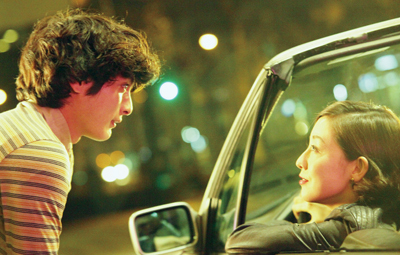

"Around the age of 19, days fly by, and you end up not knowing what you actually did during the year. That was true for me too (laughs). But during that year, people have many invaluable experiences, perhaps only understood by themselves. This film follows Yonosuke's ordinary year, so some might say, 'It's a flat film,' or 'It doesn't have much of a plot, nothing really happens.' But that's not the case; his friends get pregnant, he finds something he's passionate about – quite a lot happens. Although it's only a year after entering university, for Yonosuke himself, it's a very eventful year. I wanted to recreate that sense of time for 18 and 19-year-olds in the film."
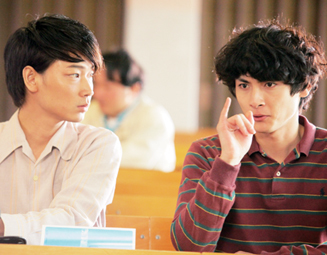
©2013 'A Story of Yonosuke' Production Committee
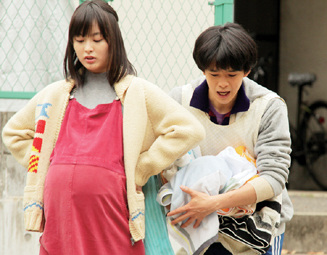
Depicting ordinary people
What happens to Yonosuke afterwards? And Yoshiko? The realistic portrayal of the characters, so convincing that you believe they exist, draws the audience in, keeping them captivated until the very end. Despite being a lengthy film of two hours and forty minutes, time seems to fly by.
"The actors were truly skilled. If a conversation between two 18-19 year olds came to mind, they would immediately improvise. How should I put it... there's a lot of idle chatter, and I wanted to recreate that natural feel in the film, so I discussed this with Kora-kun and everyone else. Therefore, I feel like we created this film with a sense of camaraderie among the younger cast. Looking back, I think it was a good approach (laughs). Yoshitaka-san, in that sense, is also a very perceptive actress. It felt like I was enjoying the interactions between Kora-kun and her just like an audience member; though as a director, I shouldn't be enjoying myself that much (laughs)."
After the deeply moving ending, the realization that everyone is the protagonist of their own life comes to mind. Yonosuke's way of living brings tears to your eyes and a smile to your face.
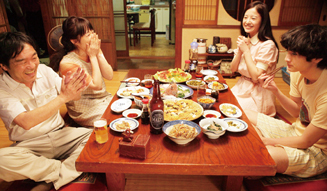
"I've always wanted to depict the lives of ordinary people in my work. People often say, 'There are many eating scenes,' or 'You like filming people eating.' But it's precisely in those scenes that a sense of daily life emerges. That might be why there are so many. I filmed with that feeling throughout this project, and I enjoy, or rather, find pleasure in, capturing everyday life on screen to depict ordinary people. I find them endearing. That will always be my stance. Even if I were to make a suspense film, I would still portray ordinary people. That will never change."
Shuichi Okita | OKITA Shuichi
Born in Saitama Prefecture in 1977. Graduated from the Department of Cinema, College of Art and Design, Nihon University. His short film 'Pot and Friend' (02) won the Grand Prix at the 7th Mito Short Film Festival. He directed his first feature film, 'The Great Happiness' (06). After writing and directing TV dramas, he made his commercial film debut with 'The Chef of South Polar' (09), for which he also wrote the screenplay. He received high acclaim as a director, winning the Newcomer Award at the 29th Fujimoto Awards and the Gold Prize at the Shindo Kaneto Awards, among others. For 'Wood Job!' (12), he received a Special Jury Prize at the Tokyo International Film Festival, and awards for Best Actor (Koji Yakusho), Best Screenplay, and Best Editing at the Dubai International Film Festival. He also won the Best New Director Award at the 4th TAMA Film Awards.
Win tickets to a special screening of 'A Story of Yonosuke'!
And here's good news for OPENERS readers: we are inviting 10 pairs of people to a special screening held at Nissho Hall on Friday, February 1st, starting at 6:30 PM. If you wish to attend, please apply via the button below.
Date | Friday, February 1st
Time | Doors open 6:00 PM, Screening starts 6:30 PM
Venue | Nissho Hall
2-9-16 Toranomon, Minato-ku, Tokyo
Application Deadline | Tuesday, January 29th, by 10:00 AM
Applications have closed.
Thank you for your many applications.
'A Story of Yonosuke'
Opening February 23rd (Saturday) at Shinjuku Piccadilly and other theaters nationwide
Starring | Kengo Kora, Yuriko Yoshitaka, Sosuke Ikematsu, Ayumi Ito, Gō Ayano, Kitarō, Kimiko Yo
Original Story | Shuichi Yoshida
Director & Screenplay | Shuichi Okita
Screenplay | Shiro Maeda
Theme Song | ASIAN KUNG-FU GENERATION "Ikimashite" (Ki/oon Music)
Distribution | Showgate
2012 / Japan / 160 min
http://yonosuke-movie.com/
©2013 'A Story of Yonosuke' Production Committee