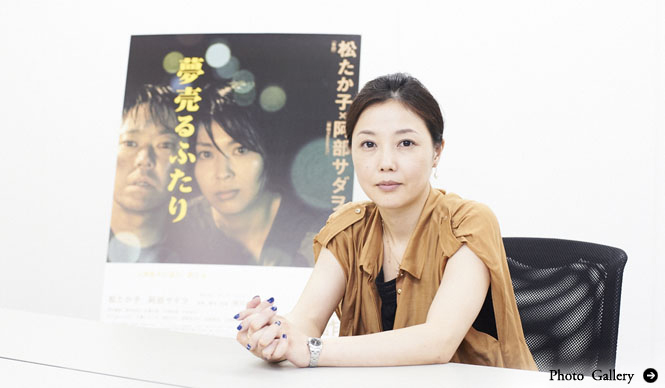
INTERVIEW | An interview with Miwa Nishikawa, director of the film 'The Tokyo Night Sky Is So Terribly Empty.'
INTERVIEW | A Shocking Love Story That Fiercely Shakes the Hearts and Sexuality of Men and Women, Finally Released!
Yume Uru Futari | Director Miwa Nishikawa Interview
Her debut film 'Snake Berries' in 2002, 'Swaying' in 2006, and 'Dear Doctor' in 2009—Miwa Nishikawa's latest film, 'Yume Uru Futari,' which has won numerous film awards, will be released nationwide on Saturday, September 8th. We sat down with Director Nishikawa, who wrote and directed the film, for an interview in commemoration of its release!
Text by KAJII Makoto (OPENERS)Photographs by HARA Emiko
I Wanted to Portray the Way Women Live, Something I'd Previously Avoided
— When was the title 'Yume Uru Futari' decided?
It was decided when the idea emerged of a couple engaging in marriage fraud, selling dreams to women, and using the money they gained as compensation to fulfill their own dreams. It was the first time the title was set from the beginning, and after that, I never wavered.
— You mentioned, 'I wanted to portray the way women live,' and the film features various women with different struggles (Takako Matsu, Rena Tanaka, Sawai Suzuki, Tae Kimura, Tamae Ando, Yuuka Ebihara, etc.). Which of these women do you feel a particular sympathy for?
When I said, 'I wanted to portray the way women live,' it was partly because that's something I had been avoiding until now, and I decided to tackle it head-on this time. Among the characters, I think I'm closest to Matsu-san in my stubbornness, but I really like Tamae Ando's role as a soapland worker.
— The film also includes an episode about a female weightlifter. Women athletes were quite prominent at the London Olympics this year.
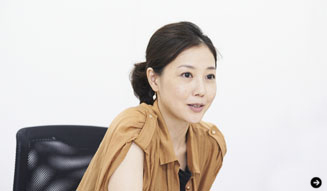
Women really gave it their all this time. We also had more female staff on set, and they were all very capable. When women decide to do something, they are decisive and pursue their goals with pure, straightforward determination. That's certainly true, but of course, the contributions of the male cast and crew were immense. I was raised and have lived my life in the male-dominated world of filmmaking, and I believe society functions through mutual recognition and support between men and women, so I don't think one is superior to the other. I've always felt a bit uncomfortable being singled out simply for being a female director.
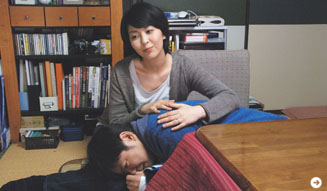
© 2012 "Yume Uru Futari" Production Committee
Beautiful on the Surface, but Get Too Close Drawn by Its Sweet Scent, and You Might Be Consumed
— What is your favorite scene in 'Yume Uru Futari'?
It has to be the scenes between Sadawo Abe and Takako Matsu. Like the argument scene at the ramen shop, or the performances across the counter at the izakaya. More than action scenes involving fire, I prefer 'sitting performances' where characters engage in psychological battles through their acting.
— Please tell us about the appeal of actress Takako Matsu.
She is truly an incredible actress. Since I also write screenplays, I have a deep attachment to every expression, every nuance. I see changes on set as a form of chemical reaction, and Matsu-san embodies all of that. Her fundamentals are so solid, and although this is a challenging role, she grasps and performs each part so perfectly that the process moves along smoothly. She's an actress capable of far more than the public image suggests, and I'm excited to see what kind of roles she'll take on in the future.
— You handled the original story, screenplay, and direction for this film. What was the most challenging aspect?
The original idea was vague about four or five years ago, and it took about a year and a half from when I started research to finalize the script. My most natural work is creating the story, and while I enjoyed the filming process for this movie, it was demanding. The best part of directing is having a familiar crew who have waited for my project, and for those approximately 50 days of shooting, I was supported by the staff as we moved forward together. This time, I felt that there were people waiting for my work, and the cast members were all friendly and easy to get along with, so it was enjoyable.
— Your original screenplays 'Snake Berries' and 'Swaying' were both based on dreams you had, and this film's title also includes the word 'dream.'
While 'dream' is often used in a positive sense, I believe it also carries a more frightening connotation. It can be beautiful on the surface, but if you're drawn in by its alluring scent, you might end up being consumed. Tokyo is like that, and there are many people who are consumed by their dreams; dreams can be a frightening thing. I wanted to depict both sides of that in this film.
— Finally, could you tell us yourself what the highlights of the film are?
Regarding 'Yume Uru Futari,' when I recommend specific highlights, my opinions often differ from those of the audience. The reception truly varies from person to person, so I would like everyone to discover their own personal highlights.
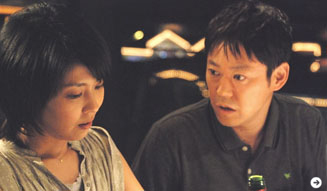
"© 2012 "Yume Uru Futari" Production Committee"
'Yume Uru Futari'
Original Story, Screenplay, Direction | Miwa Nishikawa
Starring | Takako Matsu, Sadawo Abe
Rena Tanaka, Sawai Suzuki, Tamae Ando, Yuuka Ebihara / Tae Kimura
Kyosuke Yabe, Koichi Ohori, Kana Kurashina / Yusuke Iseya / Kanji Furutachi, Katsuya Kobayashi / Teruyuki Kagawa / Tsurube Shofukutei
Production | "Yume Uru Futari" Production Committee
Planning & Production Company | Office Shirouzu
Distribution | Asmik Ace
yumeuru.asmik-ace.co.jp
Original Story, Screenplay, Direction | Miwa Nishikawa
Starring | Takako Matsu, Sadawo Abe
Rena Tanaka, Sawai Suzuki, Tamae Ando, Yuuka Ebihara / Tae Kimura
Kyosuke Yabe, Koichi Ohori, Kana Kurashina / Yusuke Iseya / Kanji Furutachi, Katsuya Kobayashi / Teruyuki Kagawa / Tsurube Shofukutei
Production | "Yume Uru Futari" Production Committee
Planning & Production Company | Office Shirouzu
Distribution | Asmik Ace
yumeuru.asmik-ace.co.jp