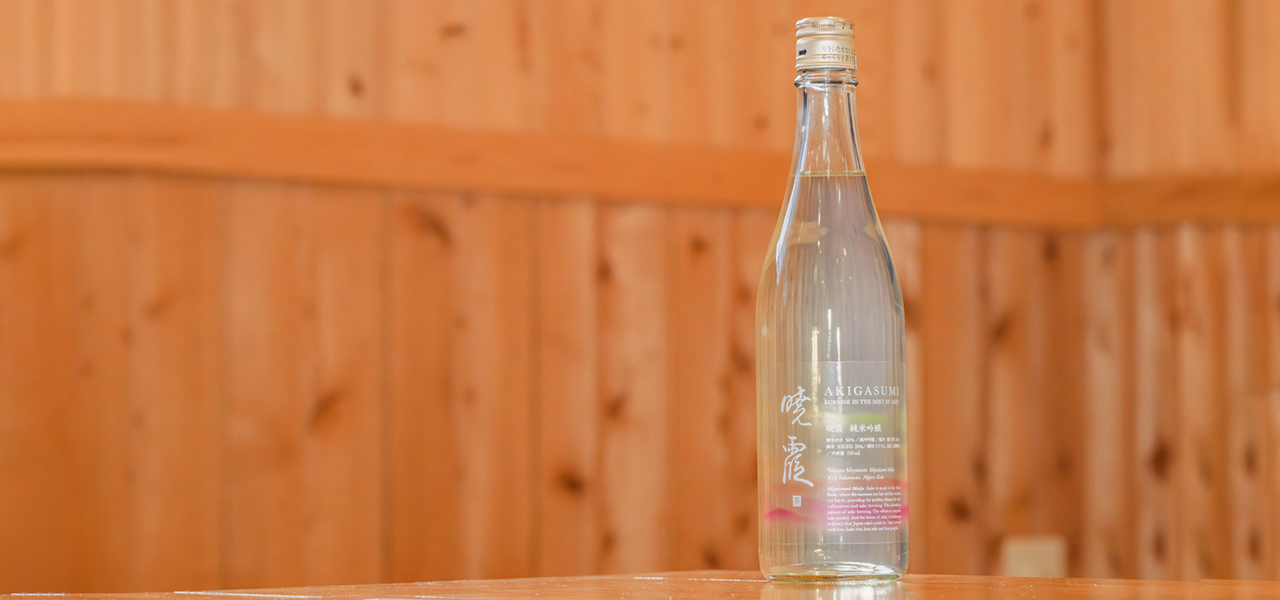
Designing sake with fragrance as the starting point—Nippon Kodo and Miyaizumi Meijo forge a new frontier in sake quality.
AKIGASUMI | NIHON KODO, MIYAZUMI MEIJO
NIHON KODO, a venerable incense maker, and MIYAZUMI MEIJO, renowned for its popular sake brand "SHARAKU." Though seemingly unrelated, these two entities have joined forces for the first time to create a sake that defies convention. Its name is "AKIGASUMI." This unprecedented approach, designing the sake's character around its aroma, and the technical challenge of fermenting three types of yeast in the same tank, may usher in a new genre of Japanese sake.
Text by TSUCHIDA Takashi
Sake Born from Aroma: A Reversed Concept
The conventional wisdom in sake brewing is to prioritize taste first. The sake's character is designed, and the aroma follows. This is the standard approach. However, "AKIGASUMI" flips this concept 180 degrees. Yamato Miyasumi, Managing Director of MIYAZUMI MEIJO, explains.
"An approach that considers brewing from the perspective of aroma is rare even within the sake industry. Furthermore, I've never heard of a brewing method for sake that primarily focuses on enhancing aroma."
This project originated from NIHON KODO's new philosophy, "Traveling with Incense," established after 450 years of history. Traveling through time and space—past, present, and future—with scent. Could this philosophy be embodied in sake? This question sparked the collaboration.
In the world of fragrance, scent layers are designed to evolve over time, from top notes to middle and base notes. What would happen if this method were applied to sake? This was the reason NIHON KODO, experts in aroma, and MIYAZUMI MEIJO, masters of sake brewing, joined forces.
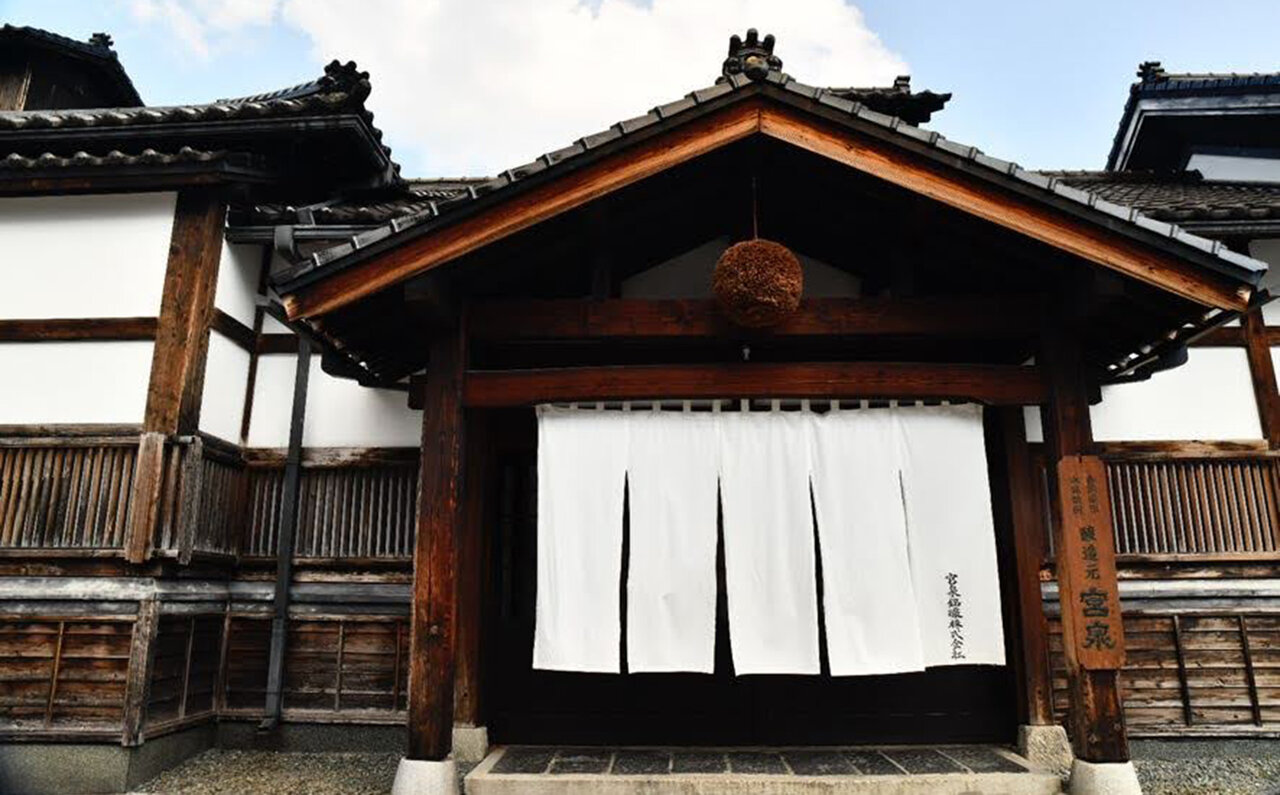
MIYAZUMI MEIJO in Aizuwakamatsu City, Fukushima Prefecture. This is the brewery that produces "SHARAKU," a name familiar to all sake enthusiasts.
An Unprecedented Technical Challenge: Fermenting Three Yeasts in a Single Tank
The most distinctive feature of this sake is its unique brewing method, using three types of yeast (1801, F7-01, and Utsukushima Kou Kobo) simultaneously in a single tank. Typically, sake brewing involves using one type of yeast and one type of rice. Even when multiple yeasts are used, the common method is "assemblage," blending sakes brewed in separate tanks.
But why a single tank? Yamato Miyasumi explains.
"It's to pursue aromatic complexity. This harmony of aromas cannot be achieved by brewing in separate tanks and blending later. There are layers of aroma that can only be obtained through the process where yeasts with different fermentation speeds influence each other within a single tank."
However, this method demands advanced techniques. Each yeast has its own reproductive and fermentation strength. If a strong yeast overwhelms a weaker one, the intended aromatic balance will be disrupted.
"We deliberately suppressed the stronger yeasts to allow the weaker ones to emerge. To achieve this, we fermented slowly at a temperature 5 to 10 degrees Celsius lower than usual. Temperature control was the most challenging part."
MIYAZUMI MEIJO's sophisticated brewing technology made this challenge possible. For each small, dedicated tank, temperature is controlled separately from other mashes. From raw material processing to creating the brewery environment, preparation, bottling, and finally reaching the consumer after shipment, every step is considered part of the brewing process, with no effort spared. This dedication allowed for this unprecedented endeavor to be realized.
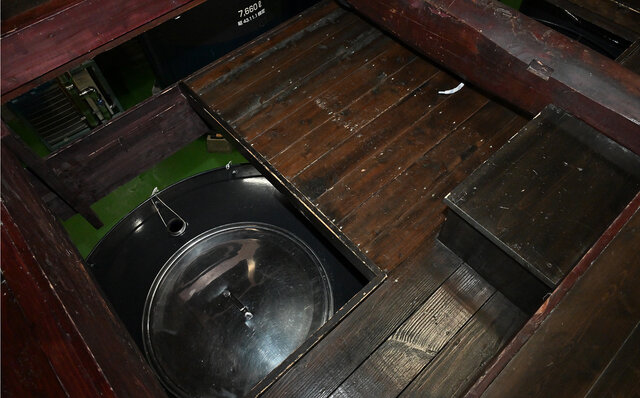
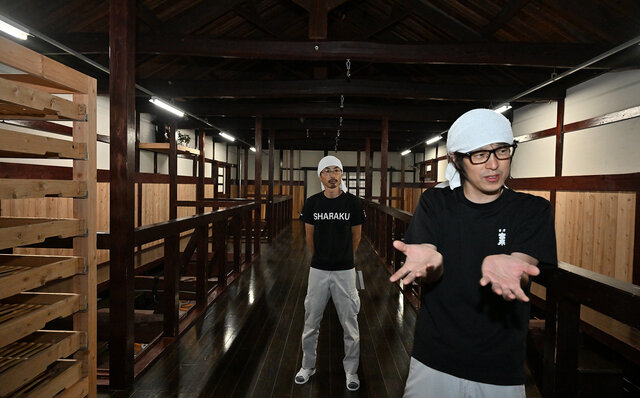
Left: The top of the brewing tank, where the three yeasts are delicately controlled. Right: Yamato Miyasumi (person on the right).
Layered Aromas and Flavors Inspired by Fragrance
For the rice, Fukushima-grown "FUKUNOKA" was used for the koji rice, imparting a soft umami, while "GOHYAKUMANGOKU," known for its crisp finish, was used for the kake rice. FUKUNOKA, registered as a new sake rice variety about six years ago, is characterized by its clear umami and gentle sweetness.
"If we used only GOHYAKUMANGOKU, the sake would be much crisper. But this time, FUKUNOKA's sweetness and umami play a role in enhancing the aroma. Even with a great aroma, if the taste isn't good, the aroma won't stand out."
The yeast selection is also meticulous. Yeast "1801" has a rapid start and produces a clear aroma derived from ethyl caproate. However, if this is too dominant, it can overpower food. Therefore, it's deliberately kept subdued to balance with the isoamyl acetate aroma produced by yeast "F7-01." Furthermore, "Utsukushima Kou Kobo" adds complexity.
Sake expert Yuji Yamauchi describes the aroma of this sake as follows:
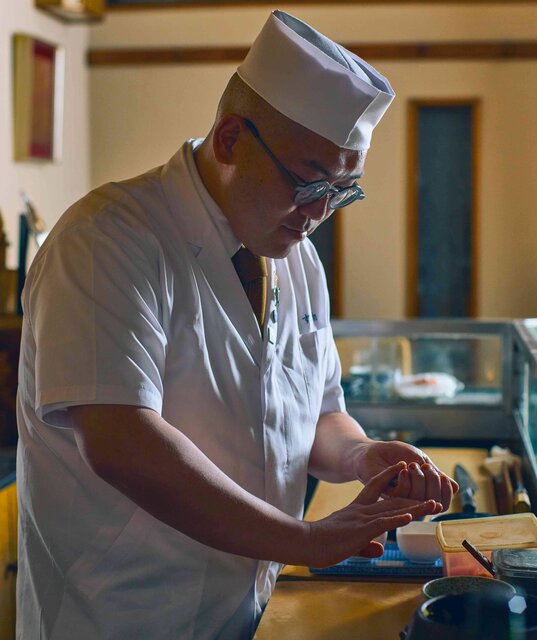
Sake expert Yuji Yamauchi.
"It's floral yet refreshing, with notes of yellow apple, pear, white peach, freshly picked pineapple, cooked rice, Joshinko rice flour, cream cheese, fresh cream, green bamboo, and a crisp alcoholic nuance."
Yamauchi also highly praises the taste.
"The initial mouthfeel has a soft sweetness. Then, a melon-like character spreads through the palate, with the acidity integrated for a gentle nuance. The finish, after a brief pause, extends with a slightly lingering caproate-like note. The rice-derived bitterness and the essence of Fukushima, the flavor of FUKUNOKA, are evident. The overall balance is excellent."
The true brilliance of this sake lies in its aroma and flavor that evolve over time. "After one day of opening, the green notes fade, and the aroma shifts to middle notes of pear, Japanese pear, and melon," says Yamauchi. Furthermore, as the temperature rises at room temperature, ester-like aromas emerge, making banana nuances more apparent than melon. This is truly an experience of "Traveling with Incense."
Brewing Backwards from Aroma: Two Years of Trial and Error
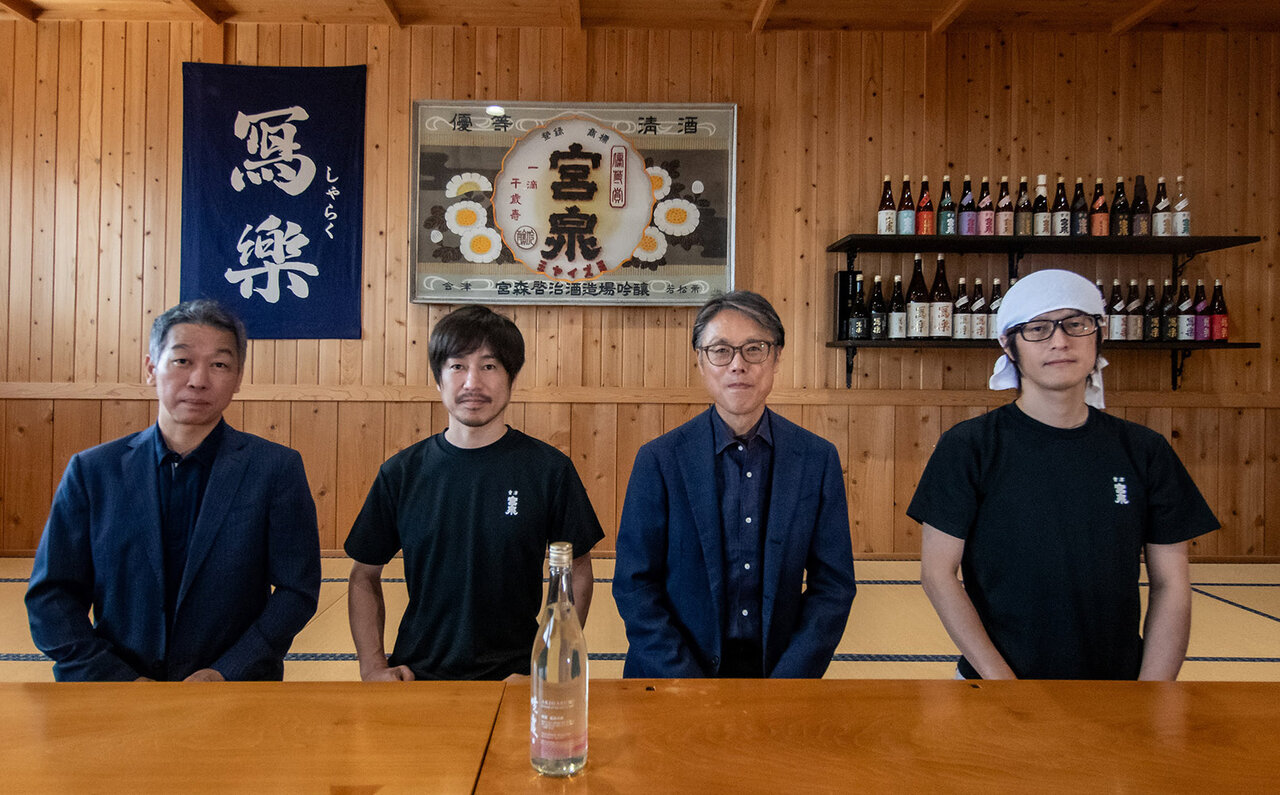
From left: Yukishi Sakamoto (GINZA RANGETSU / KIKISAKEDOKORO SAKENOANA Purchasing Department Manager / Kikisakeshi), Yoshihiro Miyasumi (President, MIYAZUMI MEIJO), Masakatsu Konaka (President, NIHON KODO HOLDINGS), Yamato Miyasumi (Managing Director, MIYAZUMI MEIJO).
The project began with tasting about 30 types of sake. The four individuals above gathered to thoroughly discuss, "What kind of aromas do you like?"
"We would smell aroma samples and work backward, thinking, 'If we like this aroma, then this yeast...'" recalls Sakamoto.
However, sake brewing is not a trial-and-error process. Samples cannot be made and tested. They repeatedly ran simulations, refining the yeast combinations, rice selection, and temperature control methods. The development period spanned one and a half to two years.
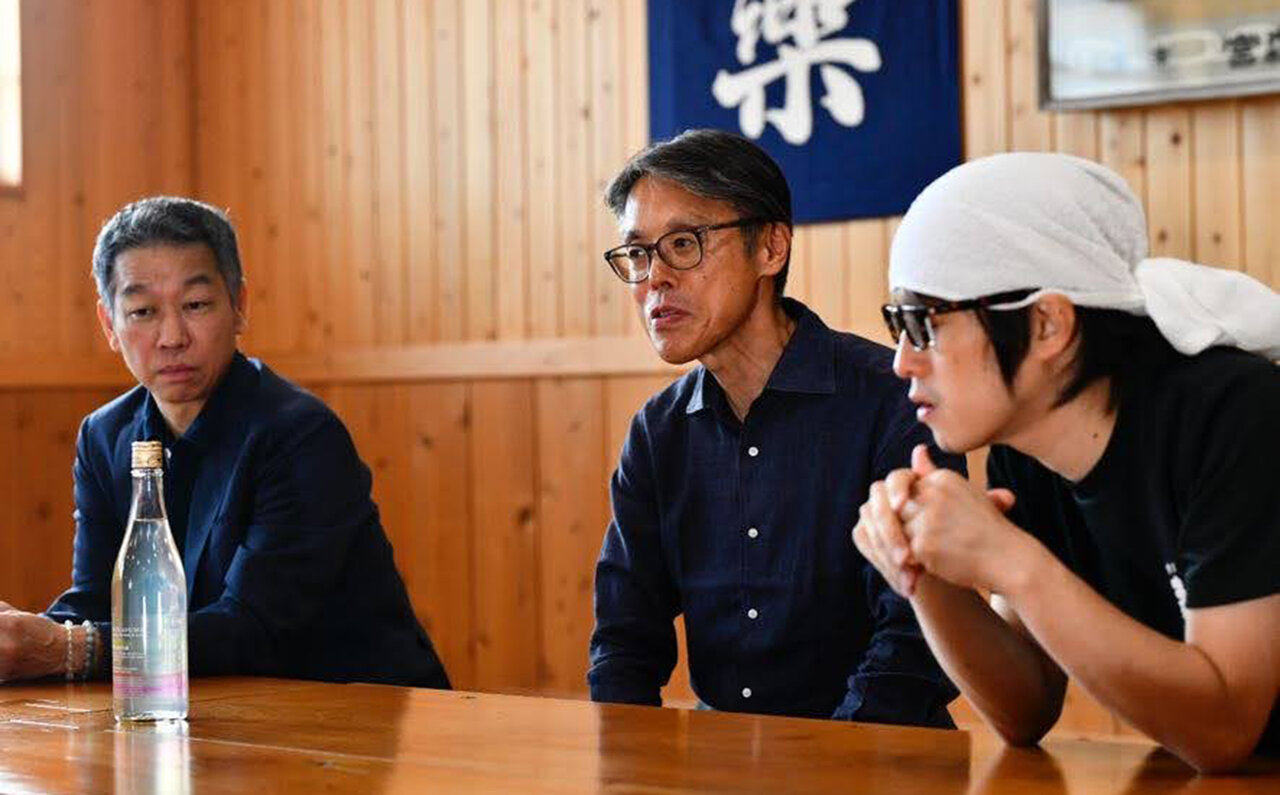
"If ethyl caproate becomes too dominant, it won't fit our design. We suppressed this aroma significantly while ensuring isoamyl acetate didn't become too prominent. The yeast 17-01, which we always use for 'SHARAKU,' produces a lot of isoamyl acetate, but it would disrupt the balance if it were too strong, so we controlled it while using it," says Yamato Miyasumi.
Miyasumi's words convey how the aroma professionals and sake brewing masters respected each other's expertise while working towards a common goal.
"We were able to achieve this because we had a clear vision of what we wanted to create," says Sakamoto. The ideal aroma envisioned by the fragrance experts and the brewing techniques to realize it. "AKIGASUMI" was born from the fusion of both their passion and skill.
Sake designed from aroma. An unprecedented technical challenge. And a new experience of "Traveling with Incense." "AKIGASUMI" opens up a new genre of Japanese sake. Why not experience the beautiful scene depicted by the fragrance experts and sake masters in a glass?
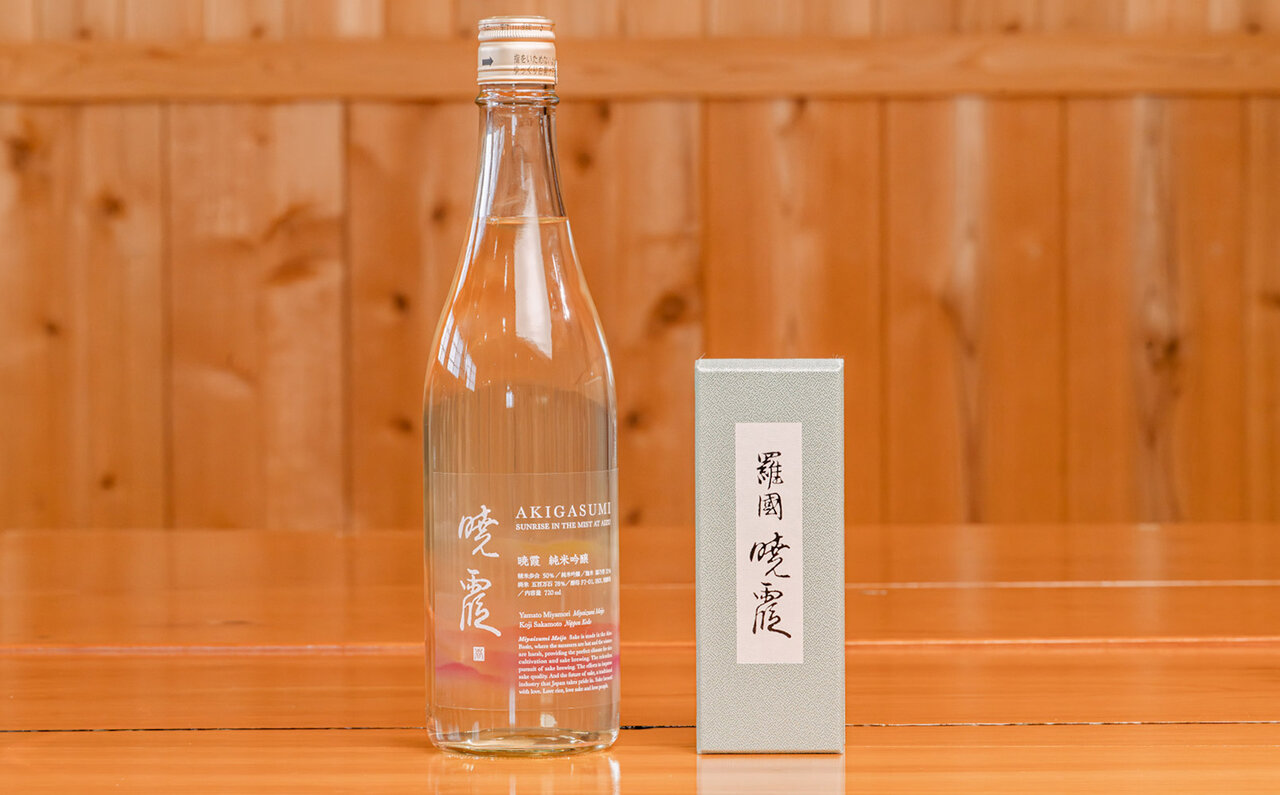
The Japanese sake "AKIGASUMI" is available in a limited edition of 300 bottles at GINZA RANGETSU's online shop (https://rangetsu.shop-pro.jp/) and in-store (GINZA RANGETSU / KIKISAKEDOKORO SAKENOANA). It can also be enjoyed at the store for 1,650 yen (tax included) per go.
Another "AKIGASUMI" Sharing the Same Worldview
In parallel with this sake, NIHON KODO has also released a premium incense, "RAKOKU AKIGASUMI." Created by perfumer Naomi Hirano, inspired by "RAKOKU," a high-quality agarwood second only to Kyara, it features a sweet aroma, refreshing citrus notes, and a clear, delicate scent.
The name "AKIGASUMI" (autumn mist) is inspired by the mist that hangs over the mountains at dawn in spring, and the scene of colorful, overlapping auspicious clouds. The dawn heading towards the future, the mist suggesting an unseen future. And the auspicious clouds where various elements overlap. This beautiful imagery is expressed in both the incense and the sake, each in its own way. A shared worldview of clarity and complexity, overlapping scents and lingering finishes, connects the two.
Sake AKIGASUMI (Once Pasteurized)
Sake Type | Junmai Ginjo
Rice | Koji Rice: FUKUNOKA, Kake Rice: GOHYAKUMANGOKU (Both from Fukushima Prefecture)
Yeast | F7-01, 1801, Kou Kobo
Alcohol Content | 16%
Volume | 720ml
Price | 6,600 yen (tax included)
Brewery | MIYAZUMI MEIJO (Aizuwakamatsu City, Fukushima Prefecture)
Sake Type | Junmai Ginjo
Rice | Koji Rice: FUKUNOKA, Kake Rice: GOHYAKUMANGOKU (Both from Fukushima Prefecture)
Yeast | F7-01, 1801, Kou Kobo
Alcohol Content | 16%
Volume | 720ml
Price | 6,600 yen (tax included)
Brewery | MIYAZUMI MEIJO (Aizuwakamatsu City, Fukushima Prefecture)
Premium Incense RAKOKU AKIGASUMI
Contents | Approx. 30g
Burning Time | Approx. 30 minutes
Length | Approx. 135mm
Price | 20,900 yen (tax included)
Sales | NIHON KODO's online shop (https://www.nipponkodo.co.jp/).
Contents | Approx. 30g
Burning Time | Approx. 30 minutes
Length | Approx. 135mm
Price | 20,900 yen (tax included)
Sales | NIHON KODO's online shop (https://www.nipponkodo.co.jp/).
Inquiries
GINZA RANGETSU
Tel. 03-3567-1021
www.ginza-rangetsu.com