Understanding the Current State of Plastics Today: Part 3 – "The Tide of Our Times Turns to Biomass Plastics"
Among the environmentally friendly bioplastics currently drawing attention, "biomass plastics" appear to have many noteworthy aspects. We once again spoke with Takuya Kobayashi of ITOCHU Corporation to learn more about biomass plastics, which could be called the star students of the plastics world, including issues related to recycling and infrastructure.
When starting something new, like snowboarding, some people "start with the gear." Buying a board, wear, and accessories can be quite expensive. Of course, it's important to get all the new equipment to build excitement and say, "Here I go!" However, if you could start by borrowing from a friend without a significant financial burden, it might be easier to begin. Biomass plastics are also still in their early stages. We'd like to delve into that topic.
EQUALLY BEAUTIFUL (hereinafter "EB")Last time, we discussed plastics in general and bioplastics. I felt that among bioplastics, biomass plastics are particularly excellent.
What can be done to promote the widespread adoption of biomass plastics?
Takuya Kobayashi (hereinafter "Kobayashi")I hope to bring it down to a more relatable level, rather than a flashy, glamorous world of coolness and style. I want people to feel that a distant concept is something close to them.
EBAs you mentioned in the first interview, food packaging and shampoo bottles are good examples. Looking at our daily waste, everyone must realize the sheer volume of plastic trash. I believe that once we accept the reality of so much plastic waste, the crucial part is what we do next. With that in mind, I would like you to explain the advantages of biomass plastics in your own words.
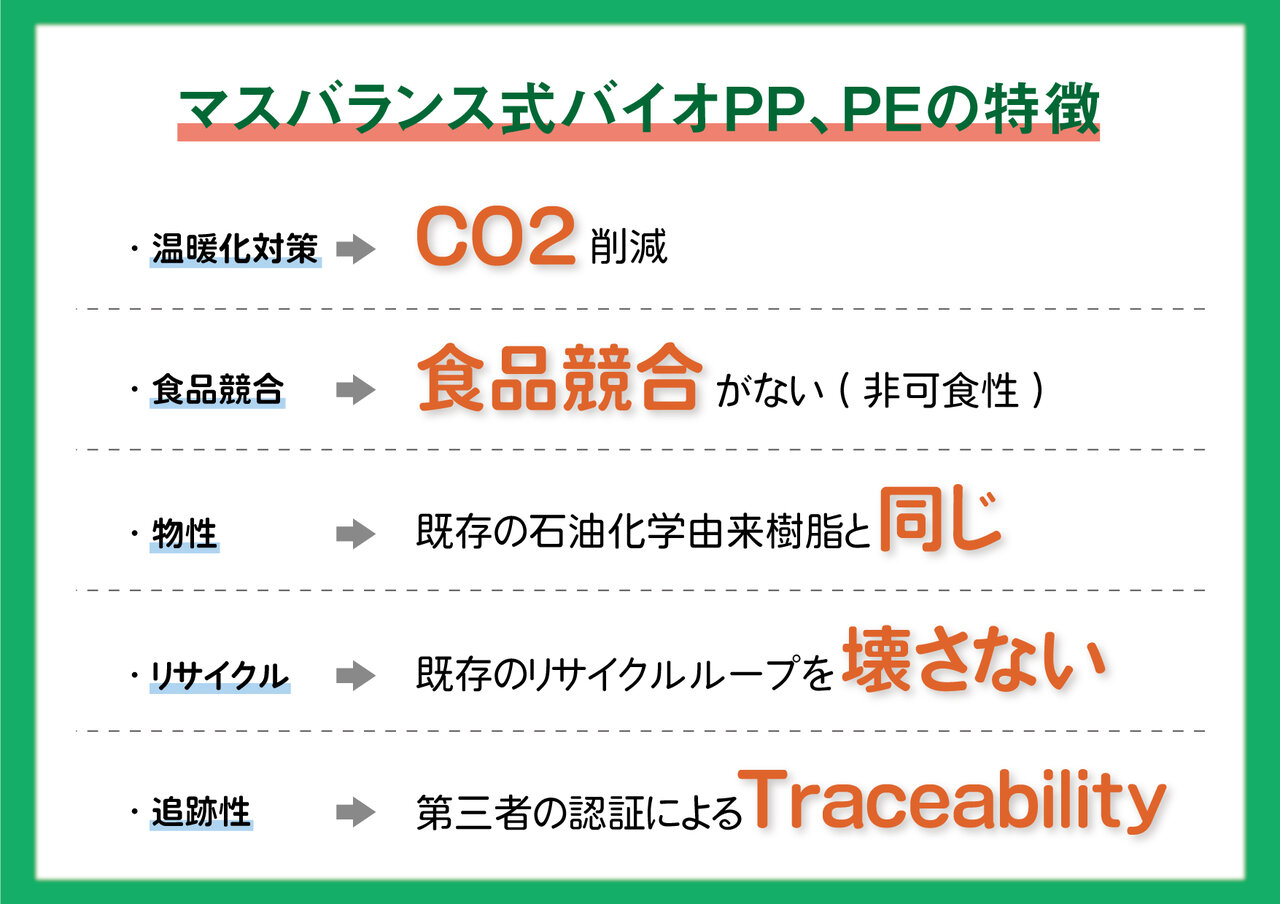
KobayashiFirst, there are five main advantages to biomass plastics. The first is the potential for CO2 reduction, which contributes to climate change mitigation. Unlike petrochemical feedstocks, the plant-derived raw materials for biomass plastics, such as tall oil, absorb CO2 as trees grow. Waste cooking oil, also plant-derived, is thought to contribute to CO2 reduction. Second, some types are "non-edible." Even with plant-derived materials, using edible crops as raw materials would mean a reduction in food supply, creating a food competition issue. Therefore, non-edible materials avoid this competition. Third is material properties. While this may get a bit technical, biomass plastics are indistinguishable in appearance and quality from plastics derived from petrochemicals. This means they can be environmentally conscious without compromising their value as plastics. Fourth, they do not disrupt existing recycling loops. Again, this is technical, but some biodegradable plastics, for example, can negatively impact the quality of recycled resin if mixed into existing recycling facilities, leading to bans in some areas, such as in Europe. Since biomass plastics have the same quality as conventional petrochemical plastics, differing only in their origin, they can be recycled together. Fifth is traceability. This is a complex concept, but I will explain. The input volume of raw materials and the output volume of products made from those materials must be strictly managed. Therefore, all supply chains, from raw materials to packaging processing, are audited by third-party certification bodies. Users can then confidently choose "certified biomass products."
EBRegarding the second point, non-edibility, there have been sugarcane-derived bioplastics recently, but these are edible and create food competition. I understand that new materials like waste cooking oil and tall oil are emerging to solve these challenges. For the fifth point, traceability, this means that the entire process, from raw material to molding, product creation, purchase by brand owners, and placement on retail shelves, can be audited. This ensures that we receive highly reliable products certified as "biomass plastic" by a third-party organization.
KobayashiThat's correct. For this to work, another element is necessary: the concept of the mass balance approach. We believe this will enable the social implementation of biomass plastics.
EBSpeaking of which, I also heard that biomass plastics can be produced in the same factories as conventional plastics.
KobayashiI believe this is an important environmental advantage, not just in terms of raw materials but also infrastructure. Biomass plastics can be produced in existing petrochemical factories without the need for new construction. This ultimately reduces the environmental burden. Consequently, the initial investment for building new factories is also reduced. This impacts product pricing and is a very promising system for the environment. It might seem surprising, but building new, small factories for new materials can ultimately be detrimental to the environment. Consider the various materials needed for construction, transportation, and the energy involved in the building process. Furthermore, even with small, dedicated plants, energy efficiency is often inferior to existing large-scale facilities.
EBI was surprised to learn that biomass plastics can be made in the same factories as petrochemical plastics. Does this mean no special lines, technologies, or materials are required?
KobayashiYes, apart from the raw materials, they can be produced on almost the same lines.
EBThat's quite unexpected. I was preparing to ask about the difficulties or challenges faced on-site due to the different raw materials, but you're saying there are none?
KobayashiThat is correct.
EBThat's a revelation! Next time, I'd like to ask about the "mass balance approach," which is said to be necessary for promoting biomass plastics in Japan.