Feature: A Journey on the Orient Express from London to Venice, Vol. 2
Feature: A Journey from London to Venice Aboard the Orient Express, Vol. 2
A Luxurious Train That Continues to Run With Over 100 Years of History
An Invitation to the "Queen of Trains," the Orient Express
A journey of approximately 1,750 kilometers, a 30-hour, one-night, two-day rail trip from London, England, to the water city of Venice, Italy. Aboard is the legendary luxury sleeper train, the "Orient Express." This premier train, considered a "palace on wheels" and a "queen of trains," which served as a model for the "Twilight Express" that retired this past March and the much-talked-about "Seven Stars" of recent times, offers a captivating experience. We delve into its allure.
Text by AKIZUKI Shinichiro (OPENERS)Photographs by Hiro Matsui
The Enduring Brilliance of the Orient Express: A Century of Heritage
In London, England, the starting point of this journey, I spent a night at "45 Park Lane," one of the most talked-about contemporary hotels.45 Park LaneI couldn't sleep well until the early morning, my excitement about the upcoming Orient Express journey was simply too much to contain.
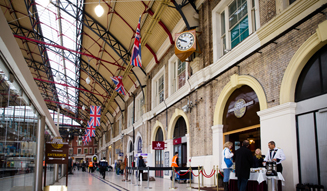
It had been about a year since I last visited Victoria Station, the departure point. The mornings of weekdays in any city are bustling with people. Amidst this, one place exuded a sense of tranquility. Platform 2 on the east side – this was a specially prepared platform for guests of the Orient Express.
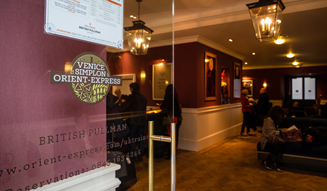
A private lounge was set up here, where check-in also took place. Receiving the program detailing the itinerary, one's heart could not help but race. The rail journey aboard the Orient Express was finally about to begin.
The "Orient Express," a luxurious long-distance night train, began its service in 1883 by the International Sleeping Car Company, commonly known as "Wagon-Lits." It's no exaggeration to say that Agatha Christie's masterpiece, "Murder on the Orient Express," made its name known worldwide. It whisked many passengers away on adventures, from Western Europe to the gateway of Asia, the Balkans. However, as the 20th century progressed and the geopolitical climate intensified, the carriages gradually began to lose their luster.
The current style of operation was revived in 1982. Belmond, the company that operates the modern-day Orient Express, the "Venice Simplon-Orient-Express (VSOE)," meticulously restored carriages that had been scattered across various locations, acquiring them from museums, auctions, and private owners. They meticulously recreated the vehicles to their original state and relaunched them approximately 100 years after their initial service.
The route for this journey was as follows: After departing London, the train proceeds to Folkestone, the gateway to the Channel Tunnel connecting the UK and mainland Europe. From there, it crosses the English Channel and enters Calais, France. It then travels via Paris to Venice, Italy.
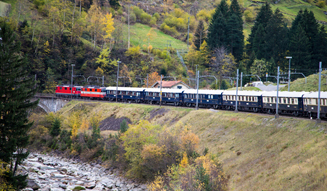
However, the route I traveled this time was a one-night, two-day journey via Brussels, bypassing Paris. I had imagined all trains passed through Paris, but the "Venice Simplon-Orient-Express" offers various routes, including not only Paris-Istanbul but also routes encompassing Vienna and Budapest, with diverse itineraries available.
Incidentally, the route in "Murder on the Orient Express," which is based on this train, is from Istanbul, Turkey, to Calais, France. Whether you reminisce about the original novel or choose based on your destination, selecting the route is part of the enjoyment of the train journey. In fact, many fortunate repeat travelers enjoy the "Venice Simplon-Orient-Express" by exploring its various routes.
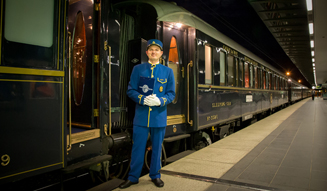
As we chatted, the train glided into the platform. With my ticket in hand, I was greeted by the smiling face of a classically attired cabin steward, and we set off for Folkestone, a port town facing the English Channel.
Feature: A Journey from London to Venice Aboard the Orient Express, Vol. 2
A Luxurious Train That Continues to Run With Over 100 Years of History
An Invitation to the "Queen of Trains," the Orient Express (2)
A Prestigious British Train Beloved Across Generations
At 10:45 AM, precisely on schedule, the train slowly departed the platform. The train from London to Folkestone is, in essence, the Orient Express, but the British section is called the "British Pullman." We boarded a luxurious dining car with a distinctive brown and yellow livery.
These carriages, still in use today, are meticulously restored original cars from the 1920s and 1930s, once used to transport passengers of large ocean liners.
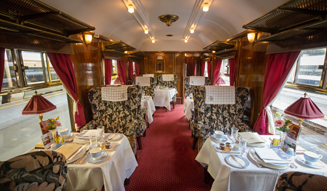
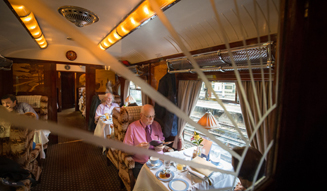
Each carriage has been completely restored to its original state, exuding extreme elegance. The interiors are particularly beautiful, featuring marquetry, Art Deco parquetry, and mahogany armchairs upholstered in tapestry. The interior is truly a "palace on wheels," adorned with breathtaking craftsmanship.
Each carriage seats 20 to 26 passengers, with a total of 11 carriages. Each carriage has a name and its own story, with unique interiors. For example, the Audrey car, manufactured in 1932, was a favorite of Queen Elizabeth II. The Perseus car was designated as a royal train and was used for the funeral train of former British Prime Minister Winston Churchill in 1965. For the British Royal Family and many VIPs, the Belmond British Pullman is a prestigious British icon, beloved across generations.
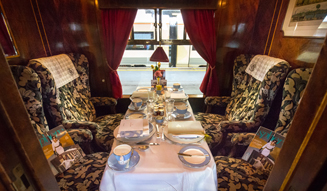
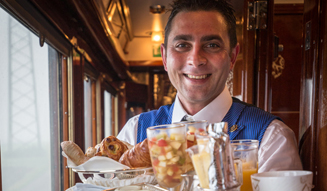
The journey from London's Victoria Station to Folkestone takes approximately three hours. Shortly after departure, the stewards greet each table and pour signature drinks. The brunch course consists of three dishes. The main course features scrambled eggs and smoked salmon, offering a delightful and romantic interlude while gazing at the British countryside.
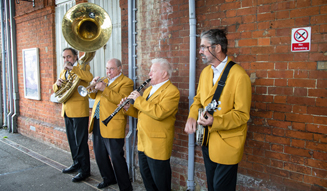
Just after noon, we arrived at our first destination, Folkestone. A marching band greeted us on the platform. Accompanied by cheerful and lively music, we transferred from the train to a bus, crossed the Channel Tunnel, and headed to our next destination, Bruges, Belgium.
Feature: A Journey from London to Venice Aboard the Orient Express, Vol. 2
A Luxurious Train That Continues to Run With Over 100 Years of History
An Invitation to the "Queen of Trains," the Orient Express (3)
The Pleasures of the Night Extend Beyond Dinner
By the time we arrived at Bruges station, the sun had set, and darkness had fallen. Ascending to the platform, a magnificent sleeping car awaited, with its deep blue body, gold lettering and trim, and pristine white roof. Unmistakably the Orient Express, its style captivated not only me, the traveler, but also the local people who happened to be on the platform. At this moment, the Orient Express made it feel as if we had slipped through time.
Boarding the carriage, which was elevated slightly above the platform, via a ramp, the experience became even more special. The interior, lavishly adorned with teak and mahogany, gleamed beautifully under the night lights, and the substantial, thick body provided a sense of security to the passengers. It evoked a similar feeling to riding in a Rolls-Royce or Bentley, offering a unique European hospitality.
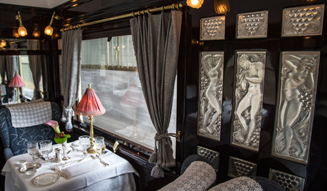
All cabins were of the compartment type, with spacious interiors featuring large sofas and full-width windows creating a comfortable ambiance. A washbasin was also provided, along with ample amenities including skincare items and towels. Of course, there were also standard electrical outlets, so despite the classical nature of the carriage, there were no inconveniences whatsoever.
After enjoying a welcome champagne and taking a moment to relax, dinner time arrived. This is one of the highlights of the Orient Express journey. Gentlemen donned dark suits, and ladies wore cocktail dresses, as we proceeded to the dining car.
This first-class dining car, named "Cote d’Azur," was manufactured in 1929, with its interior designed by the renowned René Lalique. It masterfully utilized natural light from the windows and interior lamps, day and night, to create an illusion of infinite space.
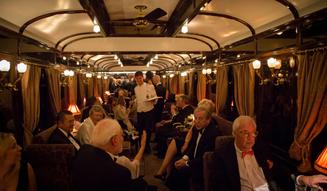
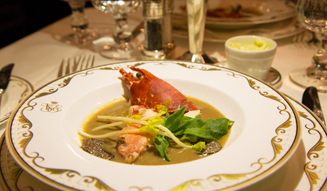
The menu featured a French course, including lobster generously topped with black truffle slices, followed by roasted venison fillet, a cheese selection, and finally, dessert. The feast, enjoyed while admiring Lalique's artwork, passed by in a flash.
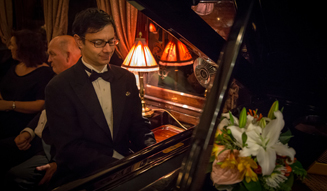
But the enjoyment didn't end with dinner. The nights on the Orient Express are long. After the meal, we moved to the bar car to savor the lingering atmosphere. It was bustling with travelers from around the world, creating a European salon-like ambiance, where a pianist played beautiful melodies, making one forget they were currently on a train journey.
At the counter bar, unique original cocktails, available only here, were served. Given the train's connection to Agatha Christie, the "Guilty 12" is a signature drink of this bar car.
Feature: A Journey from London to Venice Aboard the Orient Express, Vol. 2
A Luxurious Train That Continues to Run With Over 100 Years of History
An Invitation to the "Queen of Trains," the Orient Express (4)
Magnificent Alpine Scenery Spreads Across the Windows
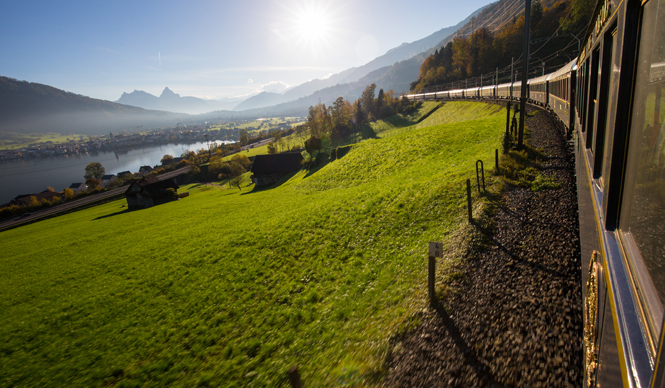
As night passed and the next morning arrived, the surroundings transformed. As the train departed from Basel, Switzerland, the Alps unfolded before us. The Orient Express gradually ascended the slopes. Parting the morning mist, the European countryside viewed from the train window was a privilege granted only to those traveling by rail.
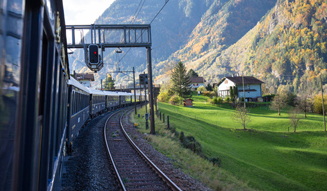
The Orient Express passed through numerous long tunnels and crossed the Alps, gradually approaching urban areas. The name "Venice Simplon-Orient-Express" is said to be derived from its route through the Simplon Tunnel, which was once the world's longest and traverses the Alps.
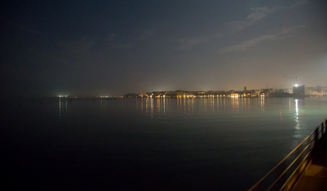
After crossing the mountains, the skies cleared dramatically. The brilliant southern European sun shone intensely into the cabin. We were now close to our final destination, Santa Lucia Station in Venice, Italy.
Since its inaugural run from Paris to Istanbul in 1883, the Orient Express has established itself as a world-renowned luxury train. The approximately 30-hour journey was filled with experiences far beyond expectations. This train, a fusion of art, cuisine, and a spirit of adventure, is like a comprehensive work of art, condensing the traditions and culture of Europe. It offers the finest hospitality.
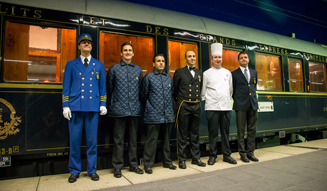
Just as it has carried royalty, aristocrats, and countless travelers throughout its history, the Orient Express will undoubtedly continue to be cherished by many. Its romance will never end.
Belmond Japan
Tel. 03-3254-1200
Venice Simplon-Orient-Express
Tel. 03-3265-1200
reservations.japan@belmond.com
http://www.belmond.com/ja/venice-simplon-orient-express/