Feature: Is Your Roaster Fired Up? | Chapter 1: Asking the Roaster, How to Interact with Your Roaster
Feature: Is the Roaster Burning?
The Era of Choosing Coffee by Roast
Chapter 1: Asking the Roaster About Their Relationship with Their Roaster (1)
First, we visited "TORIBA COFFEE ~Boutique Coffee Roaster~" (hereinafter referred to as "TORIBA COFFEE"), a specialty bean store where they use three roasters—20kg, 5kg, and 1kg—to roast coffee beans from around the world, and also offer tastings in-store. We asked about the basics of roasters and how to work with them.
Interview & Text by FUJII AkiPhotographs by JAMANDFIXEdited by TANAKA Junko (OPENERS)
The Roaster: Achieving the Best Roast for Each Bean Type
We spoke with Mr. Namekawa, a roaster at "TORIBA COFFEE," a specialty coffee bean store that opened in Ginza last year. He worked part-time as a barista during university, but after graduating, he was captivated by cutting-edge coffee culture while studying abroad in Australia, where he also worked as a barista. Upon returning to Japan, he was discovered by the president of "TORIBA COFFEE" and began working in roasting.
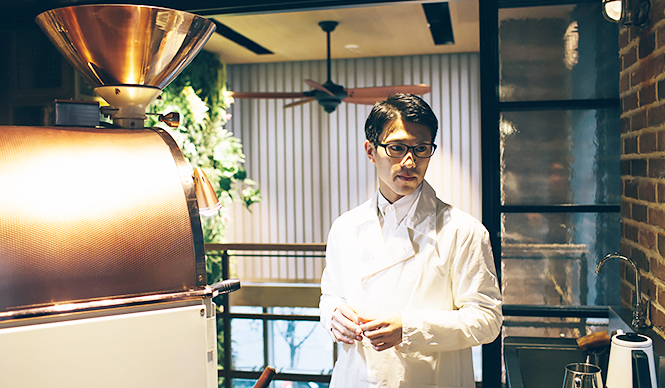
"As a barista, I deeply respected roasters, so naturally, I developed an attitude of wanting to learn." Mr. Namekawa, who looks distinguished in his lab coat, like a coffee doctor, seems ready to answer any question.


Mr. Yuta Namekawa, the roaster at "TORIBA COFFEE," who guided us into the world of roasting.
To avoid any disrespect to our "coffee doctor," let's review the basic roasting process.
The greenish raw beans, after harvesting and processing, are heated to about 200 degrees Celsius in the roaster. This heat removes moisture, turning the beans yellow, and then the surface chars. When you hear a crackling sound inside the roaster, it's a sign that the beans are cooked through (the first crack). The beans, which have expanded to 1.5 times their size like popcorn, undergo chemical changes due to the heat, bringing out the unique taste and aroma of coffee.
The early stage of this first crack is called light roast, the end of the first crack is medium roast, and continuing the roasting process results in dark roast. The degree of roast can be divided into eight stages: ① Light Roast → ② Cinnamon Roast → ③ Medium Roast → ④ High Roast → ⑤ City Roast → ⑥ Full City Roast → ⑦ French Roast → ⑧ Italian Roast. Many people probably recognize that light roasts tend to be more acidic, while dark roasts are more bitter.

Once roasted, the beans continue to roast due to residual heat, so they are immediately transferred to a cooling bin and agitated to cool down.
"It's an important job for a roaster to achieve the best roast for each type of bean. For example, the deeper the roast, the more the Maillard reaction (browning reaction) occurs, bringing out the sweetness and aroma that we associate with coffee, but this can obscure the bean's inherent flavor (individuality). Therefore, if you want to emphasize the acidity and aroma to define the coffee's character, you choose a light roast."
You can enjoy the fruity sweetness and tartness of the bean itself by roasting it lightly, or savor the balance of caramel-like sweetness and bitterness by roasting it deeply. It sounds like a lot of fun to discover your favorite cup by asking the roaster about the best roasting method for each bean.
The World of Coffee Roasting is Made of Chemistry
During roasting, Mr. Namekawa listens intently to the sounds of the roaster, watches the gauges of the measuring instruments, and occasionally scoops up beans from the roaster with a test spoon to check their color and aroma—always with a serious expression. We asked him what he pays particular attention to as a roaster.
"I carefully control the temperature when I start roasting the cold green beans, and the timing for the beans to lose moisture and turn yellow (crack) differs depending on the type of bean, so I meticulously check for that moment."
Roasters meticulously track data such as air pressure, humidity, and temperature, as heat changes the chemical composition, triggering the Maillard reaction (browning) and bringing out the flavor and aroma. The world of coffee roasting is truly chemistry. That's why it's worth delving into and exploring, and it won't end as a fleeting trend.

He scoops beans from the roaster with a test spoon. The color changes instantly at the first crack.

Beans with high moisture content, such as the Kona coffee handled at "TORIBA COFFEE," absorb heat easily, so even slight temperature changes are carefully monitored.

Measuring the airflow inside the roaster. By understanding how much air is coming in and going out, one can also check the pressure.
"Since our store's lineup is primarily blends, it's also important to have an image of the desired taste for the blend. There are two methods of blending: 'after-mix,' where single origins are roasted separately and then mixed, and 'pre-mix,' where beans are mixed before roasting. Our store uses 'pre-mix.' The advantage is that it allows us to skillfully harmonize the best characteristics of each bean in the blend, creating a sense of unity. Blending is also an expression of the creator, so it's fascinating to repeatedly experiment to find the best combination and roast level."
Additionally, there are said to be three main types of roasters: "hot air roasting," "direct flame roasting," and "semi-hot air roasting." The three "Fujir Royal" roasters from Japan used at "TORIBA COFFEE" are direct flame type for the largest 20kg and smallest 1kg models, and hot air type for the 5kg model.
"For the 5kg roaster, the optimal batch size is slightly more than half (around 3 to 3.5kg). Theoretically, it's said that the roasting outcome doesn't differ based on roaster size, but direct flame roasters, compared to hot air roasters, have a greater impact from the Maillard reaction due to surface charring, leading to more caramelization, which results in slight differences in sweetness and aroma."
Even when operating the 20kg roaster, Mr. Namekawa roasts 10 to 15 times a day, including orders for shipping. This means the beans rotate well. In fact, the coffee beans ready for drinking are typically sold out within about a week.
Feature: Is the Roaster Burning?
The Era of Choosing Coffee by Roast
Chapter 1: Asking the Roaster About Their Relationship with Their Roaster (2)
Best Enjoyed 3-5 Days After Roasting, Not Immediately After
Finally, we asked about the "best time to drink" roasted beans, a crucial piece of conventional wisdom. Just as many people believe "freshly ground is best," perhaps many also think "freshly roasted is best." Mr. Namekawa kindly explained.
"It seems surprisingly unknown that coffee is better about 5 days after roasting than immediately after. At 'TORIBA COFFEE,' we aim to have beans at their peak drinkability on display. You can drink them right after purchasing, and they should remain at their best for about two weeks, so we recommend enjoying the changes in flavor day by day—the first day, the third day, the seventh day..."
We were given the special opportunity to compare a "freshly roasted" batch with one that had been roasted 5 days prior, using the same drip brewing method.
Indeed, while the aroma of the freshly roasted beans was more fragrant, the liquid had a slightly rough, astringent quality that made it difficult to drink. Conversely, the coffee that had reached its peak drinkability 5 days after roasting, with excess gases released, was smooth and very easy to drink, as if all impurities had been stripped away. The clarity of the flavor made the sweetness and aroma even more pronounced.

So, how can we best enjoy beans that are more than two weeks past their roast date?
"As days pass after roasting, the beans will not expand as much when hot water is poured over them. Depending on the type of bean, you can adjust by increasing the amount of coffee grounds and shortening the blooming time by about 5 seconds. For a standard dripper, if you pour the water quickly under these conditions, you should be able to extract the desirable elements simply by increasing the weight."
Anyone Interested in Roasting, From Enthusiasts to Beginners, Is Welcome
Mr. Namekawa from "TORIBA COFFEE," who guided us into the world of roasting, is stationed on the second floor where the three roasters are in operation. "I provide detailed training to the staff on the first floor about the flavor profiles, so we share tasting notes. This allows us to advise, 'For this type of customer, please recommend this flavor.' You can also observe the roasting process on the second floor, so please come and visit."
Most roasters started using roasting machines out of a passion for "even more delicious coffee," so they are happy to discuss coffee if you ask them. They warmly welcome not only coffee lovers but also beginners who are just starting to become interested in coffee.
Let's go find a roaster you can consult about beans, just like finding a trusted doctor.


A small elevator dedicated to transporting beans. It carries freshly roasted beans from the second floor to the shop on the first floor.
Roaster
Yuta Namekawa
After graduating from university in 2011, he studied abroad in Australia as an English teacher, where he was inspired by Australian coffee culture. In 2012, he joined Bird Feather Knob. He obtained Q Grader and SCAA Cupping Judge licenses related to roasting. The following year, he began working full-time as a roaster for the same company. In 2014, he was appointed as the exclusive roaster for "TORIBA COFFEE" upon its opening.
Store with Roasting Machines
TORIBA COFFEE ~Boutique Coffee Roaster~
Business Hours: Weekdays 11:00 AM - 9:00 PM, Saturdays, Sundays, and Holidays 11:00 AM - 7:00 PM
Regular Holidays: Irregular
Address: Brown Place 1F, 7-8-13 Ginza, Chuo-ku, Tokyo
Tel. 03-6274-6611
http://www.toriba-coffee.com
Editor's Notes
Number of coffee beans always in stock: 6 types
Price range for coffee beans: ¥700 - ¥5000 (depending on weight)
In-store tasting available (¥100 per cup)