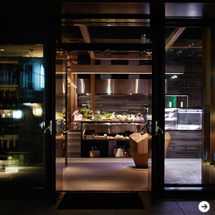
Feature | How to Create a "Pirouette" | Chapter 3 Experience "Pirouette" Early.
Feature | How to Make "Pirouette"
Crafting Tokyo's Future Through Food
Chapter 3 | For the Discerning Gourmands: An Early Taste of "Pirouette"
Towards a new future for food, the "pivot" has begun to turn in earnest. We've introduced the intentions behind "Pirouette" and its proposals over two installments. On September 3rd (Wednesday), this multifaceted culinary space, encompassing a bistro, cafe, and épicerie, finally opened its doors. In this final chapter, Chapter 3, we present the vision of "Pirouette" as perceived by adults with sharp senses and boundless curiosity.
Text by MONZEN NaokoPhotographs by CONTRAIL
—What Paris has, that Japan currently lacks.
Read "How to Make "Pirouette" (Chapter 1) First"
—From producer to kitchen, from kitchen to table.
Read "How to Make "Pirouette" (Chapter 2) First"
An Open Space Where Quality and Casualness Coexist
The members who visited "Pirouette" just before its opening were Shun Kawakami, an art director, graphic designer, and artist; Megumi Komatsu, a food writer; and Norio Osumi, OPENERS' Creative Director. All are adults who love to enjoy food – true gourmands. What was their experience of "Pirouette," surrounded by the latest information and accustomed to quality, knowing what is "authentic"...?
The use of space at "Pirouette" is truly luxurious and unique. At the center of the spacious area is an open, almost fully open kitchen. The kitchen divides the space into cafe and bistro areas, with seats generously spaced relative to the overall area. The large space is defined by exposed high ceilings, industrial-style steel frames, and copper accents. The bistro walls feature marble in parts, while the cafe walls are glass, allowing natural light to pour in. Comfortable chairs designed for long stays, and original tables made of stacked wooden planks, complete the setting.
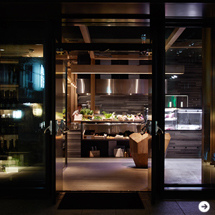
The entrance to the épicerie
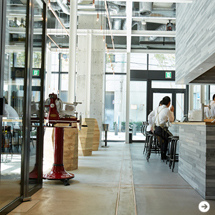
The cafe space adjacent to the épicerie
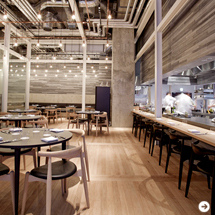
The space opposite the cafe is the bistro
While inspired by French culinary culture and advised by an M.O.F. (Meilleur Ouvrier de France) chef, "Pirouette" does not present a typical Parisian bistro ambiance. Instead, it is the culmination of careful consideration to offer high-quality food in a relaxed manner, suited for this time and place. "It's a wonderful space," Kawakami remarked immediately. "Everything from the textures and furniture to the cutlery shows meticulous attention to detail. The kitchen facilities are also excellent. It's a place that truly reflects the 'now,' offering authenticity in an unpretentious atmosphere."
"The high ceilings and the way light streams in, like a terrace," said Komatsu. "It offers a sense of openness and relaxation, a stark contrast to the conventional image of Toranomon." Osumi added, "The combination of stone, wood, and metal, along with the steel frames and beams arranged like a lattice and the copper accents on the floor, creates an industrial-evoking space that hints at experimentation and challenge. It's not just modern; it's a design that resonates with the soul."
Despite its modern appearance, the kitchen at the center is incredibly exciting and vibrant. This is because the menu changes constantly based on the ingredients that arrive that day. Ingredients are living things, and the menu adapts boldly according to their condition. The kitchen is more than just a place for cooking; it's where new dishes are born every day.
The menu the three sampled today was the bistro's lunch course (¥3,000, excluding tax), consisting of soup, salad, main course, and a post-meal beverage.
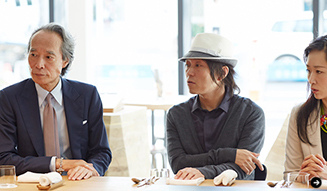
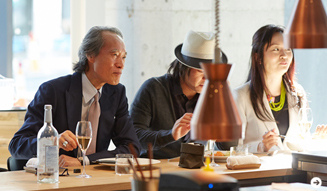
The three who experienced "Pirouette" today. From left: Norio Osumi, Shun Kawakami, and Megumi Komatsu.
Dishes Timed to Perfection, Highlighting Aroma
The first dish was "Corn Velouté with Nutmeg." Chef Naoya Kobayashi, who oversees the kitchen, explained, "We immediately vacuum-seal the corn upon arrival to preserve its aroma and moisture. Aroma dissipates quickly, so speed and timing are crucial. Since aroma leaves a strong impression, we aim to cherish it. While the cooking itself is simple to bring out the ingredient's best, we focus on executing each step with the best methods and timing."
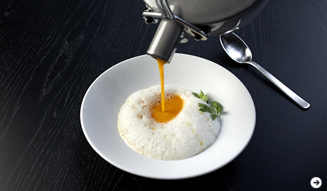
The first dish: "Corn Velouté with Nutmeg."
"Aroma is important for the diner too," Osumi noted. "This soup harmoniously blends the sweet aroma of corn and nutmeg with the smoky scent of charred corn silk." Komatsu found the presentation unique: "The way the soup is poured from a Staub kettle is charming. As the soup fills the bowl, a sweet aroma rises, making one feel happy." Kawakami added, "I also like the original tableware. The color and texture enhance the dish."
The salad also changes based on the day's ingredients. Today, with an abundance of fennel, a simple green salad was served with fennel cake salé. "The combination of a standard French dressing salad and cake salé is innovative," said Kawakami. "The caraway seeds in the greens are a Parisian touch. It's a salad that captures the freshness of the vegetables with a Parisian esprit," Komatsu observed. "The cake salé was an idea from our advisory chef, Eric Trossignon. He calls the dishes at "Pirouette" 'rock and roll cuisine.' It reflects his approach of constantly trying new challenges, unbound by tradition or classics," explained Chef Kobayashi.
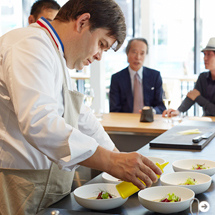
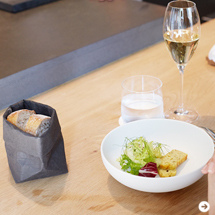
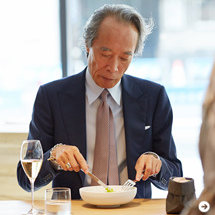
A dish featuring a simple green salad with fennel cake salé, born from Chef Trossignon's idea. The guests were captivated by this "rock and roll cuisine" that breaks free from convention and classics.
Feature | How to Make "Pirouette"
Crafting Tokyo's Future Through Food
Chapter 3 | For the Discerning Gourmands: An Early Taste of "Pirouette"
A Dish That Conveys the Strength and Character of Ingredients
The main course, a choice of meat, fish, or vegetable, followed. Osumi selected the "Wagyu Beef Roast." Chef Kobayashi explained, "This is momo meat from Shorthorn cattle, aged for about a month. It's a simple roast, but it has a powerful flavor." Osumi commented, "It's incredibly robust." Chef Kobayashi elaborated, "Aging it makes the meat tender yet rich in flavor, without the distinct character of dry aging." "The timing of sourcing and preparation is crucial for both vegetables and meat, isn't it?" Osumi mused. "Chefs can adjust the cooking, but the inherent quality of the ingredient is beyond our control. From a texture and flavor perspective, I believe this meat needs to be aged before use. We want to use ingredients that have undergone proper preparation at the right time," the chef stated.
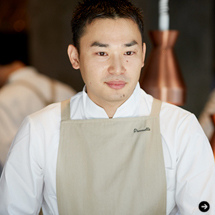
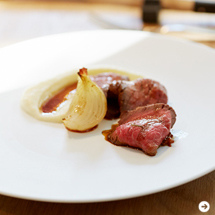
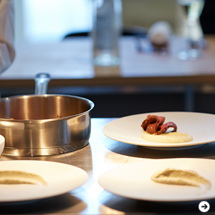
Osumi's choice for the main course: "Wagyu Beef Roast." "By coordinating with producers on sourcing timing, we can utilize ingredients without waste, not only in terms of quality but also quantity," said Chef Kobayashi (left).
Kawakami chose the "Salmon Confit." High-quality, plump Scottish salmon was cooked sous-vide to a medium-rare state, served with chickpea purée and fennel. "The cooking is superb. It has a texture unlike anything I've had before, somewhere between raw and pan-seared," he said. Komatsu opted for the vegetable main, "Carrot Soba." The combination was also unique: roasted carrots and burdock root with butter and spices, served with soba grains resembling couscous. Coriander and curry powder lent a spicy, exotic aroma. "The root vegetables, with their satisfying bite, release more flavor and sweetness as you chew. It's a dish that evokes Parisian couscous while highlighting the freshness of the vegetables. The soup and main course emphasized the natural sweetness of the ingredients, while the salad was light and refreshing. It's a well-balanced course that avoids monotony," Komatsu commented.
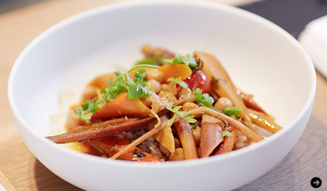
The vegetable main: "Carrot Soba."
Desserts, an additional charge, are handled by Yuta Takei, who previously served as second-in-command at the acclaimed patisserie "Libertable." "With his involvement, I believe the desserts will continue to evolve," said Chef Kobayashi. "We aim to offer desserts with a live feel, unique to a restaurant rather than a patisserie." Kawakami, a huge ice cream fan, praised the milk ice cream accompanying the "Three Grapes and Citronelle Jelly" (¥1,000, excluding tax). "The lemongrass jelly infused with vanilla aroma is also very tasteful. You can enjoy various textures." "The desserts also have a wonderful aroma," Osumi added. A good aroma signifies that the dessert ingredients are fresh and prepared promptly. Here too, ingredients that arrived that day are used, such as fruits, herbs, and spices.
Komatsu chose the "Feuille à Feuille Chocolat" (¥1,200, excluding tax). It features a crisp pâte sucrée, two types of ganache made with Valrhona Araguani chocolate, a thin, crisp chocolate layer, and ice cream flavored with aromatic tonka bean. "Surprisingly light when you taste it. The aroma of cacao and the fragrant tonka bean spread through the mouth. It matches the lightness of the restaurant's ambiance."
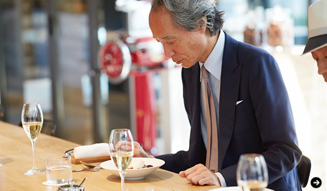
Komatsu praised the high aroma common to both the dishes and desserts.
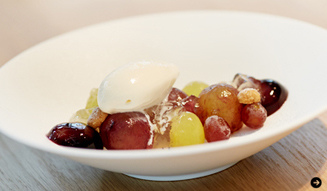
Kawakami and Osumi's choice: "Three Grapes and Citronelle Jelly."
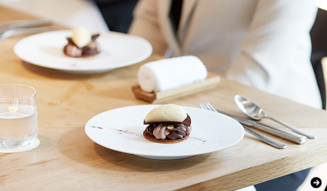
Komatsu's choice: "Feuille à Feuille Chocolat."
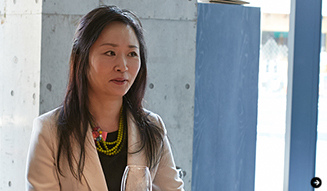
"Surprisingly light when you taste it. The aroma of cacao and the fragrant tonka bean spread through the mouth," said Komatsu.
Feature | How to Make "Pirouette"
Crafting Tokyo's Future Through Food
Chapter 3 | For the Discerning Gourmands: An Early Taste of "Pirouette"
A Place That Attracts Those Who Appreciate Authenticity
When asked for their overall impressions of "Pirouette," the three guests shared their thoughts. "The World's 50 Best Restaurants list by 'Restaurant' magazine in the UK has fostered a trend that expands chefs' possibilities, distinct from Michelin stars. This place vividly embodies that movement. The cuisine, the space, the tableware, the service, the presentation... the overall sense of style is impeccable, truly capturing the 'now.' I've had more opportunities to visit Paris recently, and as I love food, I've visited many places there, but I feel this place shares the same vibe as the hippest restaurants in Paris. I'd love to bring people who appreciate both food and design here," Kawakami said.
"The 'aromatic quality' is particularly striking. Aroma is incredibly delicate. The aroma of the ingredients and the dishes, the presentation and cutlery that enhance it, the precise timing from sourcing to preparation and serving – I feel an artistic and thorough attention to detail in everything. I'd like to revisit with very close friends who share this sensibility," Osumi remarked.
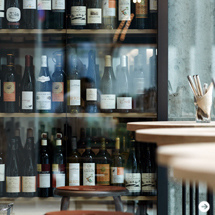
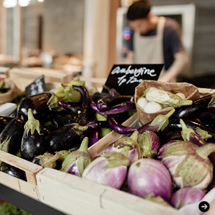
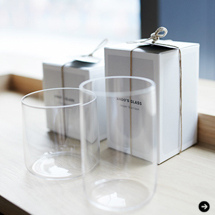
The wine corner (left), the épicerie displaying vegetables, meats, and fish (center), and the retail space selling tableware, coffee, and more (right).
"As Kawakami mentioned, it feels like the forefront of the food scene. During my visit to Paris in April this year, I sensed a food culture where quality is integrated into daily life. The ingredients and dishes are 'authentic,' yet the approach is broad, frank, and casual. The ability to purchase the same ingredients used in the dishes provides a visible sense of enjoyment and security in the supply chain... this place exudes a similar feeling.
Furthermore, although it's called a bistro, the dishes served go beyond that. In recent years, the concept of 'bistronomy,' offering gastronomic cuisine at reasonable prices, has become established among food enthusiasts. "Pirouette" is priced within the same range as bistronomy, yet it positions itself as a bistro. Instead of emphasizing the systematic knowledge and techniques of gastronomy or its reasonable prices, it maintains a subtle and lighthearted approach. I believe this is the essence of "Pirouette"," Komatsu concluded.
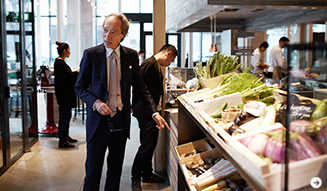
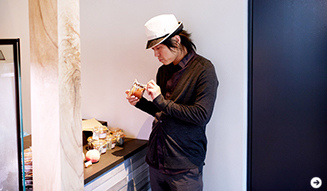
After the course, the three explored the épicerie and wine retail space. Naturally, ingredients featured in the day's dishes were on display. Knowledgeable staff were on hand in both areas, readily answering questions about the unique vegetables and the curated wine selection. The retail space also offers tableware, original coffee, and tea. It's not just the food that stimulates the curiosity of these gourmands at "Pirouette." It's also the ingredients, the tableware, and the conversations with the chefs and staff. "Who should I bring next time?" "I should buy the vegetables I enjoyed." "I want to see the tableware..." Here, a small story unfolds around food for everyone.
Every element that constitutes "Pirouette" is powerful and rich, aiming to deliver authenticity. However, rather than emphasizing each component, the approach is to present them casually, as part of everyday life. The shared sentiment among the three guests, "I want to bring back people who share this sensibility," is particularly memorable. The comfort of this place will undoubtedly attract more and more kindred spirits who appreciate authenticity.
"Actually, I've already made another reservation," said Komatsu. "It's a place you want to return to. I'd like to come back for dinner and take my time," Osumi added. Kawakami continued, "I might make a reservation too. I'll request this seat where I can see the entire open kitchen (laughs). I'm excited to see what kind of flavors the talented chef, who accurately expresses the 'now,' will create." And since those flavors change daily with the ingredients, the anticipation doubles.
The world of "Pirouette" experienced firsthand by these gourmands. How will it appear to you? Regardless, it's an exceptionally relaxed space. Upon entering, the staff will suggest fresh vegetables, and you can feel incredibly close to the chef in the open kitchen. We highly recommend visiting at least once. You'll surely want to bring back like-minded companions.
Shun KAWAKAMI
Born in Tokyo in 1977. Representative of artless Inc. An artist and designer active primarily in Tokyo. Founded artless Inc. in 2000. His work spans a wide range, including graphics, interactive media, video, installations, and spatial design, approaching from both art and design perspectives. He operates globally, both domestically and internationally.
http://s-kawakami.blog.openers.jp/(OPENERS BLOG Updated)
Megumi KOMATSU
Born in Tokyo. Inspired by the books of culinary researcher Teruko Ohara, she discovered her passion for cooking and began self-studying French cuisine in her mid-teens. After graduating from Rikkyo University's Faculty of Sociology, she worked at a publishing company before becoming a freelancer. From March to September 2012, she served as deputy editor-in-chief of "Ryori Oukoku" magazine, returning to freelance work in October. She holds a 준사범 (Jun-shihan, Associate Master) certification in Enshu-ryu tea ceremony.
http://m-komatsu.blog.openers.jp/(OPENERS BLOG Updated)
Norio OSUMI
Born in Kumamoto Prefecture in 1954. After working in advertising and public relations for a fashion specialty store, he worked as a product planning and advertising production director, and later as a magazine editor. In 2006, he joined the launch of the web magazine OPENERS, envisioning the future of internet media, and became its Creative Director. In 2011, he was appointed as a Supervisory Director for MORE TREES DESIGN Inc., an organization established to create new markets utilizing Japanese timber.
Pirouette
Address | 1F, Toranomon Hills Garden House, 1-23-3 Toranomon, Minato-ku, Tokyo
Tel. 03-6206-6927
Business Hours | [Bistro] Lunch 11:30–14:30 (LO), Dinner 18:00–21:30 (LO) *Saturdays, Sundays, and holidays: 17:30–21:00 (LO)
[Cafe] Lunch 11:00–15:00, Tea 15:00–17:00, Dinner 17:30–22:00 (LO) *Saturdays, Sundays, and holidays: until 21:00 (LO)
[Épicerie] 11:00–23:00 *Saturdays, Sundays, and holidays: until 22:00
Opening Date | September 3rd (Wednesday)
http://www.pirouette.jp
http://contrail.cc/
https://www.facebook.com/contrail.cc