Moët & Chandon Impérial 150th Anniversary (2) | MOËT & CHANDON
SponsoredPage. 1
MOËT & CHANDON
Moët & Chandon and 276 Years of Champagne
Moët Impérial 150th Anniversary (2)
Sparkling wine from the Champagne region, born in the latter half of the 17th century with a touch of serendipity, was refined by its producers into the special wine known as Champagne. Moët & Chandon was quick to spread this Champagne, which enjoyed the patronage of the French royal court and the favor of the times, throughout the world. As the era transitioned from feudalism to civil society, Moët & Chandon's presence became unshakeable.
Text by SUZUKI Fumihiko
Champagne to the World
As for spreading Champagne to the world, this was Claude Moët's vision.
Claude Moët was a capable businessman who, as a wine merchant, already had connections outside of France. He then proceeded to spread the sparkling Champagne wine, which had captivated the French royal court, to other countries. Champagne spread to Germany, Spain, Belgium, and even Russia. Although after Claude Moët's death, it was exported to America in 1787, and by the end of the 18th century, Champagne had established its reputation among the upper classes of Europe and America.
Thus, Moët's Champagne achieved success, but on the other hand, the French royal family experienced twists and turns, and after the revolution, France became a country ruled by an emperor. And this emperor, Napoleon Bonaparte, was also a man captivated by Champagne.
He is said to have declared, "I cannot live without Champagne," pouring Champagne to toast victories and drinking it to console himself after defeats. Incidentally, although Napoleon was defeated in his Russian campaign, the Russian nobility, who had been defeated by Napoleon, were also captivated by Champagne, demonstrating that Champagne transcends political allegiances.
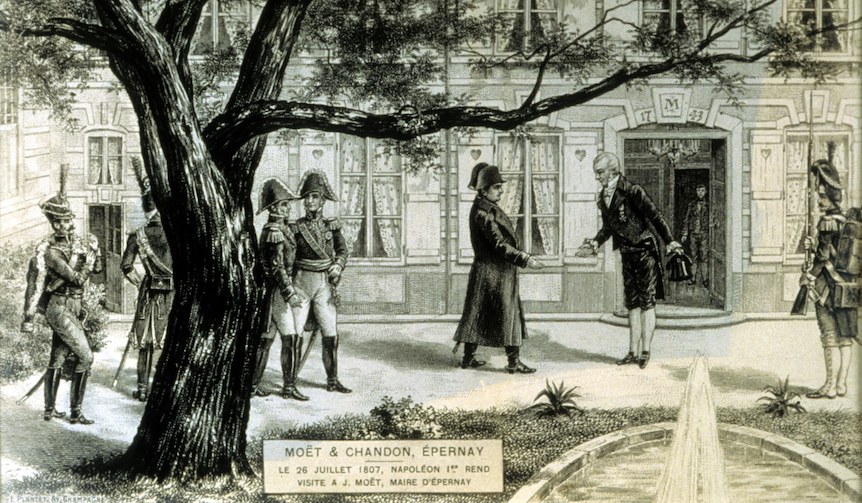
Napoleon was a loyal customer of Moët & Chandon. At "Hôtel Moët" (Maison Moët), the birthplace and current headquarters of Moët & Chandon in Épernay, Champagne, there is a "Napoleon Room" where the emperor is said to have visited for tastings. The room is equipped with a sofa, in case the emperor felt drowsy from drinking. Furthermore, a notebook detailing orders from the Napoleon family still remains today.
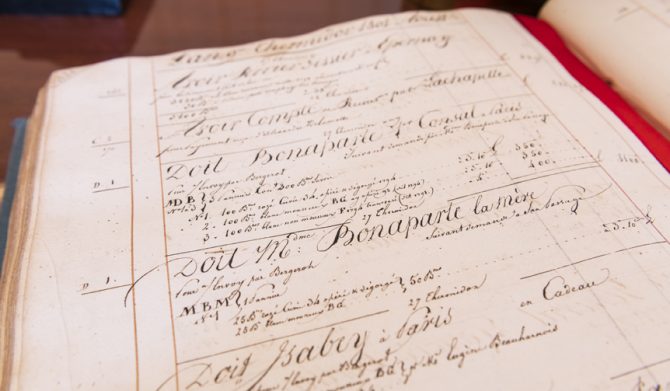
This is that notebook. It meticulously records orders not only from Napoleon Bonaparte but also from his extended family.
This site is now a UNESCO World Heritage site. Beneath it lies a vast cellar, the largest in the Champagne region, with a total length of 28 km, which is also a World Heritage site. The cellar also bears traces of the emperor, such as a plaque indicating Napoleon's visit and the Napoleon Cask gifted during his visit. Both are now open for us to visit.
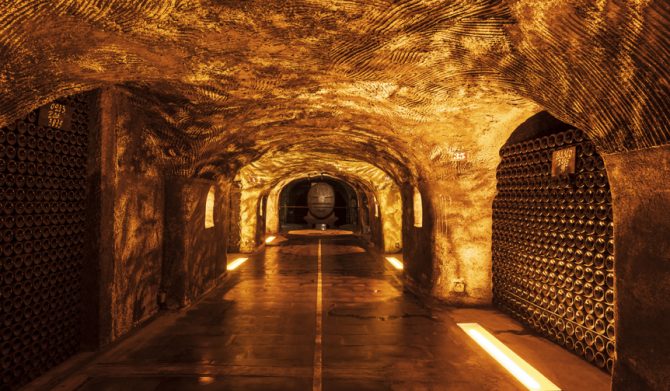
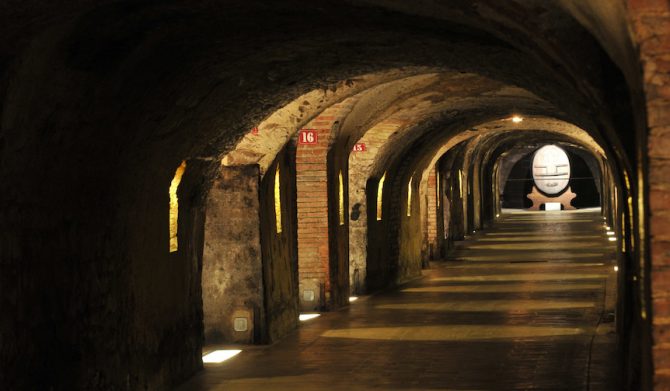
The impressive underground cellars of Moët & Chandon. In the distance, the Napoleon Cask is visible. To prevent wine degradation from light, the lighting appears red to the naked eye, but in reality, it is a white cave carved from the Cretaceous chalk soil characteristic of the Champagne region. This soil acts like a sponge, retaining water, ensuring sufficient water supply to the vines even during droughts, protecting the cellars from dryness, and maintaining a constant temperature.
It was not Claude Moët who received orders from Napoleon. Claude Moët passed away in 1760, and the head of the house at the time was his grandson, the third generation: Jean-Rémy Moët, who led Moët from the end of the 18th century to the beginning of the 19th. Jean-Rémy was not only a successor to Napoleon but also an inheritor of Claude's spirit, forging strong relationships with royalty and nobility abroad.
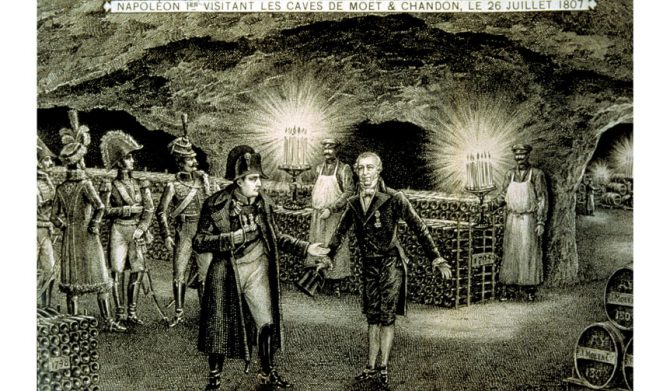
Jean-Rémy Moët guiding Napoleon during his visit to the Moët & Chandon cellars in 1807
In Champagne, succession means more than mere continuation. For instance, as the popularity of Champagne grew, more vineyards were needed. Jean-Rémy Moët therefore embarked on clearing land for vineyards, contributing to the discovery of land suitable for cultivating high-quality grapes in the Champagne region and the advancement of cultivation methods. Moët & Chandon's origins—possessing the largest private vineyards in Champagne at approximately 1200 hectares, with 50% classified as Grand Cru (top-tier) and 25% as Premier Cru (first-tier)—lie with Jean-Rémy Moët. Champagne embraced cutting-edge technology of the era in viticulture, winemaking, and bottling, inventing what was lacking and accumulating know-how. Jean-Rémy Moët embodied this style of forging tradition through innovation in Champagne.
Throughout the 19th century, Moët's Champagne was shipped to Brazil and Canada, and the world fell under Moët's spell.
Page. 2
MOËT & CHANDON
Moët & Chandon and 276 Years of Champagne
Moët Impérial 150th Anniversary (2)
The Moët and Chandon Families and the Battle for Champagne
Up to this point, we have been discussing the Moët family. In 1833, upon Jean-Rémy's retirement, Moët changed its name to Moët & Chandon. This was because Jean-Rémy's son, Victor, and Pierre-Gabriel Chandon, who married Jean-Rémy's daughter, Adélaïde, in 1816, took over Jean-Rémy's business. Moët & Chandon is named after the Moët and Chandon families. Incidentally, "Moët" is a traditional name dating back to the 15th century, but in French, it is correctly pronounced with the final 't' sound, as "Moët." Therefore, if someone is called Moët & Chandon, it is not incorrect; in fact, they might know Moët & Chandon well, so please keep this in mind.
For some time after becoming Moët & Chandon, during the period from the late 19th century to the First World War, Champagne experienced a difficult era.
This was not limited to the Champagne region but affected wines throughout Europe. It was caused by a tiny insect, about 1 mm long, called phylloxera. Phylloxera, believed to have been introduced to Europe on American grapevines, parasitizes European grapevines, drains nutrients from their roots, and causes them to die. It was confirmed in France in 1863 and in the Champagne region in 1888. Initially, there was no known remedy, and even after a remedy was discovered, the damage continued to spread until the early 1900s, dealing a devastating blow to the wine industry. In renowned regions, some producers abandoned winemaking in their traditional lands. However, at this time, Raoul Chandon de Briailles, the head of Moët & Chandon, fought against phylloxera to protect Champagne. He invested Moët & Chandon's financial resources and network to establish a research institute for phylloxera countermeasures. This marked the beginning of Moët & Chandon's viticulture research facility, which continues to this day.
Incidentally, it seems that by the 1870s, it was known that phylloxera could be stopped by grafting European grape scions suitable for winemaking onto American rootstock, which was resistant to phylloxera. However, this required abandoning existing grapevines, planting rootstock of the grafted variety, and then performing the actual grafting—a task that demanded not only labor but also significant psychological and financial effort.
Concurrently, in the Champagne region, producers, frustrated by persistent fraudulent labeling, took the initiative to define Champagne. In other words, a rule was legally established that only sparkling wine made from grapes harvested and vinified in the Champagne region could be called Champagne. Today, Champagne adheres to even stricter regulations than other sparkling wines. Champagne ceased to be an ambiguous term, almost synonymous with sparkling wine. Champagne is a wine made by people who strive to protect it.
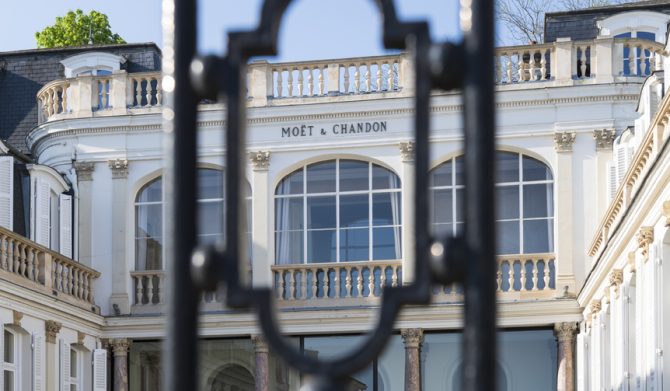
Moët & Chandon's headquarters, located on the aptly named "Avenue de Champagne." This is where "Hôtel Moët" is situated, with its cellars below. It is the economic heart of the Champagne region.
Fifteen Minutes, or Sometimes Ahead
The 20th century is the age of the citizen. Champagne is no longer solely for feudal aristocrats. Perhaps this is precisely why it became necessary to define Champagne as Champagne. In the democratic 20th century, Champagne became the king of sparkling wines worldwide.
One of the individuals who solidified this supremacy of Champagne was Robert-Jean de Vogüé, who led Moët & Chandon from 1930.
Robert-Jean was the husband of Gyslain, a member of the Moët family, and also of noble birth with a noble spirit. He served as the first co-president of the Champagne Committee, established in 1941 and still active today, which coordinates the interests of those involved in Champagne production and sales in the Champagne region. Even beyond his official capacity, he was a patriot who dedicated himself to workers and small-scale producers and growers. During World War II, he fought with the Resistance and was captured by the Nazis.
Furthermore, at Moët & Chandon, he was a reformer who was among the first to adopt stainless steel tanks.
Robert-Jean was by no means a conservative figure. He was a jet-setter who loved his wife and cars, and above all, he loved America. Robert-Jean, who reportedly spoke perfect English, was a charming and open Frenchman who respected America and was respected in return. He played golf with President Eisenhower, dined with Gary Cooper, and enjoyed Moët & Chandon in both formal and casual settings, dispelling the stuffy image of wine. With Robert-Jean, Moët & Chandon led the 20th century and was beloved in America.
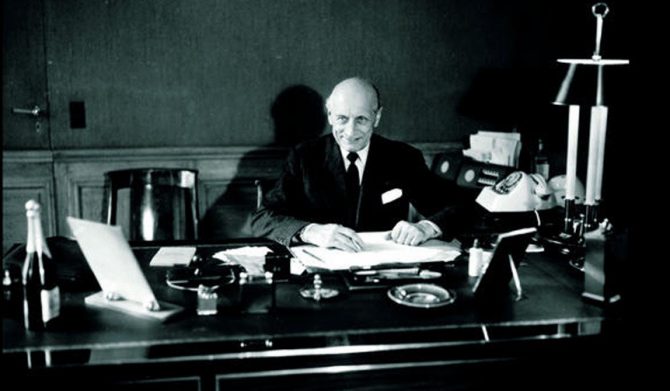
Robert-Jean de Vogüé (1896-1976)
Blessed with such an exceptional ambassador, Moët & Chandon became the first Champagne producer to be listed on the French stock market in 1962. Since then, as the first international player from Champagne, it has achieved numerous milestones in the business world. Notably, the 1971 merger with cognac producer Hennessy was historically significant as the precursor to today's luxury brand conglomerate, LVMH.
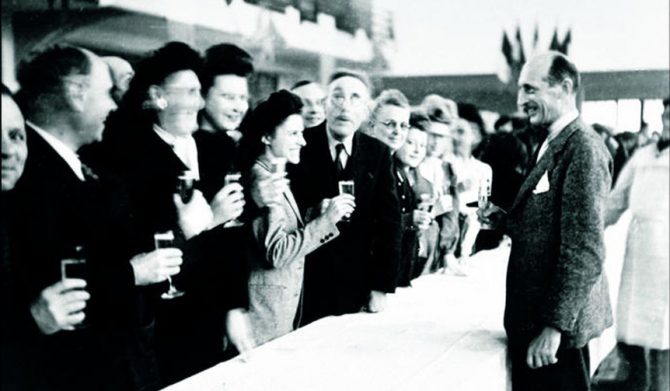
In 1976, Robert-Jean de Vogüé passed away at the age of 80. However, Moët & Chandon continues to be present at celebratory occasions—in modern times, in film, sports, arts, and politics.
Robert-Jean left behind a quote that keenly captures modern success: "Fifteen minutes, or sometimes ahead." As long as the modern era continues, and as long as Moët & Chandon remains fifteen minutes ahead, its position as the leader in Champagne will likely remain unshakeable.
Moët & Chandon and 276 Years of Champagne - Part 1
Moët & Chandon and 276 Years of Champagne - Part 3(Coming soon)
MHD Moët Hennessy Diageo
Tel. 03-5217-9906