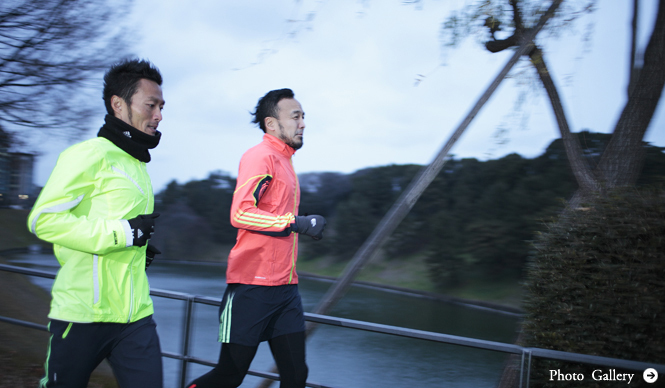
Feature | One Month Until the "Tokyo Marathon 2012" Race: Training and Tips for Just Before the Event!
One Month Until the Tokyo Marathon 2012
Pre-Race Training & Advice (1)
The Tokyo Marathon 2012 is just three weeks away. DJ Toshio Matsuura, running his first full marathon, finds his anxiety growing by the day. He visits RUNBASE, an adidas running facility, to receive advice from Taro Agui, coach and representative of the members-only running team 'Harriers.' With only a short time left until the race, what final adjustments should runners make?
Text by FUJITA Mayu (OPENERS)Photo by JAMANDFIX
Training Guidance from 'Harriers' Representative, Coach Taro Agui
Our coach for today is Taro Agui, representative of 'Harriers' and an adidas-contracted advisor. 'Harriers' is a members-only running team known to those in the know. It's a running club where members can pursue their goals through optimal training under the guidance of running professionals like Coach Agui, former ekiden athletes, corporate team runners, and professional athletes. Currently, about 210 members train here daily.
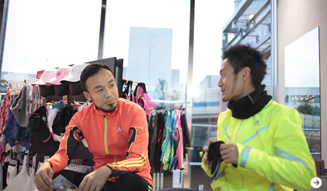
With just one month left until the race, Matsuura, facing his first full marathon, sought Coach Agui's guidance on his form, training, diet, and race-day preparations. First, a form check. While one might observe others' running form closely, there are few opportunities to see one's own. Using a video camera to objectively analyze his running form, Matsuura, like anyone else, was bound to discover something new.
Objectively Checking One's Own Running Form
AguiIn Matsuura's case, his stride zone appears wide. Since he naturally has long legs, it's common for such individuals to have a longer stride. His left-right balance is good, and his upper body is particularly relaxed, which is excellent. When you previously underwent a 'Running Dog' at RUNBASE, were you not told about any left-right differences in your landing?
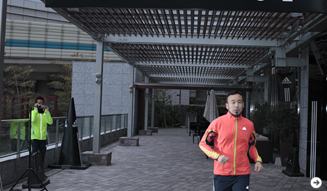
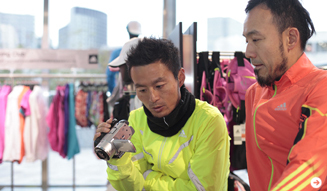
MatsuuraI wasn't specifically told about left-right differences, but I was told that the ankle muscles I use when pushing off the ground are stiff, preventing me from using them effectively. My own impression is that I'm running with my body, or rather, pulling myself forward with force... I wonder if I could move more smoothly by pushing off the ground more to increase propulsion, or by moving my legs faster and more frequently?
AguiI noticed your knees sinking when you land. When your knees sink, you tend to push off the ground more to compensate. Since you already have a wide stride, this synergizes to propel you further at speed, but only when you have energy. To conserve stamina for the latter half, you want to avoid using unnecessary force. However, this knee sinking will naturally improve as you strengthen your thigh muscles through running, so just being aware of it is important.
Your form itself doesn't have significant inefficiencies, so fundamentally, it's fine as it is. Your stride width is also sufficient; the key now is leg turnover. Faster turnover isn't always better; since a marathon is long, it's crucial to adjust your pace to maintain your intended speed.
One Month Until the Tokyo Marathon 2012
Pre-Race Training & Advice (2)
Land with your entire sole and imagine pushing off!
Next, advice on form while running. In the cold air, with snow threatening to fall, we began with stretching. Before running, we perform 'dynamic stretching.' Unlike 'static stretching,' which aims to lengthen muscles, dynamic stretching uses body movements to loosen and warm up the muscles. Especially in cold weather like this, muscles can easily get cold, so thorough dynamic stretching before the start is essential. Aim to break a light sweat. After running, use static stretching to lengthen tired muscles and cool down.
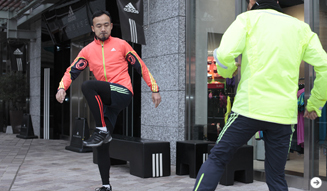
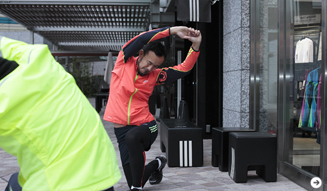
AguiAs I mentioned earlier, your form itself doesn't have major issues. Your upper body is relaxed, which is very good. However, you do seem to be pushing off the ground excessively. While pushing off might feel like it increases momentum and leads to faster speeds, it's actually better not to push off. Running long distances can cause blisters or calluses on the parts you push off, leading to imbalance. It also puts a strain on your calves, potentially causing cramps during the run.
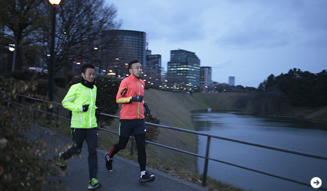
Another point is that Matsuura's heel impact seems strong upon landing. When your heel strikes the ground, your toes are angled slightly too high. He also mentions feeling fatigue in the midfoot, which suggests this is indeed the case.
The midfoot acts like a spring, absorbing shock and transferring weight and load forward. If this area is injured, you won't be able to run effectively. Furthermore, strong heel impact creates a braking effect.
In reality, you are landing on your heel and pushing off with your toes, but mentally, try to imagine landing with your entire foot, placing it on the ground, and then releasing.
Swing your elbows straight back and forward!
MatsuuraI naively thought that pushing off the ground would make me faster (laughs). Regarding my running form, I was actually wondering if I should shorten my stride and increase my turnover.
AguiMatsuura's stride running has an advantage in speed, and in the final push, stride provides more power. To leverage these characteristics, the key is to conserve energy so you can maintain a long stride until the end.
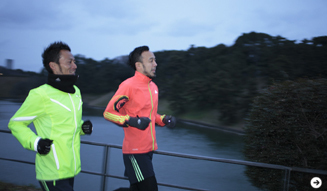
How to move forward efficiently with minimal energy is crucial, and arm swing is key. By swinging your elbows straight back, your posture improves, and you can efficiently increase propulsion. When swinging your arms, keep your shoulders fixed, swing your elbows straight back, and swing them straight forward. Surprisingly, many people don't swing their elbows straight back. If you don't swing straight, your upper body will open up and sway as you swing your arms, putting a strain on your lower body. Keep your shoulders fixed and focus on swinging your elbows straight back.
Don't panic when facing hills!
Also, the Tokyo Marathon course has three hills towards the end. Naturally, hills consume more energy than flat terrain. On hills, shorten your stride and lean forward to move efficiently. If you try to move forward with a large stride while keeping your upper body upright, you'll be pulled backward. Also, it's crucial not to rush. When you encounter a hill, you tend to tense up, thinking 'I have to conquer this!' so be careful!
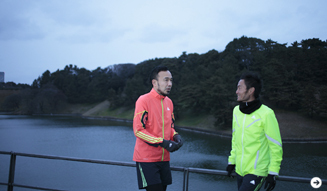
MatsuuraEven when reading books about training, when I actually run, I don't understand the intuitive aspects, like where to apply force or what it means to relax. But by actually moving my body and receiving advice, and then practicing, I could understand it smoothly. The explanations are also demonstrated with exaggerated movements, and you can have your movements checked, which is completely different from just reading a book or having explanations while sitting and talking.
AguiI'm honored, thank you (laughs).
One Month Until the Tokyo Marathon 2012
Pre-Race Training & Advice (3)
Long runs should be completed by three weeks before the race; the final week is for regular jogging only.
MatsuuraI've been running about 5 to 10 kilometers every other day, and I ran 15 kilometers for the first time the other day. It's been a month until the race, but how should I train to increase my distance from here?
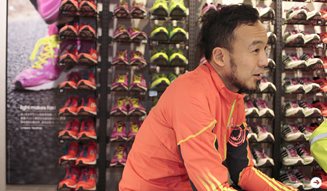
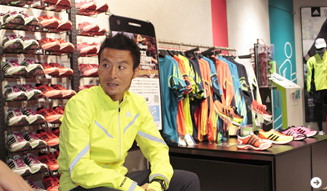
AguiYou should aim to run 30 to 35 kilometers before the race. However, running long distances accumulates fatigue, so consider three weeks before the race as the deadline for your 30km run. Adjust your training by running 30km three weeks out, 20km two weeks out, and 10km one week out, allowing your body to recover. After running 30km three weeks prior, rest for two days, then resume your usual 5-10km jogs every other day. During the two weeks leading up to the race, include one run of 10-15km at a pace that simulates your race time. In the final week, focus solely on regular jogging to maintain your condition.
It's also a good idea to practice running hills during your adjustment period and to get used to 'boredom' by running on a circuit course. Circuit courses are also recommended because you can practice picking up drinks at aid stations.
Hydration and energy replenishment, not just water, are key to maintaining stamina in the latter half!
MatsuuraWhat points should I be mindful of on race day regarding hydration, nutrition, and restrooms?
AguiHydration is important to prevent dehydration. However, on race day, if the lines are long, you could lose tens of minutes just waiting for the restroom. Therefore, it's best to avoid tea and coffee the day before and start the race feeling slightly thirsty. But don't push yourself too hard.
Regarding nutrition, while they might hand out small cut bananas on race day, for ease of consumption and energy efficiency, I recommend carrying sports gels. I personally use 'shotz ENERGY GEL.' Many runners who slow down or walk in the latter half suffer from leg injuries, but energy depletion is also a common cause. For a full marathon, aim to replenish your energy every 10 kilometers or every hour. You'll be surprised at the difference!
Don't get caught up in the race atmosphere and increase your pace!
MatsuuraAre there any course-specific points I should be aware of?
AguiThe most dangerous thing is losing your pace. It's a major event with a large number of participants. Furthermore, the Tokyo Marathon course is downhill in the early stages. The unique atmosphere and the easy downhill sections can tempt you to speed up. However, as I mentioned earlier, there are hills again after 35 kilometers and just before the finish line. At these points, your pace can easily falter by seven or eight minutes, leading to walking. Be very careful not to run faster than your planned pace.
MatsuuraThank you very much.
Taro Agui
adidas Running Advisor
Representative of the running team 'Harriers' / UK Athletics Certified Coach.
He studied in the UK and obtained his coaching qualifications (UK Athletics Level 2). Upon returning to Japan in October 2005, he established and now leads the members-only running team 'Harriers.' He currently leads Harriers' training sessions, lectures at NHK Culture Center, and coaches various adidas running events.

adidas RUNBASE
Hirakawacho Mori Tower 1F, 2-16-1 Hirakawacho, Chiyoda-ku, Tokyo
Business Hours: Weekdays: 7:00 AM - 10:30 PM | Weekends & Holidays: 7:00 AM - 7:00 PM
Admission Fee: Visitor ¥700
Shoe Rental ¥100
Wear Rental (1 item) ¥300 | (Set) ¥500
Towel Rental (Small) ¥100 | (Large) ¥200
http://adidas.jp/running/runbase/
Coach Taro Agui also participates!
Various running lessons are held daily, allowing you to choose based on your level and goals!
RUNBASE Running Clinic
Fee: Free
*Facility usage fee is separate.
*Reservations required.
http://adidas.jp/running/clinic/
adidas RUNBASE
Tel. 03-3261-9980