Series | Missing Trace: Between London's Memories and Records, Part 2
What Artist Saya Kubota Saw and Felt in London
Part 2: "Holding Ruins in Rome"
London, a city where art is deeply rooted in daily life. It is a place of "creation," where new expressions are born every day, but also a place of "resuscitation," where buried legacies are unearthed and brought back to life everywhere. The latter act is, so to speak, a game of telephone from past to present. What artist wouldn't be thrilled by such a grand, timeless "play"? Saya Kubota, who studied restoration and fine art there from April to October 2015, was one of those captivated by its charm. She writes about the people, things, and events that touched her heart during her days drifting between London's memories and records.
Text, Photographs & Illustrations by KUBOTA SayaEdited by TANAKA Junko (OPENERS)
Ruins Everywhere
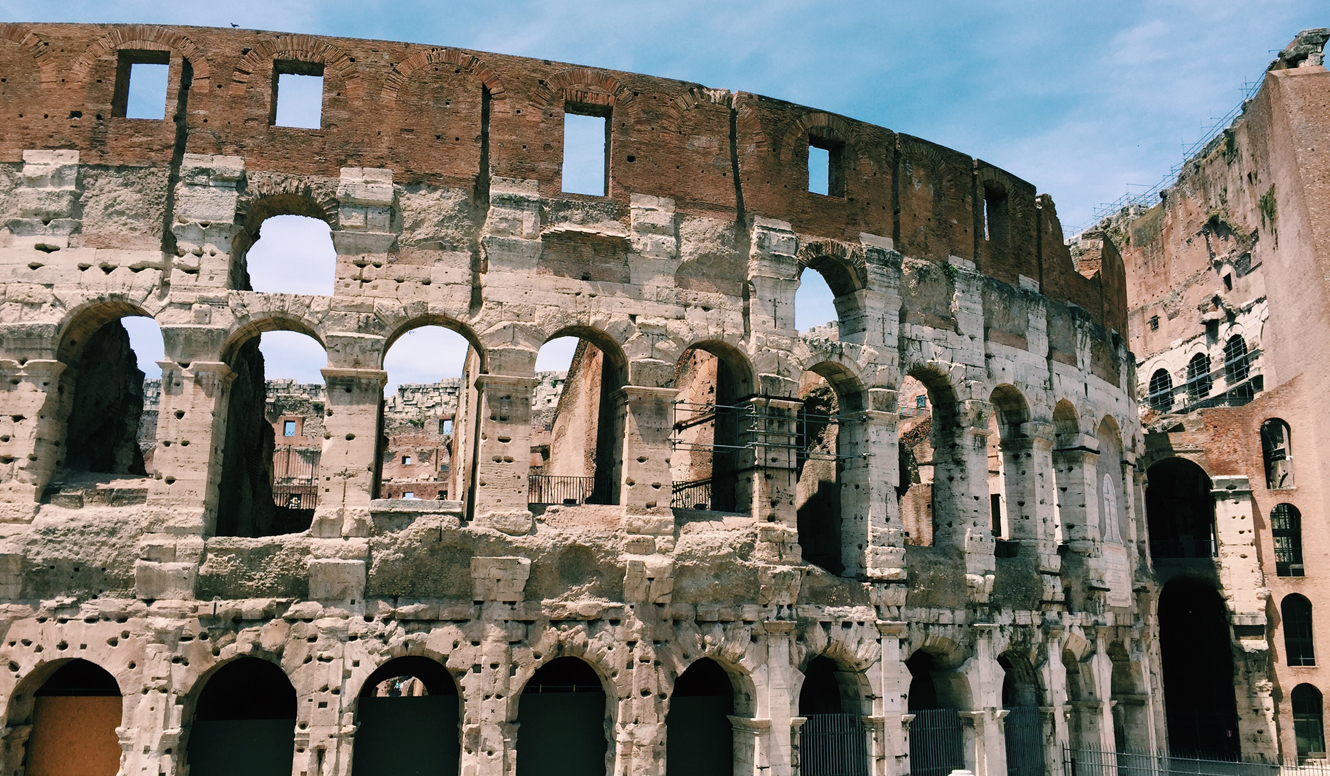
Walking through the hot Roman sun, I spotted the "Colosseum" (a circular amphitheater built during the Roman Empire) in the distance. It looked like an intricately crafted spherical invention rolling along. I immediately cursed my materialistic self for thinking, "If this were on eBay, I'd definitely bid on it."
During my research at restoration schools and museums in London, I saw, drew, and touched many artifacts. Eventually, I became curious about the experience of being enveloped by ruins, rather than just touching artifacts. So, on my way back from the Venice Biennale, I decided to visit the ruins of Rome.
Entering the Colosseum felt like being inside a large, melting machine with only bones remaining. Thinking about the years it took for the corners of the rocks to round and the strength of the structure that continued to stand, I couldn't help but feel the immense flow of time. The physical concerns I had on the way to the Colosseum—"I absolutely must not get a tan on my face," "I'm so thirsty," "The Italian cobblestones are so hard on my feet"—suddenly seemed trivial and unimportant.
Tourists, and myself included, looked like tiny protein clusters swarming around a large rock. For the ruins, our lives must be but a fleeting moment. It's astonishing that the Colosseum has existed as ruins for a far longer period than it served as an arena.
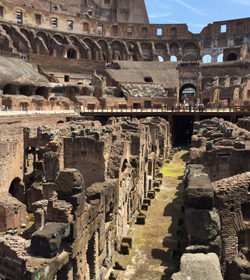
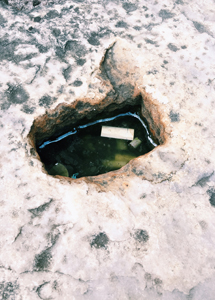
Near the Colosseum lies the "Roman Forum," another complex of ruins. With ruins scattered everywhere, one can hardly feel a sense of awe. A woman is sitting casually on an intricately decorated ruin, engrossed in her smartphone. These might have been solemnly displayed in museum glass cases, but here, you can touch them, sit on them, and some even serve as ashtrays filled with rainwater.
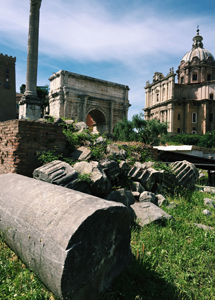
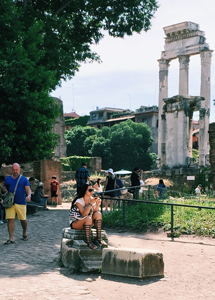
It is said that during the Middle Ages and into modern times, valuable materials like white marble and bricks were taken from these two sites for construction. Preservation efforts began in the early 19th century. After periods of use as an arena and public square, they were stripped for building materials, and only then, after their "historical value" was recognized, did excavation and preservation commence.
Even as excavation continues today, witnessing ruins used as ashtrays or casual resting spots forces one to question the very definition of "value." When does a ruin begin, and when does it end?
It's fascinating how both the Roman Forum and the Colosseum exhibit a mix of degradation from natural forces and destruction by human hands. Sometimes, like the rocks in this photo, there are many traces that make it difficult to distinguish between human and natural origins. The boundary between human action and nature seems almost irrelevant.
Flipping the Earth
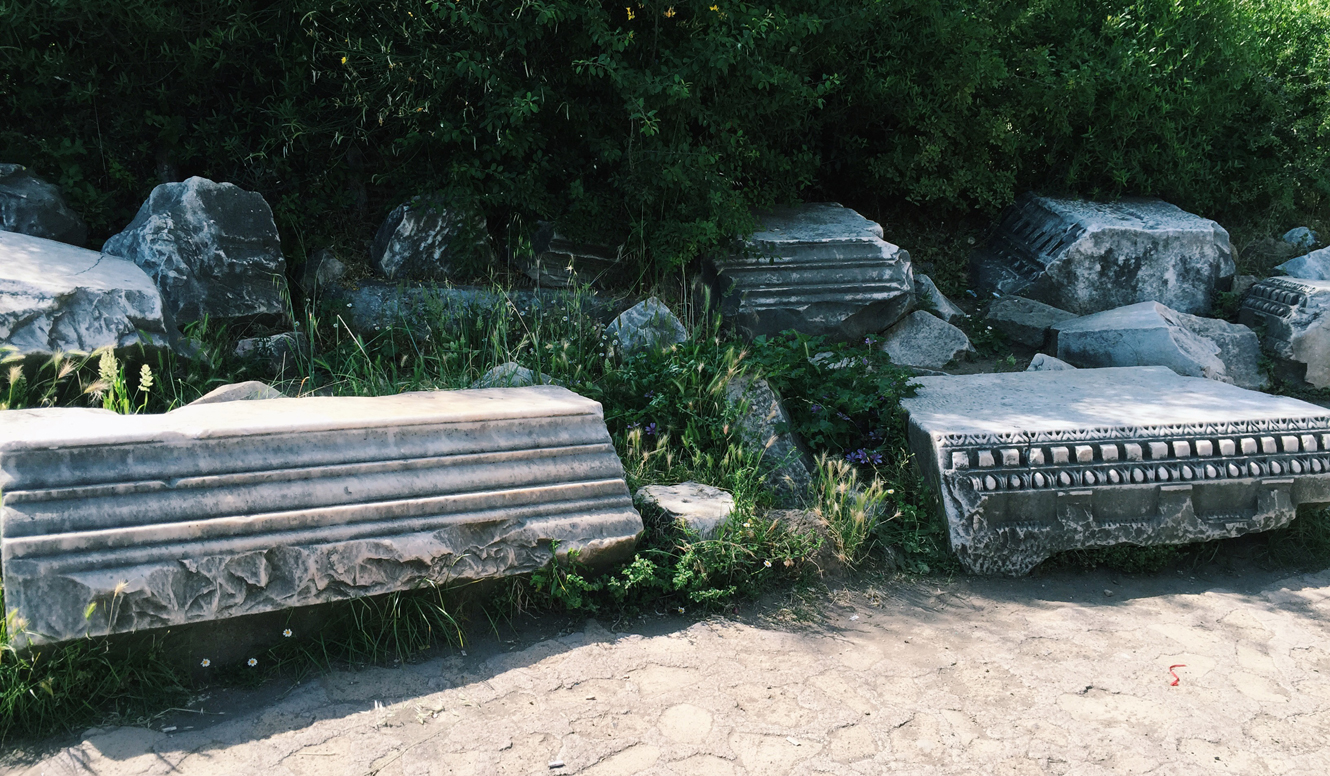
I find objects that are neither quite real estate nor quite movable property, perhaps small enough to be carried away? These semi-real estate-like objects, are they ruins or artifacts? They are of a size that even I, a personification of desire, would hesitate to take home.
On my way back from the ruins, I found a fragment of a ruin that fit in my palm, so I held it.
Looking up the word "to grasp" in the dictionary, one definition is to seize something and make it one's own. To grasp a piece of land is to capture the memory of the place where that object once resided. And I, who am holding this object, am also, in fact, an object. In a broader sense, I am a fragment of my mother, having moved from her womb.
Closing my eyes and touching the rough surface with my skin, I strangely felt as if I were inside the ruins. This reminded me of the scientist George Gamow's drawing of an inverted human body. This is my redraw of his diagram.
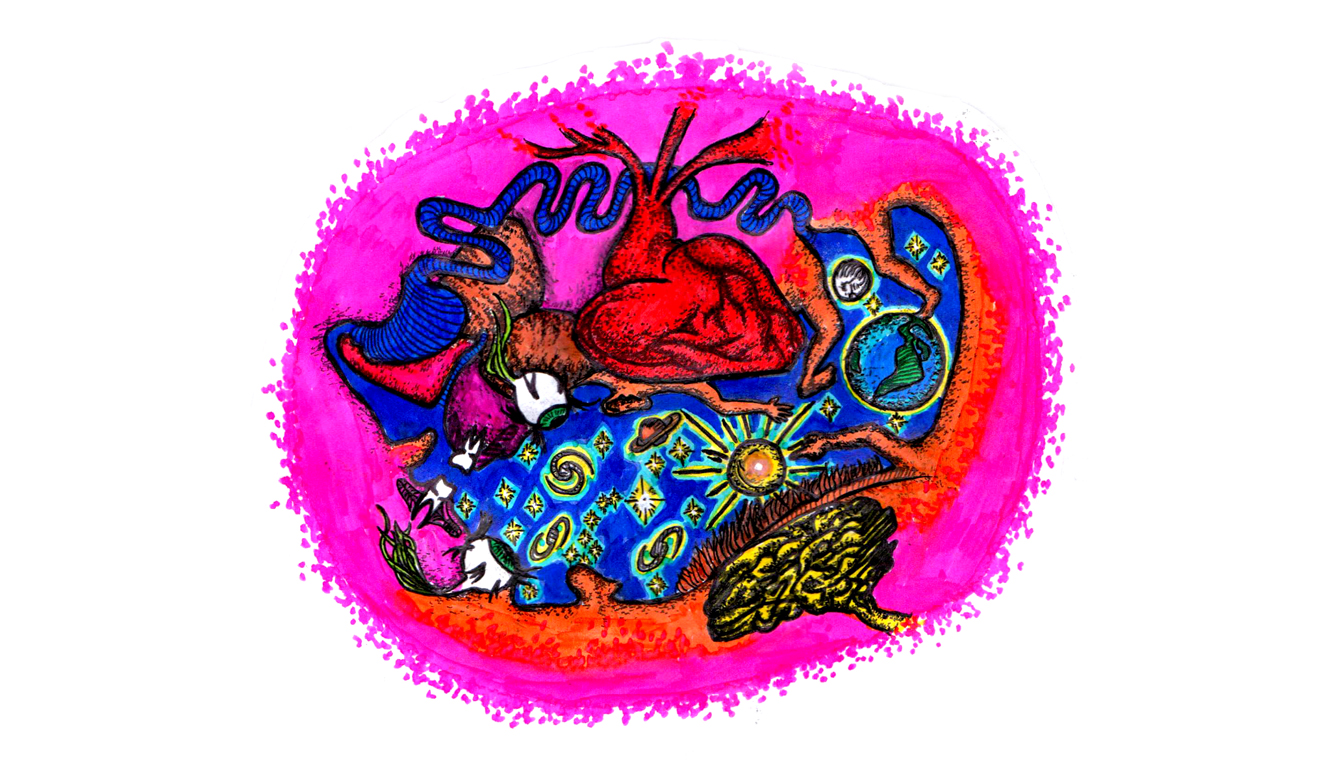
"Gamow's Diagram" © SAYA KUBOTA
Simplified, the human body has a hollow space from the mouth to the intestines, much like a chikuwa (a tube-shaped fish cake). This diagram shows a cylindrical body turned inside out, like taking off a sock. The space within the inner walls of the digestive tract contains the universe. It's a wonderfully simple and brilliant idea: the world is swallowed by the human body.
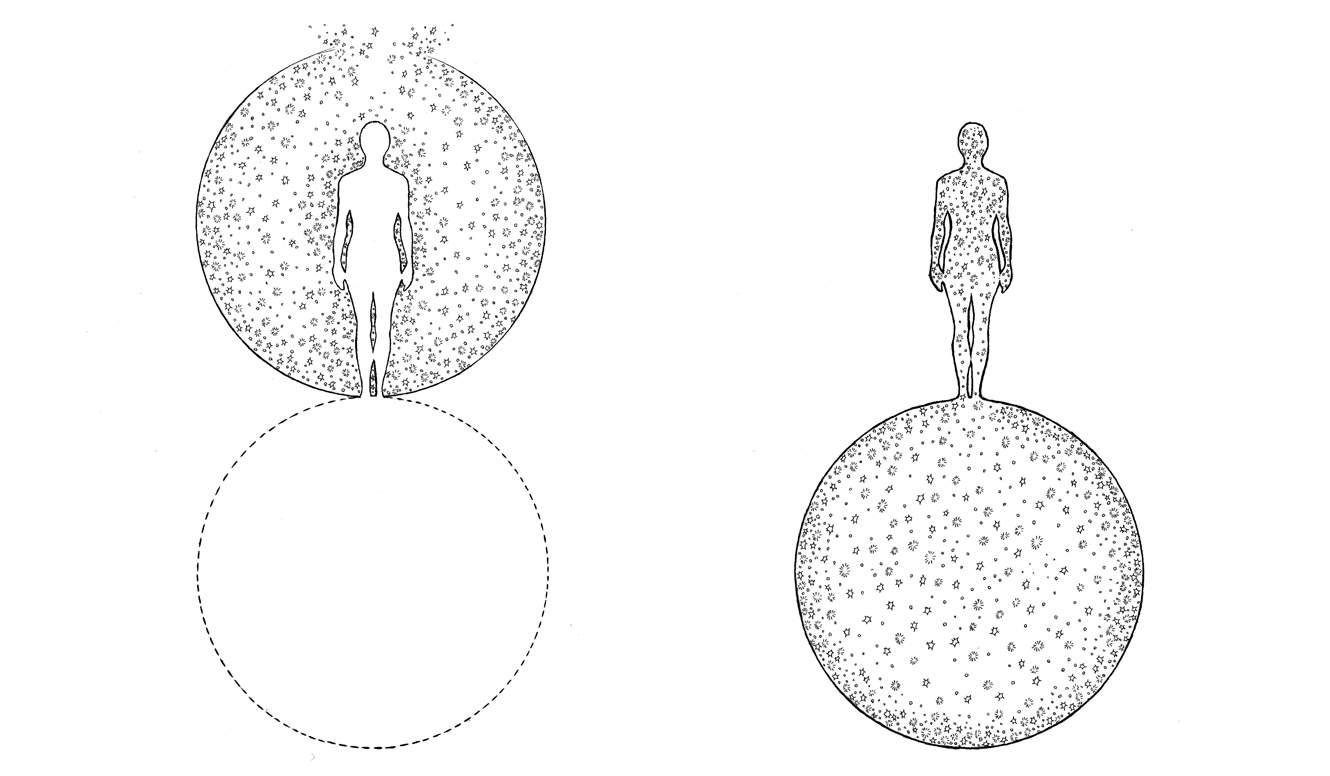
"Flipping the Earth" © SAYA KUBOTA
Perhaps touching ruins or being enveloped by them is the same experience for humans. This applies not only to ruins but to all environments. Just as Gamow enclosed the universe within the body, perhaps the circular relationship, where I, who was once enveloped by the land within an environment, can now grasp the land using objects, is what it means to create things.
Will we ever encounter something that turns our bodies and the world inside out?

Saya Kubota
Artist. Born in Ibaraki Prefecture in 1987. Spent her childhood in Hong Kong. Graduated from the University of Tsukuba, School of Art and Design. Currently pursuing a Ph.D. in Fine Arts (Oil Painting) at Tokyo University of the Arts Graduate School. Her work centers on memories and words generated by everyday scenes and encounters with people, and the new images and forms that arise from their combination. She works across various media, sometimes combining them, including two-dimensional pieces created by layering scorched tracing paper, three-dimensional works joining artifacts and ornaments, and installations using unique devices. Participated in numerous group exhibitions, including the project "Drifting Post Office" (Setouchi Triennale 2013).
http://sayakubota.com