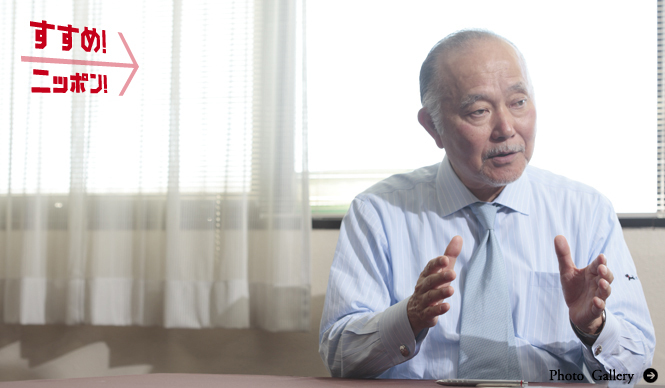
SHIFT JAPAN Interviews Professor Takao Kashiwagi of Tokyo Institute of Technology on the Smart Society After the Enforcement of the Renewable Energy Act
An Interview with Professor Takao Kashiwagi of Tokyo Institute of Technology
The Smart Society After the Enforcement of the Renewable Energy Act (1)
Enacted on August 26th as a "parting gift" from former Prime Minister Naoto Kan, the Act on Special Measures for the Procurement of Electricity from Renewable Energy Sources. This law mandates that electricity generated from solar, wind, small hydro, biomass, and geothermal power be purchased by power companies at a fixed price for its entire output for a certain period.Fixed-Price Full Output ProcurementWhat are the challenges to be addressed for its enforcement on July 1, 2012? And how will Japan's energy landscape change after the earthquake with its enforcement? We asked Professor Takao Kashiwagi of Tokyo Institute of Technology.
By Kentaro Matsui
Photos by JAMANDFIX
The Balance Between Price and Surcharge is Key
—What is the biggest point of the "Act on Special Measures for the Procurement of Electricity from Renewable Energy Sources"?
While discussions will continue at the Procurement Price and Other Calculation Committee until the end of this fiscal year,Renewable Energythe most crucial point will likely be the "purchase price" set for electricity from renewable energy sources. The purchase price will be set at different rates for each type and scale of generation, such as X yen for solar and Y yen for wind, or even differentiating between offshore and onshore wind. This is because there are differences in generation costs between large-scale solar power plants in coastal areas and small hydropower plants in the mountains, and a uniform price would be unfair. It is expected that the purchase price for solar power generation, especially from mega-solar projects, will be the highest.
—So, the higher the purchase price, the more profitable it is for power generators?
That's right. The new law states, "For the first three years after enforcement, when determining the purchase price, particular consideration shall be given to the profit of the renewable energy electricity supplier." In other words, it mandates setting a relatively high price for the first three years to ensure profitability for power companies. The aim is to foster industries related to renewable energy, increase employment, and enhance international competitiveness.
However, since the purchase price will be passed on to the electricity bills paid by citizens and businesses (excluding disaster-stricken areas), excessively high prices will likely face backlash. Setting a high price will boost new entrants and grow the renewable energy industry, but electricity bills will increase. Conversely, if the surcharge on electricity bills is kept low, the spread of renewable energy will stagnate. The key to the success of this law lies in finding the right balance between these factors.

The Future of "Surplus Power Purchase"
—Will residential solar power generation not be subject to the fixed-price purchase of its entire output?
Residential systems are already covered by the surplus power purchase scheme, so they are not eligible for the fixed-price full output procurement. The current purchase price for surplus power is 42 yen per kWh, but it is expected to fall below the current electricity price of 23 yen/kWh around 2015, and the purchase system itself may even be terminated. This is because with the enforcement of the new law and the concentrated adoption of mega-solar over three years, technological innovation and cost reduction in solar cells will advance, making solar power cheaper and lowering purchase prices.
—Then, what will happen to surplus power from homes?
I believe that with the termination of the surplus power purchase system, "liberalization of the residential electricity market" will begin. As a result, the already emergingSmart Homeswill further evolve, with surplus electricity being stored in rechargeable electric vehicles andPlug-in Hybrid Carsbatteries. This stored energy could power smart appliances during peak hours or high-price periods. Alternatively, unique and rational "smart community" systems could emerge, such as machines installed in supermarket parking lots that purchase electricity, offering discounts at checkout for electricity sold from electric car batteries.
An Interview with Professor Takao Kashiwagi of Tokyo Institute of Technology
The Smart Society After the Enforcement of the Renewable Energy Act (2)
Japan: A Nation with One-Eighth of the World's Nuclear Reactors
—With a significant increase in renewable energy supply expected, can it become the next generation of energy to replace nuclear power?
During his tenure, former Prime Minister Naoto Kan set a goal to "achieve a 20% share of natural energy in power generation as early as possible in the 2020s" and proposed a vision of "installing solar panels in 10 million households." However, even if this vision were realized, it would only account for 4% of Japan's total power generation before the earthquake. Including mega-solar and other renewable energy sources, it would reach only about 12-13%. In such a situation, it is difficult and dangerous to immediately replace nuclear power. Japan has 54 nuclear reactors, about one-eighth of the world's 431 reactors, and if all of them were shut down, there is a risk that the international price of uranium, their raw material, would plummet. This would likely lead emerging countries like China and India to pursue nuclear power development, as one gram of uranium can yield energy equivalent to three tons of coal, a 3 million-fold increase.
—However, after the Fukushima Daiichi nuclear accident, it seems that the movement to phase out nuclear power is accelerating in Europe, such as in Germany and Italy?
The media frequently uses phrases like, "Germany is an environmental leader, and Japan should follow suit..." While it's true that Germany is promoting the phase-out of nuclear power, the power generation mix for the entire EU-15 countries is approximately 30% nuclear, 30% coal, 20% natural gas, and the remaining 20% from renewable energy and oil, with renewable energy (excluding large-scale hydro) accounting for only about 4-5%. If the EU is considered as "one country," a remarkable best mix is maintained. Due to interconnected international power infrastructure (grids), electricity exchange between countries is smooth. Germany and Italy can advocate for phasing out nuclear power because they can procure nuclear-generated electricity from other countries and share power among EU nations. However, it is questionable whether Japan, lacking such international infrastructure, can simply emulate Germany's approach to phasing out nuclear power.
Rather than that, perhaps a national policy is needed to establish the highest safety technologies based on the Fukushima nuclear accident, advocate to the IAEA for these safety standards to become international norms, and while enhancing the safety of nuclear power plants worldwide, including emerging countries, transition towards a reduction in nuclear power. If the initial cost of renewable energy decreases during this transition period, it could play a role in Japan's power supply.
The Path to a Smart Society
—The necessity of "separation of power generation and transmission/distribution" is also being called for, isn't it?
A rough scenario after the new law's enforcement would be: 1) The full output fixed-price purchase system begins next year. 2) Mega-solar construction and operation are promoted within three years. 3) The cost of solar cells decreases. 4) One in five households installs solar panels. 5) Smart homes and smart communities become widespread. 6) Electricity liberalization is implemented, leading to active trading. 7) The transmission and distribution system needs to be re-examined... This is the anticipated flow. In the final point (7), the idea of "separation of power generation and transmission/distribution" might emerge, but it won't be easy. It would be contrary to democracy for the government to interfere with the integrated power generation and transmission/distribution system of a private company like an electric utility. However, in the case of Tokyo Electric Power Company (TEPCO), the government has leverage due to the massive compensation issues, so it's possible that the separation of transmission and distribution might be discussed within TEPCO's service area.
—Will the earthquake prompt the advancement of a smarter society?
I believe it should. If we liken the power grid to roads, the transmission network that sends high-voltage electricity from power plants to substations is the "expressway," and the distribution network that sends electricity from substations through utility poles to buildings and homes is the "local road." Both were one-way from the power plant, but in a smart society, they will become two-way, and the volume of electricity on local roads will increase. Control centers established in each region will manage this traffic. When local roads are congested, it may be necessary to route electricity onto the expressways. This is what smartification is: building an energy control system that can manage the diverse transmission and distribution of homes and towns. In a society where renewable energy is widespread and the low-carbon society is further advanced, smartification should be the major path forward. Considering the future development of Japan after the earthquake, it is necessary to consider the reconstruction of the transmission and distribution system with the realization of a smart society in view.
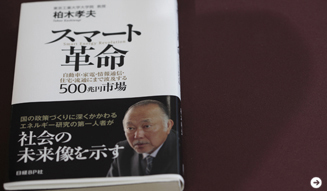
Takao Kashiwagi
Professor at the Graduate School of Tokyo Institute of Technology, Doctor of Engineering. Born in Tokyo in 1946. Graduated from the Faculty of Engineering, Tokyo Institute of Technology in 1970. After serving as a visiting researcher at the U.S. Department of Commerce NBS (now NIST) from 1980 to 1981, he became a professor at the Faculty of Engineering, Tokyo University of Agriculture and Technology in 1988. In 1995, he became a lead author for Working Group II of the IPCC. He has held his current position since 2007. He has served as chairman of the New Energy Subcommittee of the Advisory Committee for Energy and Natural Resources, Ministry of Economy, Trade and Industry, and as president of the Energy Society of Japan, among other roles. Since 2009, he has been a member of the "Council for Next-Generation Energy and Social Systems" of the Ministry of Economy, Trade and Industry, deeply involved in the formulation of national energy policy.