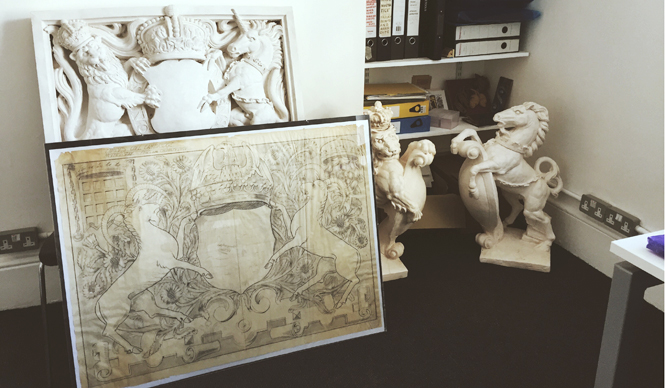
Short Series | Missing Trace: Between London's Memories and Records - Part 1
What Artist Saya Kubota Saw and Felt in London
Part 1: Melting Little Ruins
London, a city where art is deeply rooted in daily life. While it is a place of "creation" where new expressions are born every day, it is also a place of "revival" where buried legacies from the past are unearthed and brought back to life everywhere. This latter act is, so to speak, a game of telephone from the past to the present. What kind of artist wouldn't be thrilled by such a "grand game" that transcends time? Saya Kubota, who was studying restoration and fine art there from April to October 2015, was one of those captivated by its charm. She will write about the people, things, and events that touched her heart during her days drifting between London's memories and records.
Text & Photographs by KUBOTA SayaEdited by TANAKA Junko (OPENERS)
What a Restoration Student Was Diligently Unearthing
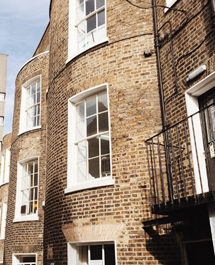
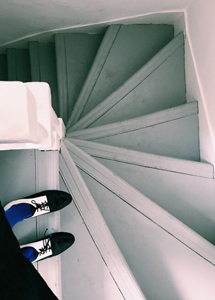
The school where I've been doing a residency since this spring, "City & Guilds of London Art School," is a somewhat unusual independent institution that primarily specializes in "Restoration" and "Fine Art." It's housed in an old Georgian building with distinctive cylindrical bay windows, a small but quite complex structure. The principal, who gave me a tour, even gets "a little lost" in this labyrinthine school, and its challenging nature might just be part of its charm.
And today, when I went to school, I was surprised. Old decorative carvings had emerged, exposed from the pristine white walls. It felt both weighty, like unearthed ruins, and grotesque, as if bone and flesh were peeking out from pure white skin, so much so that I instinctively felt I shouldn't be looking.
Actually, over many years, the decorations had become buried due to continuous repainting. It seems that restoration students are currently in the process of uncovering them. The cross-section of the paint reveals layers of pink and green, which is interesting as it offers glimpses into past rooms and perhaps the lives of some rather spirited homeowners. Buildings like this, listed as Georgian architecture, require extensive paperwork for any renovations to ensure preservation, and the remaining history essentially serves as the building's "pedigree."
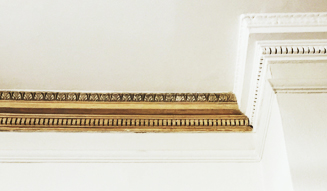
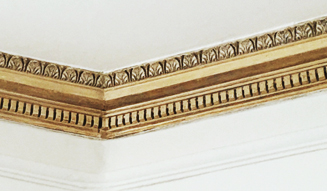
What strikes me most is wondering what the person who first painted over this was thinking. The original decoration, revealed after the paint was stripped, was sooty brown, truly like a ruin. The moment I imagine applying pristine white paint to such a dignified surface… I would undoubtedly hesitate. I recall hearing about the incident during the Meiji era when Nikko Toshogu Shrine was repainted in its original vibrant colors, sparking widespread criticism. I wonder if this person, paint can in hand, had the exact same dilemma in mind.
This leads me to ponder, what truly constitutes "preservation"? Should we pause time, or rewind it? Either way, it feels presumptuous.
The person who first painted over it surely never imagined that it would eventually obscure the very form of the decoration, or that people would forget that sculptures even existed there. It's as if the game of telephone from one homeowner to the next became inaudible due to the thickness of the paint. The very act intended to preserve and utilize has, unintentionally, buried a treasure.
Nevertheless, the decorations, made soft and indistinct by layers of paint, losing their outlines, are also incredibly charming. The starkly revealed decorations right beside them, proclaiming "I am the real thing!", are also dignified and beautiful. I find myself deeply drawn to the combination of these two.
Thus, "antiquity" is not established merely by the moment of its creation. It naturally comes into being only when combined with the "present." The current time, just like past time, holds equal weight for the future. To revere antiquity means to decide whom and what to respect across different times.
Returning to the wall decorations, respecting either the original sooty carvings unearthed by the restoration students or the current pristine, indistinct ones would both be acts of valuing their significance.
Rather than choosing between the time of origin and the present, perhaps there are more ways to approach old things by smoothly imagining and perceiving the flow of time, both past and future.
Surely, wonderful decorations are still sleeping beneath the paint all over London. The rooms are full of ruins, London is a treasure island.

Saya Kubota
Artist. Born in Ibaraki Prefecture in 1987. Spent her childhood in Hong Kong. Graduated from the University of Tsukuba, College of Art and Design. Currently pursuing a Ph.D. in Fine Arts, Oil Painting, at Tokyo University of the Arts Graduate School. Her work is characterized by new images and forms created by combining memories and words, born from everyday scenes and encounters with people. She works across various media, sometimes combining them, including two-dimensional works created by layering layers of burnt tracing paper, three-dimensional works that fuse relics with decorative objects, and installations using unique devices. Participated in numerous group exhibitions, including the project "Drifting Post Office" (Setouchi Triennale 2013).
http://sayakubota.com