Moët & Chandon Impérial 150th Anniversary (1) | MOËT & CHANDON
SponsoredMOËT & CHANDON
Moët & Chandon and 276 Years of Champagne
Moët Impérial 150th Anniversary (1)
Moët & Chandon proclaims itself "the world's most loved champagne." This is because it is said to be the world's No. 1 in sales within the champagne category. Moët & Chandon is a leading brand of champagne. This is evident from the fact that many people, even here in Japan, nearly 10,000 km east of Épernay in the Champagne region of France, where Moët & Chandon is headquartered, know the name Moët & Chandon and that it refers to a producer of champagne. So, what exactly is champagne? And why is it so famous? As a representative of champagne, let's take a look back at the history of Moët & Chandon while reviewing the king of sparkling wines, champagne. It will surely make champagne even more enjoyable.
Text by SUZUKI Fumihiko (WINE-WHAT!?)
The Magic of Champagne
As a sparkling wine, what kind of beverage is champagne, the first thing that comes to mind for everyone today? When discussing Moët & Chandon, we want to start by reviewing the history of champagne. This is because it is also relevant to Moët & Chandon's present.
The origins of champagne are often sought not in France, but rather in English testimony. This is because around 1670, sparkling wines from the Champagne region were apparently gaining popularity in England.
The Champagne region, which originally mainly produced red wine from Pinot Noir grapes, was a renowned wine-producing area but was located in the north and was cold. In an era without global warming, tractors, or scientific cultivation and winemaking knowledge, it was difficult to grow ripe, high-quality grapes, putting it at a disadvantage compared to other regions. Furthermore, it is France, the holy land of wine. About 200 km south of the Champagne region lies Burgundy, a formidable rival. There is even a theory that Pinot Noir was first introduced from Burgundy after the European temperature dropped by 3-4 degrees Celsius in the 16th century, causing devastating damage to the Champagne grapes.
Winemakers in the Champagne region, who were at a disadvantage if they made wine in the same way as others, are said to have pressed Pinot Noir to make something like white wine. This was a pale pink wine that became popular and was exported to England. This wine, exported in barrels, was then transferred to glass bottles and corked in England. However, in warmer climates than the Champagne region, yeast that had merely become dormant due to the cold would reawaken and restart the incomplete alcoholic fermentation.
Yeast consumes sugar and produces alcohol and carbon dioxide gas. In regular wine, the gas produced during fermentation escapes from the open fermentation vessel. The wine is then transferred to barrels and bottled after fermentation is complete. However, when fermentation restarts in a sealed bottle, the gas has no escape route. Thus, the gas dissolves into the wine. This is the theory, currently considered the most plausible, for the creation of early sparkling wine, the original champagne. This secondary fermentation within the bottle is later called 'prise de mousse' and remains a characteristic technique in champagne production today.
This unique sparkling wine became associated with the Champagne region and gained popularity as "the wine of Champagne." However, in the late 1600s, the method of production was not well understood. Some produced sparkling wine, while others did not, making stable production impossible. Due to its rarity, it was expensive, meaning it was a drink for a select few, royalty and aristocrats.
Winemakers in the Champagne region, wanting to produce champagne more stably, developed numerous techniques and tools throughout the 1700s. These included methods to reliably induce secondary fermentation in bottles by adding sugar, bottles strong enough to withstand the resulting pressure without exploding, hemp cords to secure corks, know-how for adjusting bottling times based on grape harvests, the use of cool, temperature-stable underground cellars for storage, and techniques for removing the sediment formed by yeast after secondary fermentation. These innovations laid the foundation for the stable, elegant, and delicious production of sparkling wine that continues to this day.
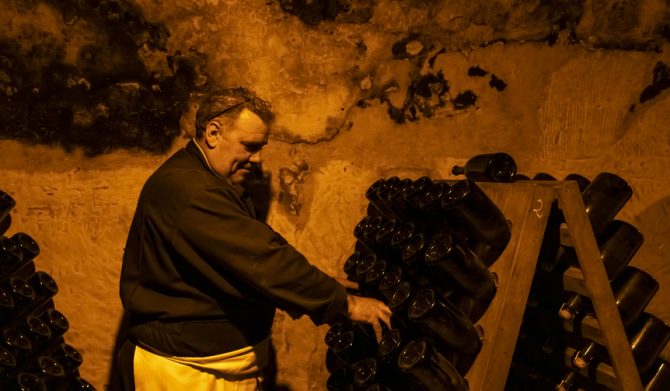
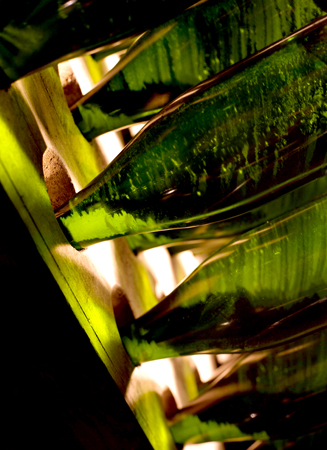
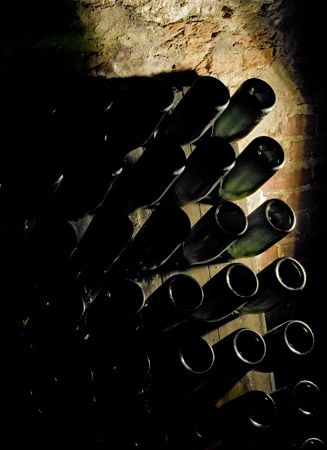
In the cellars of Moët & Chandon. The 'pupitre' used to collect sediment at the neck of the bottle after secondary fermentation. It is called 'pupitre' because the bottles, inserted at an angle, are gradually rotated to move the sediment. This was one of the inventions in Champagne in the 1800s. Today, automated versions of this process also exist.
Among the key figures of this era, often called the "father of champagne," the most well-known is Dom Pierre Pérignon. A Benedictine monk, he is credited with developing techniques for obtaining clear juice from red wine grapes used for Mass and for improving quality by blending grapes from different regions, laying the groundwork for 'assemblage'.
And another extremely important figure is the King of France. Louis XV, who succeeded the Sun King Louis XIV, paid attention to the sparkling wines of the Champagne region as a beverage for the new era. In 1728, while other wines were required to be transported in barrels, Louis XV permitted the distribution of Champagne wines in bottles. This allowed champagne to be distributed throughout France. The fact that the founding years of many renowned champagne houses are concentrated between the late 1700s and early 1800s is due to this period when champagne became stably producible and could be distributed in bottles.
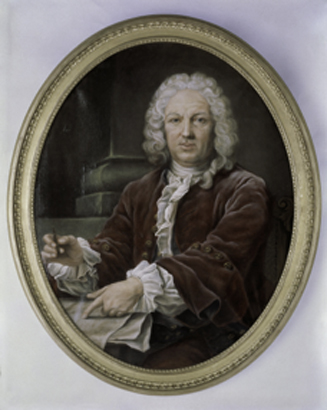
Claude Moët (1683-1760)
The king was captivated by the wines of Claude Moët, an important Champagne wine merchant who registered his winery in the Champagne region in 1743. This Claude Moët was a pioneer in exclusively producing sparkling wines in the Champagne region and is the founder of Moët & Chandon.
Incidentally, Louis XV, who had many mistresses, had a famous mistress, Madame de Pompadour, who greatly influenced his reign. She famously praised champagne, saying, "Champagne is the only drink that leaves a woman beautiful after drinking it." Madame de Pompadour was a patron and enthusiast of Claude Moët's wines.
Moët & Chandon sometimes still uses the expression "SHARE THE MAGIC OF CHAMPAGNE WITH THE WORLD." The origin of this "magic" lies in Madame de Pompadour's words about how champagne makes women beautiful.
The prototype of champagne was created as a wine distinct from others. Champagne would go on to conquer the world and become a beloved presence as a darling of the times.
Moët & Chandon and 276 Years of Champagne: Part 2
Inquiries
MHD Moët Hennessy Diageo
Tel. 03-5217-9906