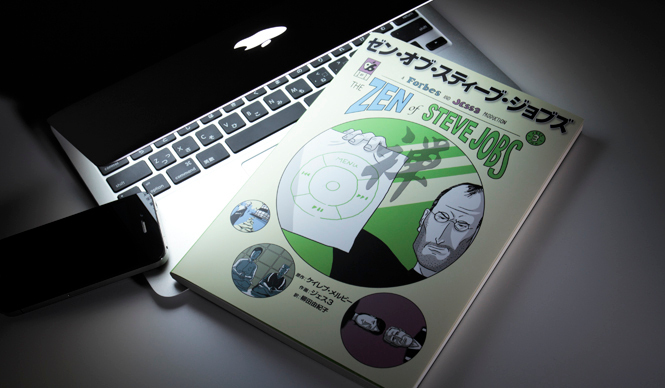
BOOK | Steve Jobs' "Zen" Manga?
BOOK | The Zen of Steve Jobs
A Comic Book Depicting the "Zen" That Supported Jobs
In the early 1970s, a young Jobs encounters a Zen Buddhist monk who came from Japan to spread his teachings. While experiencing a string of great successes and failures, Jobs developed innovative products. How did he incorporate the spirit of "Zen" into his ideas? This American comic book delves into the lesser-known side of Jobs, who continues to have a profound impact on people worldwide even after his death. Here is a book review by translator Yukiko Yanagida.
Text by YANAGIDA YukikoPhotographs by JAMANDFIX
Apple Stores Like Katsura Imperial Villa
Apple, which has just announced the new iPad and seen its stock price reach an all-time high since its founding, seems to be thriving even after the fall of its titan, Steve Jobs.
This may be a bit of a leap, but I believe Japan has two contrasting forms of beauty. One is the understated beauty of "wabi-sabi," exemplified by the Katsura Imperial Villa. The other is the rich and opulent beauty, which could be called "Nippon Baroque," as seen in the Toshogu Shrine in Nikko.
Bruno Taut, a German architect who defected to Japan before the war, praised the Katsura Imperial Villa as "authentic" and criticized the Toshogu Shrine as "kitsch." Conversely, Americans uniformly praise the Toshogu Shrine. In fact, even America's national architect, Frank Lloyd Wright, drew numerous ideas from the Toshogu Shrine.
Los Angeles, where I live, is a glittering city full of the Toshogu-esque sensibility, yet pockets of Katsura Imperial Villa-like spaces are scattered throughout. Many of these are found within upscale shopping malls... Yes, the Apple Stores. The design of Apple Stores is minimal and serene, like the Katsura Imperial Villa or a Zen rock garden, making them an extremely unique presence in America. Furthermore, among American products, which are often rather coarse, the beauty and perfection of Apple products are extraordinary.
So That's How It Was! Steve Jobs and Zen
Anyone Japanese, upon seeing or touching an Apple Store or Apple product, would surely feel the influence of Japanese culture, particularly that of the Katsura Imperial Villa, somewhere within it. But how exactly did Jobs internalize Japanese culture and sublimate it into his products?
The comic book "The Zen of Steve Jobs," published by the venerable American publisher Forbes, directly answers such questions.
This book depicts the 30-year relationship between Jobs and a Zen monk (Kōbun Otogawa, 1938-2002) whom the young Jobs met before founding Apple. While Zen might sound intimidating, there's no need to overthink it, as this is an American comic book, after all.
And true to Forbes' reputation, the artwork in the comic is elegant and very refined. I particularly like the "black turtleneck, jeans, and round glasses" look that became Jobs' trademark in his later years.
Reading "The Zen of Steve Jobs," one can feel a sense of satisfaction, thinking, "Ah! So Jobs was indeed influenced by Japanese culture, especially Zen!" For businessmen, it may also offer hints for developing products with international competitiveness. Though I hesitate to praise it too highly as it is self-promotional and self-authored, it is a stylish and invigoratingly rewarding book. It's no wonder it sold out instantly on its release day in Japan's Amazon and that the publisher had to ship additional copies.
The comic continues even after the titan's passing. "The Zen of Steve Jobs" is scheduled for translation and publication in twelve countries besides Japan, and is being released worldwide.
The Zen of Steve Jobs
Author | Caleb Melby
Art | Jes3
Translation | Yukiko Yanagida
Publisher | Shueisha International
Price | 1365 yen