Life is Edit. #007 ~Hiroshi Sugimoto as a Litmus Test~
Life is Edit.
Series | Encounters to Cherish
#007: Hiroshi Sugimoto, a Litmus Test
New "somethings" are spun and born through encounters with individuals. New "somethings" are sparked and created by a single object. The job of an editor is precisely to create such "encounters." And life itself is, in essence, editing.
—Text editor Akira Shimada introduces the people, objects, and events that have moved him.
Text and Photos by Akira Shimada
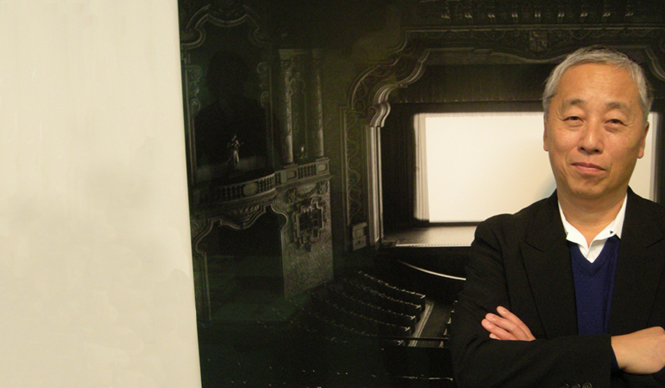
This time, I'd like to introduce Hiroshi Sugimoto, a superstar artist in the contemporary art world.
In 2005, the magazine Brutus dedicated an entire issue to Hiroshi Sugimoto, achieving an unprecedented sell-out for an art feature. The retrospective exhibition held at the Mori Art Museum in Roppongi Hills the same year broke the museum's attendance records. These achievements clearly demonstrate Sugimoto's immense talent and widespread recognition. He is truly an artist Japan can be proud of.
For me, Hiroshi Sugimoto is a heroic figure. I have always been deeply impressed by his work and his words. Every time I encounter his art, I am prompted to contemplate the nature of life, the finiteness of time, and the transience of existence. He reigns supreme in my inner world as a singular, irreplaceable presence.
Sugimoto, who bases his creative activities in New York, returned to Japan for his solo exhibition "Radiant Light" at Gallery Koyanagi, which ran until January 12, 2008. It was on this occasion that we met for the first time in about a year. When I told him about this feature for Openers, he said, "Write whatever you like." But those words, ironically, only made me more nervous (laughs).
Every time I meet Sugimoto, I feel as though I'm being tested. It's like a novice monk engaging in a Zen kōan with a high priest. I feel as though Sugimoto is telling me, "Your training is still insufficient" (laughs).
Triggered by Hedi Slimane's Photography
It was about seven years ago that I first encountered Sugimoto's actual work. It was at a solo exhibition held within the Hermès Ginza store.
The "Seascape" series, in particular, which captures tranquil seas, left a profound impact on me, and I've been captivated by Sugimoto ever since (laughs). My first meeting with him happened by chance.
It was at a Steady Study exhibition. Ms. Mizuyo Yoshida, the company's representative, and I were enthusiastically discussing Hedi Slimane's photography when she told me about his first solo exhibition, 'Berlin,' being held at Gallery Koyanagi. She then introduced me to Mr. Koyanagi, the owner. I felt that to truly appreciate Hedi's photographic prowess, one had to see the actual prints, not just the photobook. So, I visited Gallery Koyanagi and was intently viewing his works when... I noticed someone who looked like Sugimoto in the back of the gallery! I then spoke to Mr. Hashiguchi, a staff member, who introduced me to Sugimoto (I later learned that Mr. Hashiguchi was a former Hermès staff member who had organized that very exhibition. Like me, he had apparently fallen under Sugimoto's spell and moved to Gallery Koyanagi).
At that moment, I impulsively asked Sugimoto directly, "What do you think of Hedi's photographs?" He kindly replied, "His work is better in a photobook. That's because his work comes alive through his perfect editing. See, this layout and the arrangement of the photos, it's quite good, isn't it?" To that, I immediately responded, "Indeed. Regarding fashion, Hedi is more of a ready-to-wear person than haute couture, and he possesses a skill that is conveyed to the public, a high level of editing ability. So, are these prints here like haute couture, and the photobook like mass-market ready-to-wear?" Sugimoto smiled and said, "You say interesting things." I was truly delighted by those words. It felt as though I had gotten a little closer to Sugimoto, as though I had been recognized a bit (I hope it wasn't a misunderstanding—sweat).
Later, in the autumn of 2005, for the magazine 'Gentry,' where I was then working, I arranged a dialogue between the kabuki actor Ebizo Ichikawa XI and a national treasure at Kyoto's Daigo-ji Temple. What was particularly memorable was the evening after the photoshoot. Sugimoto brought with him Mr. Sōitsu Sen, a tea master. Yes, as you might guess from the name, he is a descendant of Sen no Rikyū (the 15th generation!).
Sugimoto, known for his works exploring the theme of time, and a descendant of Sen no Rikyū who appeared as if traveling through approximately 400 years of time... On that occasion, I felt as if I had slipped through time for a moment, and even without alcohol, I felt a pleasant intoxication on that night in the ancient capital of Kyoto...
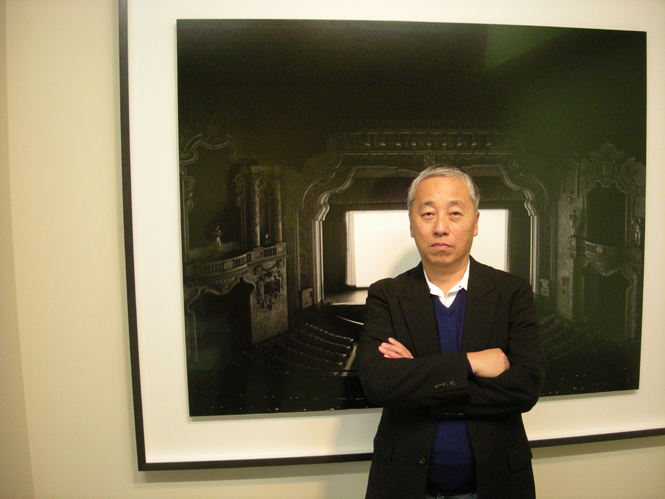
Hiroshi Sugimoto in front of his "Theaters" series. Taking a photo with my digital camera feels almost sacrilegious, but please excuse me (laughs).
People Connected Through Sugimoto's Work
Many of Sugimoto's works constantly evoke a sense of time. The title of the retrospective exhibition at the Mori Art Museum was precisely "END OF TIME," a profoundly deep title. Therefore, when I meet someone with whom I feel I can share time, breathe the same air, and sense a deep connection, I invariably present them with a copy of Sugimoto's "HIROSHI SUGIMOTO" collection (I always keep at least three English copies in stock at home). Among those I've gifted it to are Paul Smith, Thom Browne, and Kean Etro (designer for Etro),ALESSANDRO AGNINI(Art Director and husband of Ms. Oshima of Bottega Veneta), and many others. Of course, through Sugimoto's work, we have deepened our mutual understanding and friendship. There are other people who left a lasting impression on me through Sugimoto's work as well. One is the British actor Jude Law.
Two years ago, Jude Law visited Japan for the opening of the Dunhill Omotesando Hills store. By chance, I had the opportunity to have a meal with him. Knowing he had a deep appreciation for modern art, I immediately asked him upon meeting, "I hear you like art? Do you know Hiroshi Sugimoto?" Jude replied, "Of course! I'm a huge fan of Sugimoto's work. What? Do you have a connection?" Following this conversation, a few days later, I took Jude to Gallery Koyanagi. Unfortunately, Sugimoto was not there, but through Mr. Koyanagi and Mr. Hashiguchi, Sugimoto's work was introduced to him, and Jude was thoroughly impressed. It's truly amazing how globally active actors are knowledgeable in everything from art and music to fashion (he was apparently very excited at Loveless after seeing the gallery). Since then, I've considered Jude and I to be "friends with a certain shared sensibility" through the work of Hiroshi Sugimoto (laughs).
The Eternal Litmus Test
As I mentioned at the beginning, Sugimoto is an eternal hero to me.
Because my feelings are so strong and my writing so inadequate, the more I write, the more I feel I am failing to convey Sugimoto's true brilliance and charm, leading to self-loathing over my powerlessness...
Sugimoto's work contains so many clues to understanding "time = life." I always envision Hiroshi Sugimoto as someone who meticulously contemplates, enjoys serendipity, possesses unceasing effort, and holds unwavering conviction. This applies not only to his works but also to the words he crafts. His writing, filled with profoundly resonant phrases, offers a "gratitude," like a ray of light illuminating darkness, as I delve deeper into understanding his art.
When I met him this time, I told him how many people I had connected with through his work, and how the degree of understanding his art has created a distinction between "my side and the other side" within me. Sugimoto laughed and said, "In that case, I suppose I'm like a litmus test." His broad-mindedness and witty remark are among the reasons I am even more captivated by him.
With the permission of Gallery Koyanagi, I have included some of Sugimoto's words alongside his works. The following are excerpts from his extensive body of work and his profound words. When confronting such deep words and creations, I always take a deep breath, calm my mind, and assume a formal seated posture (laughs).
SEA OF BUDDHA
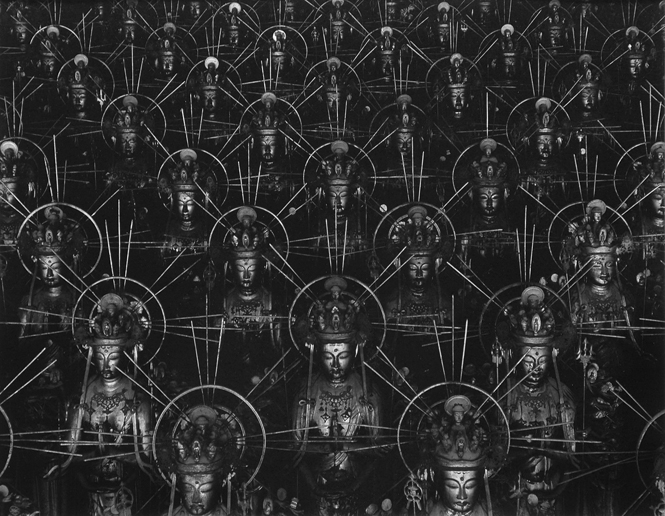
In the mid-1970s, when I moved to New York, the art scene there was dominated by Minimal Art and Conceptual Art. These were experiments exploring what happens when abstract concepts are made visible. I realized that similar artistic endeavors existed in Japan in the 12th century. What would it look like if the conceptualized afterlife, known as the Pure Land of the West, were recreated as a model in this world? This has been passed down to us today, after eight hundred years, in the form of an installation of one thousand Kannon statues.
It took me seven years to obtain permission to photograph. Before the shoot, I removed various decorations added in the early modern and modern periods, including contemporary fluorescent lighting. In this way, I recreated the thousand Buddhas, illuminated by the morning sun rising from the east, as the Heian aristocrats would have seen them. I wondered if contemporary conceptual art would endure for another eight hundred years.
IN PRAISE OF SHADOW
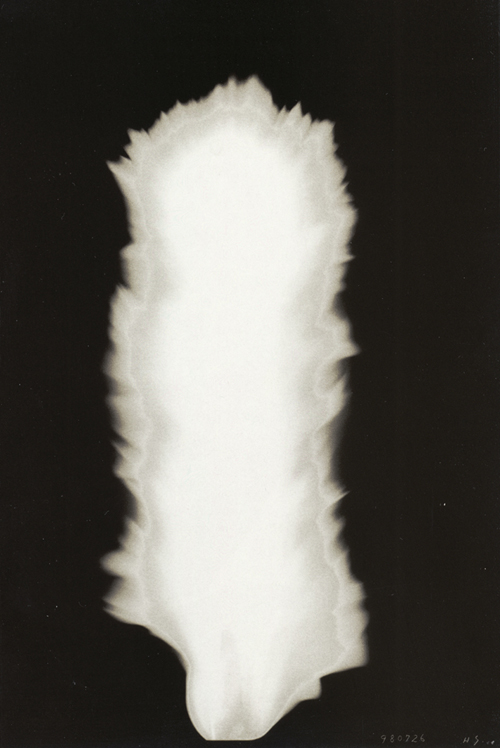
Junichiro Tanizaki was one who resisted the violent artificial light brought by modern civilization until the very end. I, too, have a penchant for anachronism. I find more peace living in the past, when no one else is around, than in the cutting edge of the present. It is undoubtedly true that the ability to control fire gave humanity a decisive advantage over other animals.
Since then, for millions of years, humanity's nights have been illuminated by firelight. I decided to document "the life of a candle." One midsummer night, all the windows were thrown open, and the night breeze was invited in. As the candle was lit, so too was my camera's lens. The candle flame flickered in the breeze and burned out after several hours. Afterward, a deep darkness remained. I savored that profound darkness as I slowly closed the lens. The life of the candle varied each night. Some nights it burned fiercely and briefly, others it burned quietly, without a flicker. But every night, a beautiful dawn arrived.
THEATERS
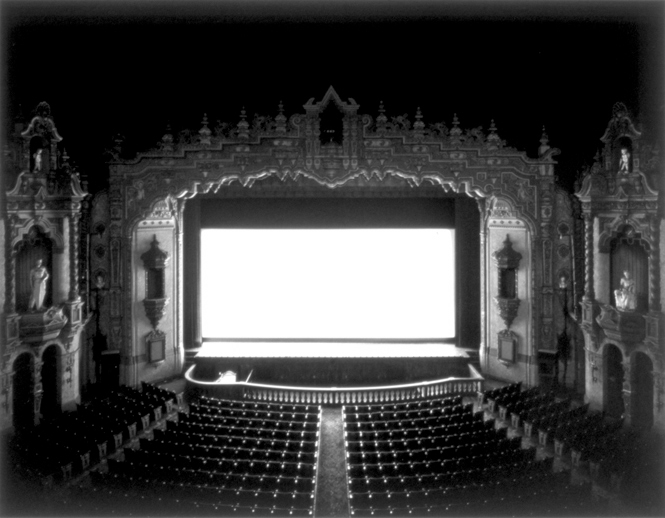
I have a habit of asking myself questions. One evening, around the time I began photographing at the Natural History Museum, I had a vision in a semi-conscious state. The self-questioning that led to this vision was: "Suppose I were to photograph a single film." My answer was as follows: "A luminous screen would be provided." I immediately began experimenting to bring this vision into reality. I succeeded in bringing a large camera into a one-dollar theater in the East Village, disguised as a tourist. When the movie started, I opened the shutter. For the time being, the aperture was fully open. Two hours later, as the film ended, I closed the shutter. I developed the film that night. And that vision appeared brilliantly before my eyes.
What do you think?
If you feel a spark from these photos and words, you too are already infected with Sugimoto fever (laughs).
Whenever I ask Sugimoto about his next project, he always says the same thing.
"I'll surprise you."
I am constantly captivated by his works, which exceed expectations and feel like riddles.
That is why Sugimoto is my eternal hero.
Three years ago, when the Fondation Cartier pour l'art contemporain in Paris made its first journey across the sea for its debut exhibition in Japan, I had the opportunity to engage in a dialogue with its director, Hervé, for Cartier's public relations magazine. Hervé, known as a connoisseur of contemporary art who has discovered many modern artists, including Takashi Murakami, is rumored to provide extensive direction and guidance on artwork creation for certain artists. I asked him if he had given similar instructions to Sugimoto. Hervé's response regarding Hiroshi Sugimoto was remarkably concise.
"We have nothing to teach Hiroshi Sugimoto.
Rather, we learn from him."
As a disciple under Sugimoto, I wish to continue learning from him...
I sincerely believe this.
Until January 12, 2008, Gallery Koyanagi (Tel. 03-3561-1896) is exhibiting several pieces from the "Theaters" series.
I would be most grateful if you could experience them firsthand and journey through time and space.