New Series | Hirotoshi Maruwaka's "Travel Monogatari" ~Accompanying Treasures~ | Guest: Yohei Sadoshima | ThreeBond
New Series: "Dōgyō Ippin" | Toshihiro Maruwaka and Guests Share "Travel Monogatari"
First Travel Companion | Yohei Sadojima (President & CEO, Cork Inc.)
Preparing for a Journey to Read Books (Part 1)
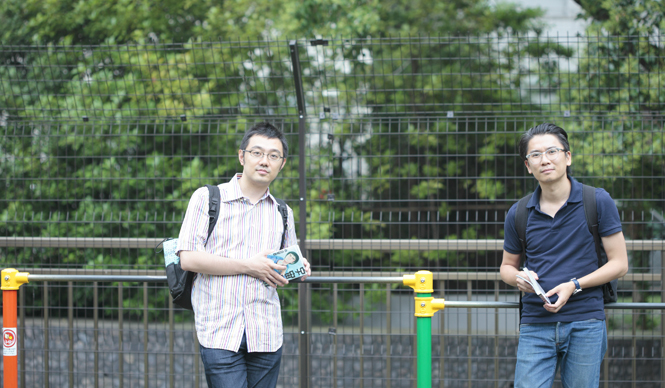
Toshihiro Maruwaka, representative of Maruwakaya, produces products that fuse and project traditional craftsmanship with the latest technological capabilities. A new series begins where he hosts guests who bring along items they would take on a journey, and they discuss travel. Supporting this series is ThreeBond, a manufacturer of industrial sealants and adhesives, who believes that "travel has the power to connect people. This can be the bond between travel companions, or the bond between travelers and local residents."—For this inaugural installment, we welcome Yohei Sadojima, a creator agent known for producing "Space Brothers" and "Dragon Zakura."
Photographs by JAMANDFIXText by KASE Tomoshige (OPENERS)
30 Books Then, Kindle Now
Toshihiro Maruwaka (hereinafter, Maruwaka)
To start, what is something you absolutely must bring on a business trip?
Yohei Sadojima (hereinafter, Sadojima)
Actually, not much. I don't have any particular preferences for business trips. If I need something, I figure I can buy it there. On recent trips, I often don't know what time my flight will be until the day of. I know the departure date, and then the night before, I'll think, 'What time do I have to wake up tomorrow? Oh, 5 AM!'
Maruwaka
So your mind isn't on your destination yet?
Sadojima
I'm still in "Japan" until the last minute. So I just throw my luggage together haphazardly and head out. I use a random suitcase... and for nearby trips, like to Beijing, I even use a duffel bag. My packing is very casual.
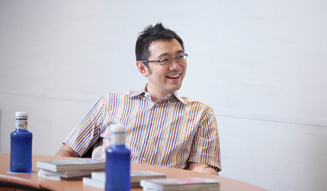
Yohei Sadojima
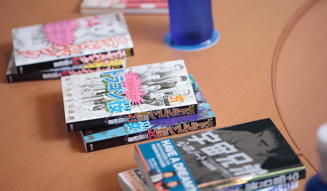
Various manga works produced by Sadojima, including "Space Brothers"
Maruwaka
For the very first installment... I think I've chosen someone who's in for a rough ride (laughs).
Sadojima
Lately, I only bring my Kindle. The main thing is, I hate not being able to read when I want to. I absolutely cannot stand not being able to read when I want to. I'm so busy now that the number of books I read has significantly decreased, but I still hate not reading. I really hate it.
Maruwaka
So, as long as you have a book, everything else will be fine?
Sadojima
In the past, I didn't have a Kindle, so I brought actual books. When I was a student, I didn't have much money, so I never booked expensive accommodations. When going through immigration, they often ask where you'll be staying, but I never had a fixed plan. I'd stay in youth hostels or other cheap places.
So you didn't have strong preferences for hotels either.
Sadojima
Well, it was because I didn't have money. I spent a lot on travel expenses alone. Also, I enjoy dining out, so I would go to expensive restaurants during my trips. For those occasions, I'd bring slightly nicer clothes. I'd happily spend 10,000 or 20,000 yen on lunch, but my accommodation would be 3,000 or 5,000 yen. In Asia, I could keep costs even lower.
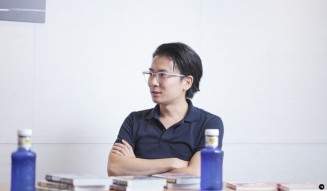
MaruwakaEven considering it was back then, that's quite unusual, isn't it? You spent money on dining and brought nicer clothes, but hotels were a low priority? Your priorities were completely different.
SadojimaThat's right. As a student, I wouldn't even take taxis. I'd take trains occasionally, but I mostly walked everywhere. You can't walk around with a suitcase, can you? So I used a 100-liter backpack for my travels.
Maruwaka
So you were like a backpacker even in the city.
Sadojima
Exactly. And when I went on trips for about 20 days, I'd carry around 30 books (laughs). The backpack was filled with 30 books. Once, in England, I threw my back out. I couldn't move at all and had to take a taxi to the hospital (laughs).
Maruwaka
Many interesting people my age have skewed values... but yours is a remarkably interesting kind of skew (laughs). No, that's incredible. A herniated disc because of books. 30 books is practically a small bookshelf.
Sadojima
When planning a trip, I'd also plan 'where I would read what.' If I went to Portugal, I'd think, 'I'll read this collection of poems by Fernando Pessoa (a poet and writer from Portugal)!' In that vein, I'd think, 'I want to read this book in this park in England.' I'd spend time reading in cafes in Taiwan. I'd read while having breakfast, then go to a park and read, have lunch, and then go to another park and read, and that would be the end of my day. I don't go out at night, so I go to bed early.
Maruwaka
In your previous job (as an editor at Kodansha), most of the people there were book lovers, weren't they? Were there people similar to you?
Sadojima
No, I've never talked about this before. It's about my student days (laughs). In any case, books are important for travel.
Reverence for Books and Authors
Sadojima
I have a strong desire to read a book in the very atmosphere that the author experienced. It might be cliché, but I was inspired to visit Asia after reading "Far Eastern Faraway" by Kōtarō Sawaki, and when I kayaked down a river in Alaska, I was inspired by Tomoyuki Noda's books.
Maruwaka
To what extent can you share the minds and realities of authors and manga artists? You also demand this from your employees at Cork, don't you? But if you were already like this in your student days, it must be quite challenging to keep up with you, Sadojima-san.
Sadojima
That's right... I think I really love books. I have immense respect for books and authors. When I see young people wanting to join Cork, my dissatisfaction isn't with their abilities, but with their lack of love for books and reverence for authors. In my line of work, this deficiency is an absolute lack of capability. Maruwaka-san, don't you also need an obsession with objects?
Maruwaka
I need to be captivated by the artisans and their techniques. There are quite a few people who like objects. But few go as far as wanting to know the mindset of the creators, what brings them joy or sorrow. That's the difference.
Sadojima
I understand when manga fans say they like 'Work A and Work B,' but if they really love the author, liking both Work A and Work B might not make sense if they aren't similar individuals. It's okay to say you like A and C, but saying you like A and B might be a problematic combination. When I actually meet an author, if I mention a strange combination of favorite works, they won't trust me.
Maruwaka
Although our professions are completely different, I believe our fundamental thinking is the same. It's very similar. It's the same with artisans. It's true that they like this object and that object, but sometimes the artisans themselves are on bad terms. Their relationships are almost mapped out. If I want to praise this person, I have to consider that person, but if I praise them directly, they might get angry, so I'll say I like this other person, and since that person respects the first person, I'll move on to this one next (laughs).
Sadojima
Yes, that's very important.
Maruwaka
If you disregard that in meetings... for example, if I say, 'Please make chopsticks here and a bento box there, just for now,' they get angry. They might say, 'I don't want them eating with those chopsticks.'

New Series: "Dōgyō Ippin" | Toshihiro Maruwaka and Guests Share "Travel Monogatari"
First Travel Companion | Yohei Sadojima (President & CEO, Cork Inc.)
Preparing for a Journey to Read Books (Part 2)
Photographs by JAMANDFIXText by KASE Tomoshige (OPENERS)
Reading at a Specific Age and Place
Maruwaka
The advent of Kindle, allowing you to read instantly when you want to, must have been a huge development for you, Sadojima-san. You don't have to carry 30 books anymore.
Sadojima
It's lighter. However, many books aren't available on Kindle. Nowadays, when I go abroad, I'm too busy with work to read many books, so I don't need that many. My dream is to always be thinking about when and where I'll read a particular book, like Dostoevsky's "The Brothers Karamazov." I often think about when I'll read it at what age... that's quite enjoyable.
Maruwaka
That's fascinating. I think very few people love books to that extent, or love them in that way.
Sadojima
What I brought today is my Kindle and this book, "Fleeting Light." This is my absolute favorite book. I always take it with me when I travel privately now.
Maruwaka
Oh! You've read it many times, of course.
Sadojima
I've read it many times. I fold the top of the pages, and I fold the bottom too.
Maruwaka
What's the difference between folding the top and the bottom?
Sadojima
It depends on when I read it. When I find something I like, I fold it. I might fold the top, the bottom, or both. Sometimes I fold it twice. It's like teaching my past self, who read it before, what I liked then. So, when I reread a page, I might read the same page three or four times because I remember thinking, 'This part was good back then.' I love it that much. It's set on Zakynthos island in Greece.
Maruwaka
Have you been there?
Sadojima
I want to go, but it's very far and expensive... it's difficult, so I haven't been yet.
Maruwaka
When did you encounter this book?
Sadojima
It was in my third year of university. I bought over 10 copies and gave them away to people. For a while, it was out of print, and there wasn't a single used copy available. It seems to have been reprinted in the last two years. So, I can give it away again if I want to.
Maruwaka
About how far into the book did you realize, 'This is amazing!'?
Sadojima
Probably around page 100. I was on the train on my way to class. I started reading in the morning, maybe on the second or third day? The book is quite difficult to read. I didn't really understand what it was trying to say. The language was difficult. It mentions many plant names. Names of plants I'd never heard of kept appearing. It was quite challenging, and around page 100, I ended up missing my train stop.
Maruwaka
Did it suddenly click for you?
Sadojima
I was so immersed in the story that when I realized it, I had already gone quite far past my stop. Then I thought, 'I'm reading such a wonderful book, I shouldn't go to school today. I can't stop reading this book halfway through.' So, I went home that day and read it all the way to the end.
Maruwaka
Is that what happens when you get absorbed in a book? (laughs)
Sadojima
That was the only time I've ever done that, with "Fleeting Light." I'm not someone who skips classes, generally. This was the first and only time a book was the reason for skipping class. I've reread it many times since then.
Maruwaka
Isn't that similar to music? Like a song you love so much, one that changed your life, that you can't part with?
Sadojima
Yes. That's why I always match my music to my reading. Like, 'I'll listen to this music while reading this book.' When I was a student, I used to carry around 30-40 CDs in their cases and listen to music while reading. But it was so inconvenient, and I got tired of it, so I stopped listening while traveling and stopped bringing them. Nowadays, you can listen to music on your iPhone, right? It's nice to read a book while listening to music. I also love finding the perfect music for a particular book. It makes me happy when I find something that fits perfectly.
Maruwaka
Besides books, your only other attachment seems to be food. Your suitcase must be interesting. It's definitely not the suitcase of an ordinary traveler.
Sadojima
It's rather plain. But now, my wife handles the preparation of my daily necessities.
Maruwaka
I see. We should have brought your wife today to talk about travel essentials (laughs).
Unconcerned with Travel or Daily Life
Maruwaka
Besides books, is there anything else you've thought, 'This is it!' about?
Sadojima
Before I got involved with Cork, the company I'm running now, I was obsessed with golf. I played quite seriously. My goal was to shoot 75 per round. It was difficult to achieve, so I was always frustrated when playing golf.
Maruwaka
So you're completely the type to have obsessions.
Sadojima
During that period, I would only travel to places where I could play golf. On trips to Hokkaido, my wife would stay at the hotel while I played golf. I'd wake up at 5 AM for an early morning round. I'd play alone, return to the hotel by 8 AM, and then have breakfast with my wife.
Maruwaka
Do you think you have fewer things that you consider 'This is it!' compared to others?
Sadojima
I think so. I rarely feel that way.
Maruwaka
Indeed, you don't seem to be particular about things in your daily life either.
Sadojima
Yes, conversely, if I were to become particular, I'd be too demanding. Since there are so few things I find acceptable, I've ended up accepting everything.
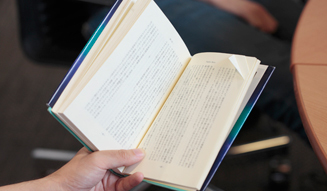
Sadojima folds pages he likes
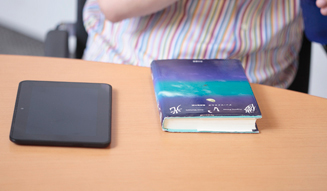
The "Kindle" (left) and the novel "Fleeting Light"
Maruwaka
Please tell us about your third companion.
Sadojima
My Kindle, a book, and this backpack.
Maruwaka
I also use a backpack. It's reassuring to have an umbrella in the side pocket, isn't it?
Sadojima
I like walking, so a backpack is ideal.
Maruwaka
So, those are the three items. You tend to be concise, Sadojima-san (laughs). But it's very much like you. It seems like these are the only things left after stripping everything else away.
Sadojima
No, I really don't have many things I want to bring on trips. I often bring a toothbrush, but if I forget it, a toothbrush sold at the airport is fine. I don't seem to be particular about things. I bring an umbrella, but I'm not particular about it either.
Maruwaka
I remember you mentioning clothing earlier. You said it's generally fine to wear anything, as long as it doesn't make the other person uncomfortable. I feel the same way. For example, even if it's formal attire, wearing a traditional Japanese formal kimono might be inappropriate in some situations. But shorts might be fine if the person gives off a good vibe. Is that how you think about clothing when traveling abroad as well?
Sadojima
Yes. Nowadays, I want to represent Cork, the company I run. For example, when I meet people in China, I dress quite formally. I don't wear a suit, but I do wear a shirt. I used to not even bring shirts, but now I consider it. Depending on who I'm meeting, I also wear a jacket.
Maruwaka
So, for you, clothing is also a tool.
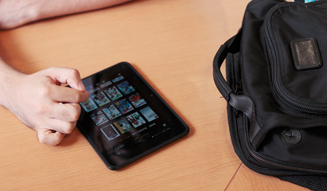
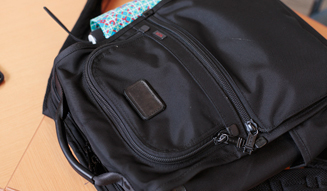
His favorite Tumi backpack
Sadojima
Yes. However, if I were to seriously search for clothes, I would buy something I really like. I understand the feeling of Steve Jobs having many pairs of the same glasses. But I don't really have many clothing designs I like, and even if I did, I wouldn't buy multiples of the same item. So, I don't do that.
Maruwaka
I actually aspire to that myself eventually. Wearing the same thing all the time, or always buying the same pen – that's a mutual love, isn't it? Since I generally like objects, I do search for them, but I haven't reached that level yet, so I tend to stray. I think, 'Isn't this one better?'
Sadojima
I'm pursuing that too. I'm not desperately searching, but even with pants, I think, 'I want something really good,' but I can't find it, so I end up thinking, 'Uniqlo will do.'
Maruwaka
Ultimately, I think that's what it comes down to. In my work, the reason I became interested in items made with traditional techniques is because the depth of what they possess is different. They aren't things you stumble upon. Even when meeting artisans, there are people who try to judge them based on their overall presentation, like they would with books, without reading the author's work. But sometimes, even if something looks beautiful, the spout might be completely useless. That happens often.
Thinking about which book to read at a specific location goes beyond what most people do, even the authors. Evaluating things to that extent is crucial. I believe Japanese people have always had that kind of sensibility. Therefore, when it comes to travel, I don't want to talk to people whose sole purpose is the journey itself. What they aim to discover at the destination is what's important. You are currently passionate about your work at Cork, aren't you?
Sadojima
For example, with golf, I'd play intensely and think, 'I want to get better,' but I'd constantly question myself, 'What do I want to achieve by getting better?' I wasn't going to become a pro (laughs), so what's the fun in practicing hard and always winning company tournaments? Golf itself is fun, but I didn't find much enjoyment in continuing it for so long. With Cork, the more I get into it, the more I can immerse myself. That's a good thing.
Maruwaka
I believe the keyword "books" will remain relevant. But to reiterate, why books?
Sadojima
Just today, I was writing a blog post and thinking about what kind of person I am. Around fourth or fifth grade, I started thinking, 'Why do humans live? Why was I born?' I didn't think anyone around me knew the answer, and I didn't think my parents could answer it. But I thought the answer must be in books. So, I started reading. I read many books, searching for those occasional gems. That's how it is.
For example, this is my favorite passage in "Fleeting Light." "When he set out for the South Pole, he borrowed Tennyson's poetry collection from a friend and took it with him. Even on the arduous return journey, when every grain of sand felt heavy on his shoulders and feet, he did not discard it. He carried it back to return it to its owner. I can easily understand the feeling of wanting to take something you love with you when venturing to the ends of the earth. It must be a precious item, if only because it makes you believe you will meet its owner again."
It's a scene where an adult tells a child various episodes. One of them is about Wilson, who was exploring the Antarctic. Just before he died, when his body could no longer move, he said, 'Let's return to base,' and he discarded everything he was carrying. Even when he was almost weightless, he kept Tennyson's poetry collection, even though it wasn't his. When spring came, the person who discovered Wilson's body found it. I really love that episode. What can I say? Perhaps taking something very important to someone else, and something very important to yourself, when embarking on a journey where you might die, is a noble act. This part doesn't significantly affect the overall story, but the novel is built on such scenes. I really like the scenes where adults are talking to children.
Maruwaka
That story deeply relates to the core theme of this series, doesn't it?
Sadojima
It perfectly aligns with the theme of travel.
Maruwaka
Did you know that when you brought this book?
Sadojima
I didn't know (laughs).
Maruwaka
You didn't know (laughs). But I believe that when you choose something unconsciously, that's when you're truly choosing. For example, if someone asks me to pick a teacup, I think about many things. 'Will this sell if I offer it? If it sells, should I offer this artisan's work over that one's?' Once I start thinking like that, it's over. But the fact that you choose things unconsciously is what makes them good. That's why I chose the theme of travel for this series. Travel is something you can't really plan intentionally.
Sadojima
I can't really travel alone these days, mainly because I have a family. When I used to travel alone, I'd bring postcards. I'd write and send one postcard every day.
Maruwaka
To whom?
Sadojima
To my girlfriend, for example. I really enjoyed that. Writing about what happened that day. When traveling alone, you don't talk to anyone. Back then, we didn't have mobile phones, so I couldn't email either.
Maruwaka
But fundamentally, you are a romantic and charming person, which I believe is a prerequisite for this series. The desire to convey your feelings to others, and your purity, are attractive qualities. I think these qualities emerge especially during travel. Mr. Tsuchida, who was the first guest to cooperate with this series, also mentioned going to distant islands just to eat. Like with classic cars, one might think, 'Couldn't this be avoided?' Postcards are similar, aren't they? They are excessive, in a way. But because you're not doing it out of calculation, it gains meaning. I believe that's the case.
Sadojima
That's right. I don't have time to write postcards now (laughs).
Maruwaka
You sleep in just a T-shirt and a towel (laughs). Today, I'm glad we chose travel as the theme, as I've heard such insightful stories. Thank you very much.
Yohei Sadojima | SADOSHIMA Yohei
Born in 1979. Spent his middle school years in the Republic of South Africa before attending Nada High School. After graduating from the University of Tokyo's Faculty of Letters in 2002, he joined Kodansha. In the "Morning" editorial department, he served as a sub-editor for Takehiko Inoue's "Vagabond" and Moyoco Anno's "Sakuran." "Dragon Zakura" by Norifusa Mita, which he launched in 2003, achieved sales of 6 million copies. He also nurtured Chuya Koyama's "Space Brothers" into a mega-hit with over 10 million copies sold, leading to its adaptation into an anime and live-action film. In October 2012, he left Kodansha and founded Cork, a creator agency. http://corkagency.com/
Toshihiro Maruwaka | MARUWAKA Hirotoshi
Born in 1979. From Tokyo. Representative of "Maruwakaya Inc.," which shapes contemporary Japanese culture. He derives contemporary value by embodying universal "beauty" and the "moment" of the present in objects and experiences. He engages in "monozukuri" (craftsmanship) with Japan's finest, from traditional crafts to collaborations with cutting-edge industries, such as "Kitajima Shibori Seisakusho." He has led projects like "Kutani Ware Flower-Filled Skull Candy Jar" (in the collection of the 21st Century Museum of Contemporary Art, Kanazawa), "Koueiemon Izumigama x Jaime Hayon" (exhibited at Milan Design Week), and "PUMA AROUND THE BENTO BOX." http://maru-waka.com/
[Series "Dōgyō Ippin" Supporter]
Kosaku Tsuchida | TSUCHIDA Kosaku
Born in 1977. From Tokyo. Managing Director of the industrial sealant and adhesive manufacturer "ThreeBond Co., Ltd." (at the time of the interview). He conceptualized "Kuttsuku Kizuna Mechanism," which investigates and researches the mechanisms by which human bonds are formed. Through interviews with individuals active in various fields, he strives to research not only bonding objects but also connecting people. His connection with Maruwaka also stems from "Kuttsuku Kizuna Mechanism." "ThreeBond presents Kuttsuku Kizuna Mechanism Website"
http://929kizuna.com/

An industrial sealant and adhesive manufacturer founded in 1955. Operating under a regional management system divided into six global regions—Japan/Asia, China, Europe, North/Central America, and South America—the company has a global presence, primarily in the automotive industry, but also in sectors such as electronics and infrastructure.
Maruwakaya
http://maru-waka.com/
http://h-maruwaka.blog.openers.jp/