ART | Espace Louis Vuitton Tokyo: "Monuments of Traffic"
ART | ESPACE LOUIS VUITTON TOKYO
“Monuments of Traffic”
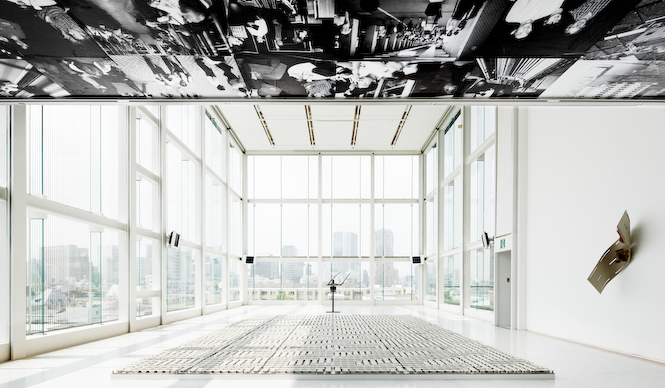
Currently, at ESPACE LOUIS VUITTON TOKYO, an art space on the 7th floor of the Louis Vuitton Omotesando Building in Tokyo's Omotesando district, the exhibition “Monuments of Traffic” by German artist Thomas Bayrle is being held. The exhibition runs until Sunday, September 1st. In the balanced space curated by Bayrle, Erik Satie's "Furniture Music" plays, and a windshield wiper conducts.
Text by SUZUKI Fumihiko (OPENERS)
Minimalist Space
If one were to attempt a simple explanation of "minimalism" in architecture, art, and music, it might be described as an expressive method that primarily uses small, identical constituent elements, repeating them while introducing slight variations to create a collective of a certain scale.
The works by German artist Thomas Bayrle currently on display at Espace Louis Vuitton Tokyo are largely based on minimalism.
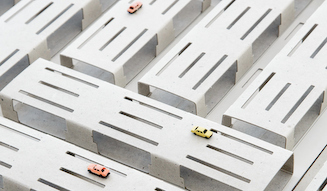
The most typical example is the work titled “Carmageddon”.
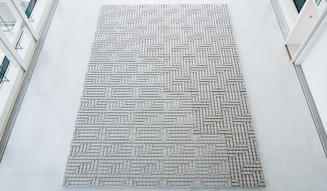
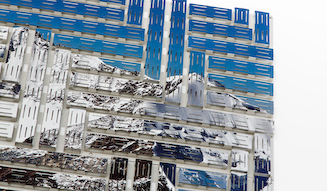
This piece consists of multiple gray cardboard forms, folded into a C-shape with slits resembling the kanji character "三" (san), arranged on rectangular panels. Each panel with these arranged "C" shapes forms a unit. These units are then placed side-by-side to create something akin to a large rectangular panel, which then becomes a single artwork.
The arrangement of the "C" shapes within each unit varies subtly, and miniature car models are placed on some of these "C" shapes.
When viewed from a distance, this collection of "C" shapes appears to form a patterned surface, much like a textile.
©Louis Vuitton / Jérémie Souteyrat
Courtesy of Espace Louis Vuitton Tokyo
Erik Satie's “Furniture Music,” playing in the space, is also a form of minimalist music, where the piece progresses through repetition of the same short musical phrase.
Thus, Espace Louis Vuitton Tokyo is currently a minimalist space.
Intensity
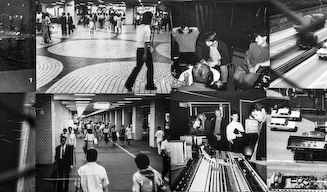
However, while looking at the photographs, taken by Bayrle himself in the late 1970s and arranged like a mosaic on the walls, of Shinjuku and Tsukiji, we find ourselves captivated by the people, cars, and buildings within each image, and we pause, thinking, "Hmm?"
We were looking at the overall mosaic-like pattern, but then our attention is drawn to the individual elements that compose it. At that moment, we feel as though we begin to understand what the artist intends to convey.
©Louis Vuitton / Jérémie Souteyrat
Courtesy of Espace Louis Vuitton Tokyo
The word "Intensity," used by Thomas Bayrle during his explanation of his work upon his visit to Japan for this exhibition (which opened on May 18th), also seemed to hold a clue.
Here, we will use the word "intensity" to translate "Intensity." This intensity refers to the degree of forcefulness, the burden that an object imposes on "me" as the subject.
For example, when we view people as large units, such as "Japanese" or "German," we don't concern ourselves with each individual within that unit. Even when referring to "100 Japanese men in their 30s," we temporarily forget the obvious fact that these 100 individuals are all distinct. Or rather, we cannot perceive people in such vague categories without forgetting this fact.
Bayrle poses a question to this innocent yet crude way of thinking.
When someone is right in front of us and recognized as "you," their intensity as a 36-year-old Japanese man might be 100 to "me." Yet, when we say "100 Japanese men in their 30s," does not the intensity of each of those 100 people become 100 to "me"? If so, why is a person who should have an intensity of 100 as an individual reduced to an intensity of 1 when they join a group? If 100 people, each with an intensity of 100, gather, shouldn't the total intensity be 10,000? He asks questions like these.
Bayrle's works re-examine these self-evident truths.
However, his approach is very gentle.
ESPACE LOUIS VUITTON TOKYO
Monuments of Traffic (2)
Swimming Through Japan
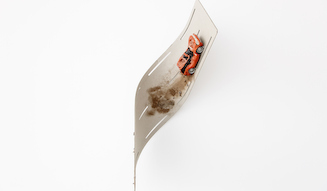
The story behind “Carmageddon” is the future. Each of the aforementioned "C" shapes represents a highway-like road. The assumption is that if a world comes where cars are no longer needed and roads are left abandoned without any cars to use them, children will view these countless remaining road objects as something mysterious.
Similarly, the work titled “Mountains on Motorways,” where "C" shapes representing roads are arranged, features mountain landscapes depicted on the surface of these "C" shapes. After seeing “Carmageddon,” this piece appears as the future of nature, left in a state of disarray after being cut and reshaped by artificial structures like roads, and then abandoned when those roads became obsolete.
Does the artist, through this work, criticize technology? No, Bayrle does not simply criticize technology. He suggests that even if nature is soiled or transformed by human hands, it continues to exist as valuable nature, just as it did before.
©Louis Vuitton / Jérémie Souteyrat
Courtesy of Espace Louis Vuitton Tokyo
According to Bayrle, the merits and demerits of technology are roughly 50-50. Therefore, it is not wise to view the advantages and disadvantages of artificial objects as opposing forces. In a 50-50 battle, a clear winner is unlikely.
In the aforementioned series of photographs capturing Tokyo in the late 1970s, this approach to contrast is further developed.
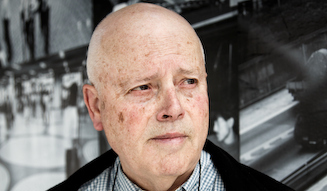
Bayrle states that he took these photographs during a six-week stay in Tokyo in August. When asked why he described his experience as "swimming" through Tokyo, he explained that despite the high population density, people in Tokyo do not collide with each other. They pass by each other smoothly, like the flow of water, without greetings or signals, as if it were the most natural thing. This impression led him to use the word "swim."
He further elaborated, "Japan has a culture that presupposes interaction between individuals, such as the way people eat sushi. It has a culture that respects personal time for introspection, like reading or meditating on a train. In Japan, the collective and the individual are not in opposition; they are each respected. This is a fundamental element of my creative process."
When finally asked about Tokyo today, nearly 40 years later, this was the response:
"In the 1970s, Japan, like my beloved camera, was at the forefront of the world in many fields, so there was a great sense of energy and competitive spirit. Yet, even then, Japanese people lived with respect for both the collective and the individual. Now, the energy and momentum of growth have considerably subsided, and I believe Japan and Tokyo have established a firm position in the world. Perhaps this is why finding meaning in re-examining one's own culture has become more significant."
"Now, the energy and momentum of growth have considerably subsided, and I believe Japan and Tokyo have established a firm position in the world. Perhaps this is why finding meaning in re-examining one's own culture has become more significant."
©Louis Vuitton / Jérémie Souteyrat
Courtesy of Espace Louis Vuitton Tokyo
"Various problems, both international and domestic, will likely continue to arise in Japan. My hope is that society will continue to be one where people do not clash but rather merge smoothly."
Monuments of Traffic
5-7-5 Jingumae, Shibuya-ku, Tokyo, Louis Vuitton Omotesando Building 7F
Dates | Saturday, May 18, 2013 – Sunday, September 1, 2013
Hours | 12:00 – 20:00
Phone | 03-5766-1094
Web | www.espacelouisvuittontokyo.com

©Louis Vuitton / Jérémie Souteyrat
Courtesy of Espace Louis Vuitton Tokyo
Thomas BAYRLE
Born in Berlin in 1937. Lives in Frankfurt am Main. He began his training as a weaver, a background that influenced his fundamental artistic explorations of patterns and grids. For over 30 years, he taught at the Städelschule in Frankfurt, influencing many artists. His works have been exhibited in numerous art shows across Europe, and a major retrospective was held at WIELS Contemporary Art Centre in 2013. He has also participated in group exhibitions such as "documenta" (1964, 1977, 2012) and "von hier aus" (1984). In 2012, he received the Arnold Bode Prize at "documenta (13)."