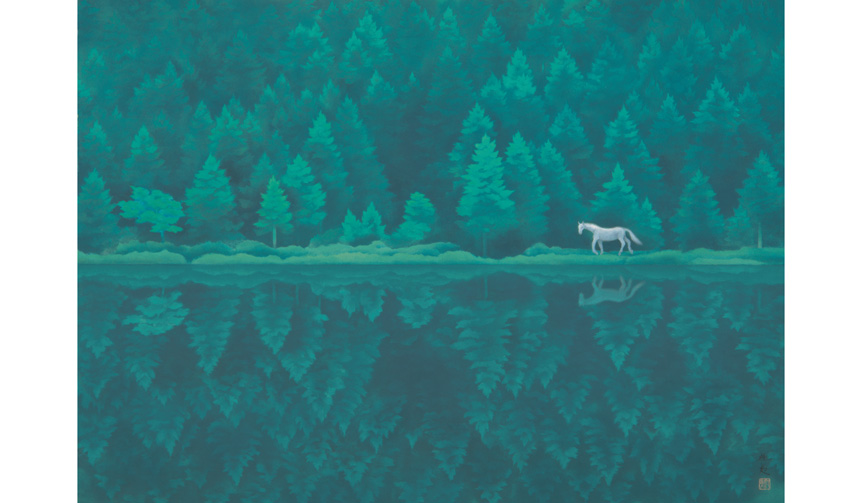
“Kaii Higashiyama Centennial Exhibition”: Approximately 70 Works Featuring His Unique Inner Landscapes | ART
ART | Serene Landscapes Merging Nature's Scenery with the Artist's Inner World
The Retrospective of Kaii Higashiyama, Hailed as a National Landscape Painter
The "Kaii Higashiyama Centennial Exhibition" Looking Back on His Artistic Career
Kaii Higashiyama (1908-1999) was celebrated as a leading national landscape painter of the post-war era. To commemorate the 110th anniversary of his birth, a major retrospective exhibition, "Kaii Higashiyama Centennial Exhibition," the first in Tokyo in 10 years, will be held at The National Art Center, Tokyo, from October 24, 2018 (Wed) to December 3, 2018 (Mon).
Text by OZAKI Sayaka
The Full Scope of Higashiyama's Artistic Journey Through the 20th Century
The "Kaii Higashiyama Centennial Exhibition" is a retrospective commemorating the 110th anniversary of the birth of Kaii Higashiyama, who painted beautiful landscapes that merged the scenery of nature with his own emotions, earning him acclaim as a national artist.
Born in Yokohama, Kaii Higashiyama graduated from the Tokyo School of Fine Arts. His study abroad in Germany in 1933 marked a significant step towards his future artistic endeavors. However, he experienced a period of hardship, including conscription into the Pacific War and the loss of close family members around the end of the war.
It was the vibrant life force emanating from nature that offered Higashiyama a path forward during his darkest times.
His work "Afterglow" (1947), which received a special prize at the Nitten exhibition, vividly reflects Higashiyama's state of mind at the time, depicting a mountain landscape illuminated by the setting sun.
From then on, Higashiyama began to observe nature with an unpretentious, honest eye and heart, painting landscapes that projected his own emotions onto the life he found there.
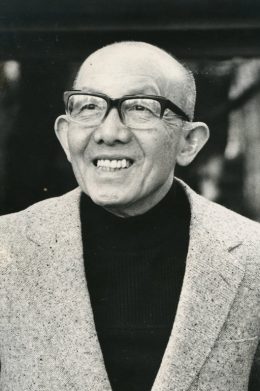
Kaii Higashiyama Portrait (1984, age 75) Photo: Nikkei Inc.
In 1962, seeking landscapes that resonated with his soul, Higashiyama traveled to Northern Europe and presented a series of works including "Reflection" (1962) and "Winter Flowers" (1964). His ethereal and pure compositions were highly acclaimed, and the frequent use of blue in these works led to his image as the "painter of blue."
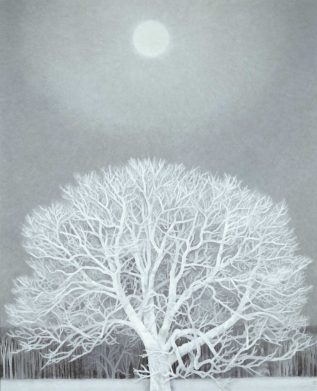
"Winter Flowers," 1964, by Kaii Higashiyama, Collection of The National Museum of Modern Art, Tokyo
Upon returning to Japan from Northern Europe, Higashiyama was commissioned to create large-scale murals for the new Imperial Palace. In search of Japanese motifs, he journeyed to Kyoto, a city that embodies the essence of Japan's ancient culture, and presented a series of works depicting the old capital. These works, revealing a Yamato-e-like aspect of the artist, distinct from his Northern European series, added a new dimension of charm to Higashiyama's style, signifying a return to Japanese aesthetics.
In 1968, the same year the Imperial Palace murals were completed, he exhibited his Kyoto series in the "Kyoto Seasons" exhibition. He created new works in a fresh style, such as "Illuminated Flowers," which depicted flowers with dynamic and fantastical flair.
The year after the public unveiling of his Kyoto series, Higashiyama embarked on journeys to Germany and Austria.
In works like "Window" (1971) and "Distant View of an Ancient Capital" (1971), he captured the accumulated culture that gave the ancient capital its charm, reflecting it in the robust stone buildings and townscapes of Germany and Austria, where people had lived for centuries. These pieces expanded his expressive range, offering a new appeal distinct from his previous focus on depicting nature.
A key characteristic of Higashiyama's landscape paintings is,
as early demonstrated in his seminal work "The Road" (1950), their simple compositions and clear colors.
Having honed his skills through travels not only in Japan but also in Northern Europe, Germany, and Austria, Higashiyama continued to explore his unique inner landscapes that resonated with viewers' emotions. He achieved this by maintaining a sense of naturalness even in decorative compositions and by skillfully employing the power of cool, blue-infused colors.
This exhibition will feature a special recreation of the screen paintings for the Hoodo of Toshodai-ji Temple, considered the culmination of Higashiyama's artistic achievements, a project that took 10 years to complete. We invite you to experience the full spectrum of Higashiyama's art, which evolved alongside the 20th century, through approximately 70 masterpieces, including these grand screen paintings.
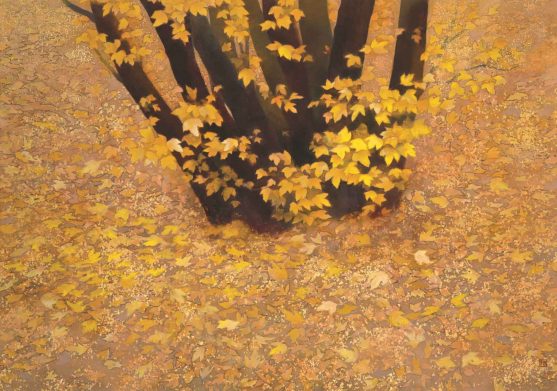
"Autumn Departure," 1990, by Kaii Higashiyama, Collection of The Nagano Prefectural Shinano Art Museum, Higashiyama Kaii Gallery
Kaii Higashiyama Centennial Exhibition
Dates: October 24, 2018 (Wed) – December 3, 2018 (Mon)
Opening Hours: 10:00 – 18:00 (Fridays and Saturdays until 20:00; last admission 30 minutes before closing)
Venue: The National Art Center, Tokyo, Special Exhibition Gallery 2E
Address: 7-22-2 Roppongi, Minato-ku, Tokyo
Organizers: The National Art Center, Tokyo; Nikkei Inc.; TV TOKYO Corporation; BS TV TOKYO Corporation
Special Sponsorship: Daiwa Securities Group Inc.
Sponsorship: Daiwa House Industry Co., Ltd.; Toppan Printing Co., Ltd.; Toyota Motor Corporation; Panasonic Corporation; Mitsui & Co., Ltd.
Special Cooperation: Toshodai-ji Temple
Cooperation: The Nagano Prefectural Shinano Art Museum, Higashiyama Kaii Gallery
Inquiries