Discovering the Art of Autumn at a Museum Hotel Embracing Japanese Beauty | Hotel Gajoen Tokyo
Hotel Gajoen Tokyo
Discovering the Art of Autumn at a Museum Hotel Embracing Japanese Beauty
This summer's intense heat has finally given way to the first hints of autumn, yet the season's unpredictable weather still leaves one hesitant to plan outdoor excursions. We propose, instead, an art-filled escape within a city hotel. Hotel Gajoen Tokyo in Meguro, often called the 'Dragon Palace of the Showa Era,' houses precious artworks throughout its premises. Here, one can enjoy art appreciation in elegance, unbothered by inclement weather.
Text by MAKIGUCHI June
Encountering Japanese Beauty Across Time. Rooms Designed by Condor, Too.
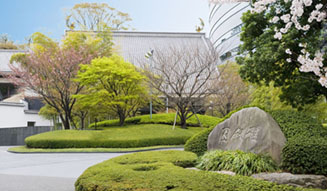
Hotel Gajoen Tokyo will celebrate its 90th anniversary in December 2018. For many years, it was known as Meguro Gajoen, a beloved venue for weddings and events. In April 2017, it reopened after rebranding to welcome a wider range of guests. Reborn as a luxury hotel, all 60 guest rooms are suites of 80m² or more. The concept is 'Wa Kei Sei Shin' (Harmony, Respect, Purity, Tranquility). The rooms are designed to be serene, reflecting the spirit of 'wabi-sabi' found in tea rooms, with a focus on nature and light. Surrounded by greenery, a rarity in Tokyo, guests can enjoy a truly relaxing stay.
The history of its predecessor, Meguro Gajoen, began in 1928. Founder Rikizo Hosokawa renovated his home in Shibaura, Tokyo, to open 'Shibaura Gajoen,' a purely Japanese-style restaurant. It was a high-end establishment that prided itself on serving authentic flavors, specializing in Japanese and Beijing cuisine.
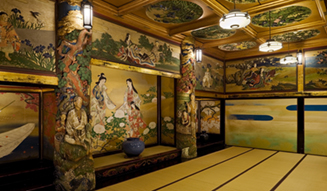
In 1931, the establishment relocated to Meguro, aiming to be a restaurant accessible to everyone. To delight the eyes as well as the palate, artists were summoned from across the country to decorate the interior with murals, ceiling paintings, and sculptures. Hosokawa also had a patron's spirit, supporting artists seeking work, and spared no expense in commissioning them. The result was a lavish and magnificent building, earning it the nickname 'Dragon Palace of the Showa Era.'
Most of the art created at that time was carefully relocated and is still preserved today when the building was newly constructed. The numerous works of art and crafts displayed within the hotel symbolize the ultimate hospitality born from the founder's sole desire to please his guests. Preserving them is, in turn, a continuation of Gajoen's hospitality spirit. Today, it is recognized not only domestically but also internationally as a unique museum hotel embodying Japanese beauty.
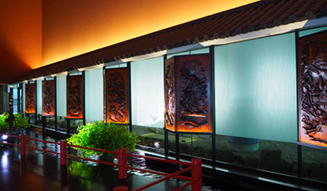
Walking through the main entrance and into the hotel, one suddenly encounters a passageway with flowing water. Passing through the 'Maneki no Daimon' gate and proceeding further, one is greeted by a succession of vibrant decorations. Splendid and magnificent – these words barely do it justice.
Art can be found on the walls, floors, and ceilings throughout the hotel, making a simple walk a form of art appreciation. However, there's a way to see some artworks up close that are normally off-limits. This is through the art tours exclusively for hotel guests.
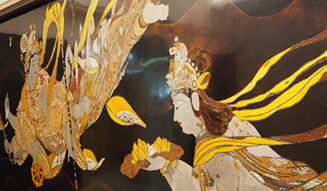
The tour begins on the 5th floor(*The order may vary by day).This is the bridal floor, featuring a shrine, chapel, beauty salon, photo studio, and family waiting rooms. Along the corridor, the lacquered artwork 'Maiden's Dance' welcomes visitors.
Techniques such as mother-of-pearl inlay (raden), gold lacquer (maki-e), and mosaic (zougan) are used. The maiden gracefully plays celestial music while scattering flowers and fragrance. The original design was created by Takezan Kimura, a painter who restored the screen paintings of Kongobu-ji Temple on Mount Koya. The ceiling of the corridor also features 'Maiden's Dance,' based on Kimura's original design, but rendered as a polychrome wood carving.
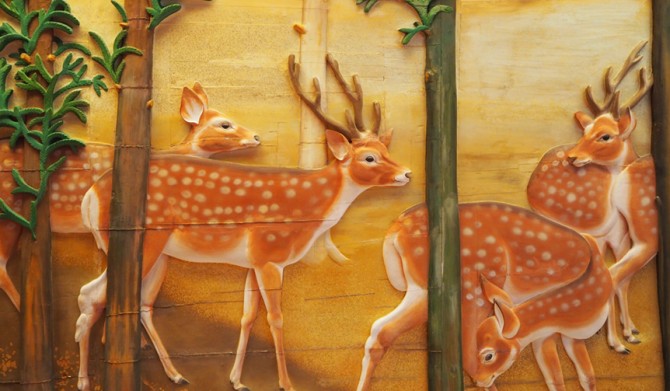
Passing through the family waiting room, one enters the shrine, where the polychrome wood carving 'Spring in Kasuga' by Tomiji Negami, depicting deer from Kasuga Taisha Shrine in Nara, greets visitors at the entrance. The charming deer seem to bless the couple's new beginning.
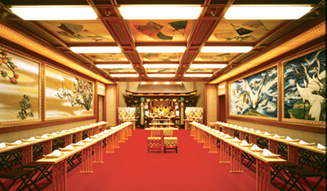
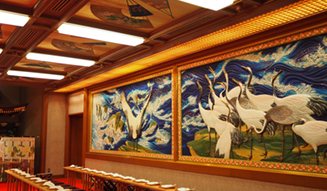
In the Omi-den hall beyond, the spirit of Izumo Taisha Shrine is enshrined. To the right is 'Flock of Cranes on Waves,' based on a design by Kiboku Kodama, and to the left is 'Plum Blossoms and Autumn Leaves,' based on a design by Shunso Hishida, each representing a season. They seem to embody the wish for the couple to spend many years together, hand in hand.
Gajoen, which has blessed over 220,000 new journeys in life as Japan's first comprehensive wedding venue, exudes a pleasant energy. As it has long been cherished as a banquet hall for celebrations, the presence of auspicious motifs is particularly striking.
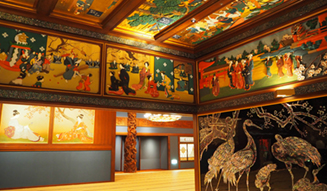
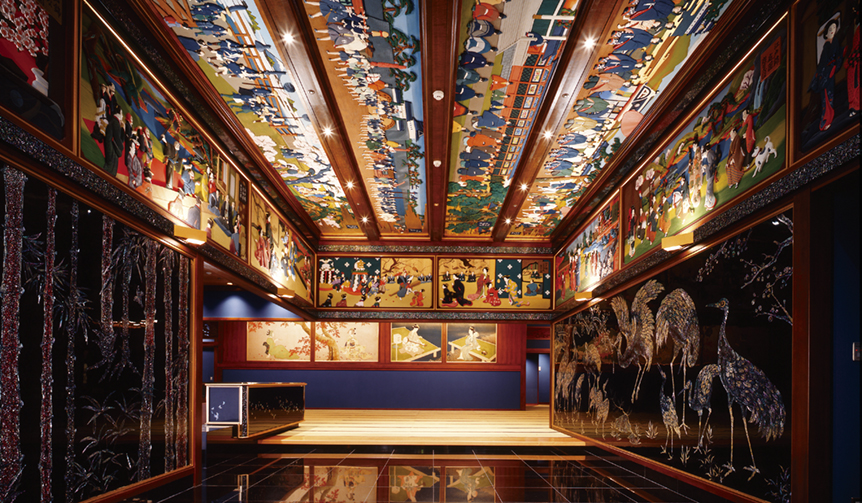
On the 4th floor are Japanese-style banquet rooms. The main entrance features the interior that was once the front entrance of the restaurant when it was 'Meguro Gajoen,' recreated almost as it was, and it continues to welcome many guests. The wall surface inside the entrance is truly breathtaking. In black lacquer with mother-of-pearl inlay, 'Plum Blossoms and Cranes' and 'Bamboo Forest and Sparrows' are depicted, based on original designs by Chikaho Otake, similar to the mother-of-pearl inlay artwork in the transom above the entrance. Combined with the colorful polychrome wood carvings adorning the transom and ceiling, it is exceptionally brilliant. The three-dimensional paintings in the transom depict 'Scenes of Pleasure in the Four Seasons and Annual Events of the Tokugawa Shogunate's Inner Palace.'
The astonishing craftsmanship of mother-of-pearl inlay and polychrome wood carving, as well as the vibrant depiction of seasonal events, is fascinating, making one lose track of time. Standing before these precious artworks, which could never be created today, leaves one speechless. Both the 5th and 4th floors are adorned with decorations that are instantly recognizable and evoke celebration, ensuring that guests are never bored, even during waiting times. It conveys the founder's wish to make each celebratory day even more special.
On the 1st floor is the Japanese restaurant 'Tofutei,' characterized by its thatched-roof traditional Japanese house. The private room 'Chikaho,' named after Chikaho Otake who drew the original artwork, features mother-of-pearl inlay with iridescent butterfly shells embedded in black lacquer on the walls and pillars. The mother-of-pearl inlay on the wall, 'Ancient Pine and Cranes,' is truly magnificent. This mother-of-pearl work uses the 'togidashi' technique, where shells are shaped, coated with lacquer, and then polished with charcoal to reveal the pattern. The ceiling and transom paintings depict the four seasons of Hokkaido's lakes (Lake Akan, Lake Mashu, Lake Kussharo).
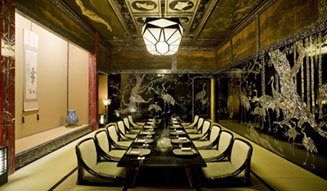
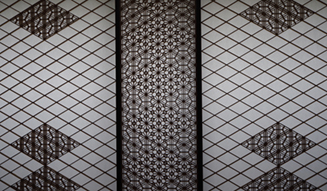
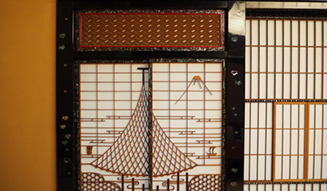
The room 'Shusei,' recommended for its balance of Gajoen's signature art forms—mother-of-pearl inlay, kumiko woodwork, and pillar carvings—features ceiling and transom paintings by Shuho Ikegami depicting seasonal flowers and seventy-seven birds, along with mother-of-pearl inlaid sliding doors and latticework depicting Mt. Fuji. It offers visual delight from every angle.
At the far end of the 1st floor is the Chinese restaurant 'Shunyuuki.' While boasting Chinese cuisine served since the hotel's founding, the interior is equally remarkable. A must-see is the room 'Nanpu,' designed by Josiah Conder, the architect behind landmarks like the Rokumeikan and Nikolai Cathedral. This is a remnant of the former Iwanaga residence, which stood on the site when the founder purchased it in 1931. The mantelpiece and arched bay window are vestiges of its past as a Western-style building, with the ceiling and mantelpiece adorned in the Art Nouveau style popular at the time. For architecture and interior design enthusiasts, dining here is a dreamlike experience. Also noteworthy are the murals by Kunitoshi Tateyama, a recipient of the Order of Cultural Merit, and the decorative elements gracing the ceiling.
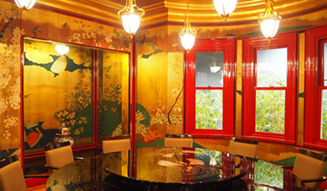
The private room 'Tamashiro' allows guests to admire 'Cherry Blossom Flower Viewing Dance,' a painting by Tamaki Masuda, a master of bijin-ga (pictures of beautiful women). The vibrant design, inspired by the Shinbashi Odori dance, and the vivid vermilion lacquer on the doors, baseboards, and door frames are exhilarating.
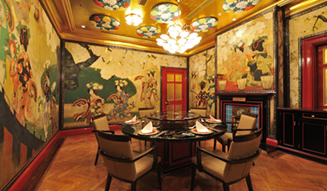
In the center of 'Tamashiro' is the oldest existing revolving table, beautifully restored and still in use.
In fact, the revolving Chinese dining table originated in Japan. The founder's spirit of hospitality is evident in the idea: 'Could we serve dishes while seated and pass them to the next person?'
Furthermore, the 'Hyakudan Kaidan' (100-Step Staircase), built in 1935 as a banquet hall, also still exists. It is designated as an Important Tangible Cultural Property of Tokyo and is highly regarded as the pinnacle of traditional Japanese decorative beauty and aesthetic sensibility.
Vibrant Japanese paintings, bas-relief sculptures, and more fill every space, with each room offering a distinct atmosphere. It is a space where one can experience the diversity of Japanese art.
Completing the 90-minute art tour, which includes explanations of the beautiful polychrome wood carvings in the 1st-floor corridor and the Nanpu staircase at the entrance to the costume salon, one feels a profound sense of gratitude: 'It is wonderful that these have been preserved.'
The preservation of culture entails responsibility, and it is the unique spirit of hospitality that has breathed life into Hotel Gajoen Tokyo since its founding that makes this possible.
Why not experience the enduring Japanese beauty and hospitality at Hotel Gajoen Tokyo, while enjoying the exclusive privileges afforded to guests and escaping the intense heat?
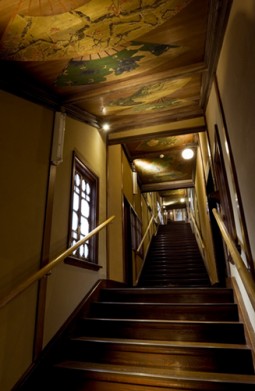
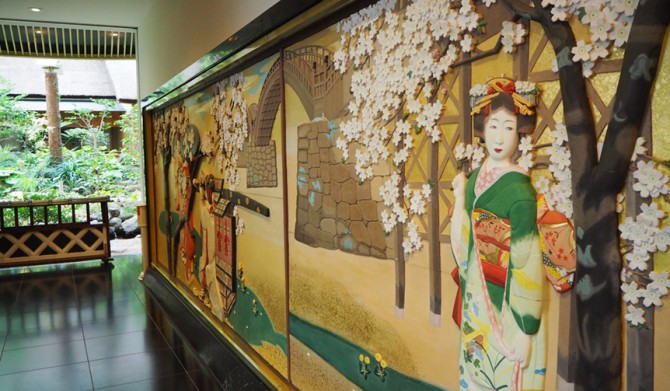
Gajoen Art Tour (Exclusive for Hotel Guests)
Every Monday, Wednesday, Friday, and Sunday
9:00 AM - 10:30 AM
*Reservations required by 5:00 PM the day before. Limited to capacity on a first-come, first-served basis.
*Photography permitted
http://www.hotelgajoen-tokyo.com/stay/guide
For a vibrant immersion in art at Hotel Gajoen Tokyo, consider the "Nadeshiko NADESHIKO" Kimono Plan, a girls' getaway package.
Nadeshiko NADESHIKO Kimono Plan (Women Only)
This plan includes a stay, where you can choose your favorite design kimono or retro kimono from a wide selection, wear it in traditional Japanese style, tour the Tangible Cultural Property 'Hyakudan Kaidan,' and enjoy a meal. You can arrive empty-handed, get dressed, and then freely explore the hotel and its surroundings outside of your tour and meal times.
What's Included
[1] Full Kimono Rental & Dressing by Staff
Kimono selection and dressing can be arranged in your room at your desired time. Includes everything from undergarments and juban to tabi socks, geta sandals, and bags. Dressing takes place between 3:30 PM and 5:30 PM (approx. 60 minutes). Please specify your preferred time in advance.
[2] Participation in the Hyakudan Kaidan Tour (Tangible Cultural Property) - 6:30 PM onwards
[3] Dinner - 7:30 PM onwards
Choice of three restaurants (subject to availability)
■ Japanese Restaurant 'Tofutei'
■ Chinese Restaurant 'Shunyuuki'
■ RISTORANTE 'CANOVIANO'
*For groups of 5 or fewer, sharing may be possible at Shunyuuki and Tofutei.
[4] Breakfast and Executive Lounge Access Included
Price: Refer to the website
http://www.hotelgajoen-tokyo.com/restaurant/nadeshiko
Period: October 1, 2018 (Mon) - December 30, 2018 (Sun). Reservations required.
*A plan without accommodation is also available.
Two types of plans are available: the standard plan (¥13,000 per person), which includes kimono rental, dressing, lunch, and a tour of the Hyakudan Kaidan,
and a full package plan (¥25,000 per person) that includes professional hairstyling, photography, rental accessories, and one drink.
*The full package plan requires reservations at least one week in advance, until December 28 (Fri).
Hotel Gajoen Tokyo
http://www.hotelgajoen-tokyo.com/
Hotel Gajoen Tokyo is a member of Small Luxury Hotels of the World
Small Luxury Hotels of the World (SLH) is a hotel group comprising unique and luxurious independent hotels in 80 countries worldwide. Over 520 hotels, including cutting-edge designer hotels, urban hideaways, historic country houses, and private island resorts, are members. Strict criteria for membership include a high commitment to providing a comfortable travel experience in all aspects, such as originality, location, quality, service, and amenities for enjoying one's stay. Only 12 hotels in Japan have been certified.
https://www.slh.com/