Tomoki Yusuke, Editor-in-Chief's Dialogue | Vol. 31 Kishin Shinoyama
Page. 1
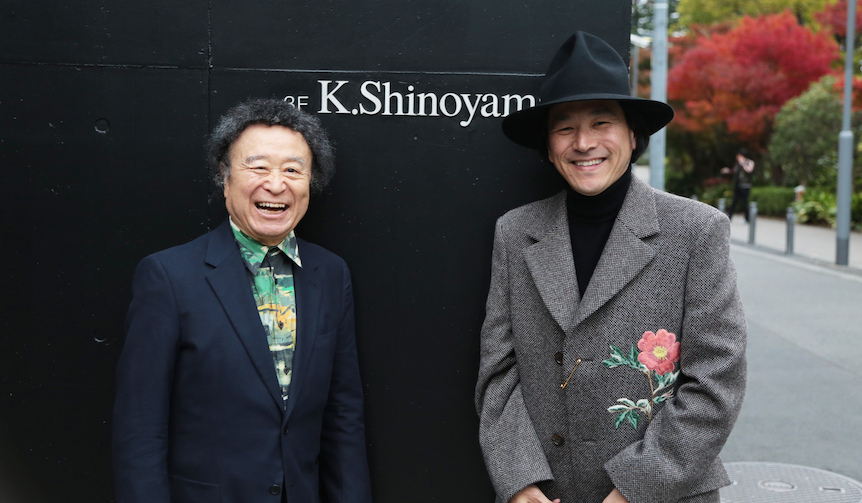
Our guest this time is the master of photography, Kishin Shinoyama. Every time we collaborate on magazine series or photo books, the editor-in-chief is always impressed not only by his novel perspective but also by his fearless approach to new challenges. Today, we visit his atelier to discuss the background of his latest work and his drive for future projects.
Interview by SUKEZANE TomokiPhotographs by SATO YukiText by HATAKEYAMA Satoko
The Latest in the "House" Series: What is 'House of Innocence'?
Tomoki Sukezane, Editor-in-Chief (hereinafter, Sukezane)Starting with 'House of Pleasure,' exhibited at the Hara Museum of Contemporary Art from late last year to early this year, followed by the photo exhibition 'LOVE DOLL × SHINOYAMA KISHIN' in spring, and now the new work 'House of Innocence' featured in the New Year's issue of Asahi Camera. I was fortunate enough to be involved in the shooting of all of them. Seeing your work, I thought the "House" series might conclude with 'LOVE DOLL × SHINOYAMA KISHIN.' However, you then created a work with an even newer and more innovative approach. What was the driving force behind that?
Kishin Shinoyama (hereinafter, Shinoyama)Well, as I keep shooting, new talents just keep overflowing (laughs). But seriously, once I finish one theme, I immediately start thinking, 'So, what's next?' What I want to shoot next naturally emerges, and as I shoot it, the work comes together. This new 'House of Innocence' is featured in the New Year's issue of Asahi Camera with a cover and about 32 pages of gravure, forming a kind of series with 'House of Pleasure' and 'LOVE DOLL × SHINOYAMA KISHIN.'
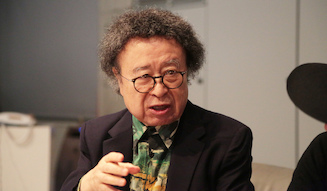
Sukezane'House of Pleasure' had a dynamic impression, but 'LOVE DOLL × SHINOYAMA KISHIN' and 'House of Innocence' evoke a more subdued beauty.
Shinoyama'House of Pleasure' was about photographing mysterious women who appear in the historic and special Hara Museum, and then displaying those photographs in the very places they appeared, creating a nested structure. Furthermore, in the previous New Year's issue of Asahi Camera, 'House of Pleasure 2' was presented as a nested-within-a-nested structure, showing those women appearing again in that museum to do something. While I found that development interesting, I then received an offer to photograph love dolls.
SukezaneI see. So that was the flow of things.
ShinoyamaI'm not a love doll enthusiast myself. I much prefer living girls. However, love dolls, which used to be called Dutch wives, have evolved tremendously over the past few decades, and Japan is at the forefront of this technology. Moreover, love dolls are made to be as close to human as possible. So, I became curious: what if I photographed them as if they were human? And what would happen if I placed a human girl next to them and photographed them both nude? That's why I'm distinct from those who love love dolls as sex toys, the so-called 'dollers.'
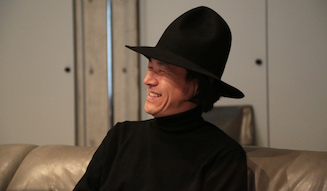
SukezaneI also saw a love doll for the first time during the shoot and was surprised by its texture and intricate detail. They are quite expensive too, aren't they?
ShinoyamaI believe that in the future, as these beautifully crafted dolls become equipped with artificial intelligence and evolve, they may truly surpass human capabilities. Science fiction often features stories where dolls become superior to humans, eventually taking the initiative.
However, my approach isn't so much about science fiction as it is about the idea that a world where humans and dolls live and have sex together might arrive very soon. I believe a new world, different from the one we've inhabited, will open up. 'LOVE DOLL × SHINOYAMA KISHIN' was a mix of love dolls and humans, but 'House of Innocence' adds mannequins to the mix of love dolls and humans. The three become one, blurring the lines of who is human. While this is my fiction now, it's unclear whether this world exists in the recent past or the future, or whether these figures are living or dead. I wanted to create a mysterious and sensual world where these elements blend, and that's what I aimed for with 'House of Innocence.'
SukezaneMannequins are newly added this time, but what prompted you to think, 'Mannequins can work too'?
ShinoyamaSeveral photographers have previously shot mannequins alongside models. Helmut Newton photographed them with fashion models, and Bernard Faucon created a masterpiece using old children's mannequins. However, in Newton's work, the mannequin exists as an object, and humans interact with it. In my work, it's about creating a scenario where 'mannequins and love dolls might be living alongside humans.' One could even argue that humans are inferior in terms of capability. The idea that such a mysterious world might exist in the near future has been bubbling up. My talents are overflowing, you see (laughs).
SukezaneThis is also a kind of question posed to contemporary humanity. Speaking of the location where you shot this latest work, did you envision it as a decadent place from the outset?
ShinoyamaSince it's a fictional world, any place that didn't feel like our everyday reality would have sufficed. Coincidentally, I found a great spot deep in the countryside, which further amplified my imagination.
People often ask, 'Where is the location?' but it's more interesting not to answer that. A theme of this work is to encourage viewers to imagine various possibilities.
Keeping in mind the individuality of the models, love dolls, and mannequins, humans are depicted as almost doll-like, dolls as almost human, and those full of life as close to the deceased. These images are mixed together.
This further blurs the line between this world and the next. In a sense, it's a dream world. I chose the title 'Innocence' because I felt it would be better if the raw eros and sexuality of humans didn't come through. It's an eros sublimated to a higher dimension.
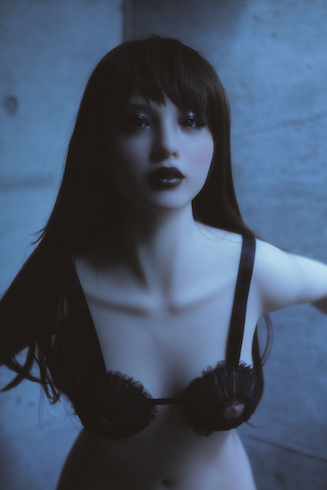
'LOVE DOLL × SHINOYAMA KISHIN'
© Kishin Shinoyama
SukezaneYou personally selected all the models, love dolls, and mannequins, and you were particularly meticulous about the mannequins. Does this mean you had these ideas in mind even at the stage of choosing the mannequins?
ShinoyamaActually, there are very few mannequins these days that realistically replicate humans. The expressions on mannequins are limited, which can make clothes look less appealing, so many are abstract. In my essay at the end of the Asahi Camera New Year's issue feature, there's a phrase: 'Have we crossed the uncanny valley?' The uncanny valley is a term coined by a robotics scientist in the 1970s, suggesting that as robots or artificial life approach humans, they are initially perceived as cute, but beyond a certain point, they become unsettling. However, if they become so sophisticated that they are indistinguishable from the real thing, the impression shifts back to positive. Apparently, it's called the 'uncanny valley' because the graph of human emotional response forms a valley. It's a well-known term online. I'm also interested in how our perception changes as dolls and mannequins get closer to humans, and what happens when they become even more sophisticated. It's fascinating, isn't it?

SukezaneIndeed, it does sound like a strange sensation. Come to think of it, the obi of the 'LOVE DOLL × SHINOYAMA KISHIN' photo book also states, 'When encountering a being of beauty beyond imagination, I feel an anxiety as if I am lost in a near-future labyrinth.'
ShinoyamaMental anxiety and unease become immense energy when creating something. When I meet you for shoots, I always play the role of a cheerful and easygoing photographer, but in reality, I'm a very thoughtful and sensitive one (laughs).
SukezaneI apologize for making you accommodate someone like me. Thank you so much; I'm learning a lot (laughs).
Page02.The best way to shoot is with today's cameras for today's times!
Page. 2
The best way to shoot is with today's cameras for today's times!
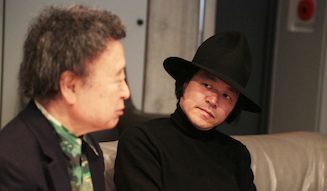
SukezaneFor how many years have you been shooting the cover and lead gravure for Asahi Camera's New Year's issue?
ShinoyamaSince 1995, so it's been 23 years now.
SukezaneDoes this mean you're capturing what most interests you each year, reflecting your state of mind at the time?
ShinoyamaOf course, I don't take up themes that don't interest me. However, Asahi Camera is fundamentally a magazine for camera enthusiasts. Therefore, I believe it's best to create something that isn't overly complex photographically, something that makes readers think, 'How was this shot?' or 'I'd like to try shooting something like this.' Also, I aim for grand-scale photographs befitting the festive New Year's issue. While there are many nudes, I've also shot a considerable amount of Kabuki and world-class ballet dancers. For the past few years, the "House" series has continued the narrative of me wandering into a phantom house of unknown location, where beautiful women reside.
SukezaneI truly love the "House" series. It's fantastical and romantic, like the Dragon Palace.
ShinoyamaYes, the Dragon Palace! Just as opening the treasure box instantly returns everyone to reality as old people. It's similar to that. So, perhaps for New Year's, everyone should go to the Dragon Palace! Doesn't that sound good? (laughs).
SukezaneThat sounds like a commercial for going to a hot spring (laughs).
ShinoyamaAlso, women's bodies, while seemingly similar, are not. Even within the theme of the nude, it's becoming increasingly futuristic.
Therefore, in 'House of Pleasure 2,' featured in last year's New Year's issue, the women who escaped from the Hara Museum roamed the museum.
In this year's New Year's issue, it's a house where innocent women, whose location is unknown, reside.
In a way, this might reflect how the era is being swept up by desires and anxieties towards the futuristic. Furthermore, to create something, one needs 'anxiety.'
A work that confidently presents itself as 'Look how amazing this is!' is the most boring kind. It's better to create something superior by doubting one's own perspective with a sense ofドキドキ (dokidoki - heart-pounding excitement/anxiety).
SukezaneYes, I understand that very well.
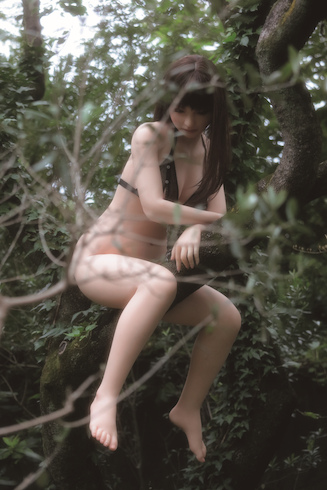
'LOVE DOLL × SHINOYAMA KISHIN'
© Kishin Shinoyama
ShinoyamaTherefore, I believe that the encounter between humans and love dolls, with the addition of mannequins, creating a mixture of people and objects where it becomes unclear which is real and which is fake, is very fitting for the current era. The covers of Asahi Camera's previous New Year's issues have also aligned with the themes of their respective times. For example, I went to the Atlanta Olympics in 1996, and the following year's New Year's cover featured athletes. Athletes competing in the Olympics possess extraordinary bodies, but before their events, they battle intense anxiety. Performers on stage are similar; they become so immersed in their roles that they cease to be human. It is precisely these moments that are truly beautiful and emit a mysterious light. Furthermore, these moments can only be captured by photography. I am doing what can only be done through photography.
SukezaneIt's like your life's work. So, are you always thinking about the theme for next year's New Year's issue?
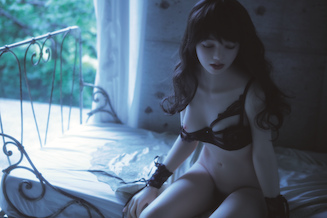
'LOVE DOLL × SHINOYAMA KISHIN'
© Kishin Shinoyama
ShinoyamaWhat's different about Asahi Camera as a medium is that you can do anything with a camera. Nudes, idols, dolls – anything is acceptable.
I've continued to select themes that resonate with the times each year. But what's interesting is that around the year 2000, cameras also drastically shifted to digital.
Photography was invented 190 years ago. What has been the most significant transformation in the history of photography? It's the advent of digital. Until then, it was all chemistry, but now it'selectricity. This difference is truly immense.
SukezaneSo, the mechanism for releasing photographs to the world changed dramatically.
ShinoyamaAfter this major transformation, it became commonplace to view photographs on the internet, computers, and smartphones. In the 90s, when I started shooting covers, it was the heyday of print. That we are still shooting covers and lead features even after the shift to digital, I think, signifies a change in the meaning of photography itself.
SukezaneYou always have the latest cameras, but do you ever shoot with analog cameras?
ShinoyamaI only use the 8x10 camera for my 20-year-running series in BRUTUS called 'Human Relationships,' and even then, it's only because the very first installment was shot with that camera. Even with the 8x10, there's only one type of color film left, no color negatives, no black and white, and no Polaroids. In the past, I'd take a Polaroid to decide on the composition and exposure before the main shoot, but now that's gone, so I shoot directly. Other than that, it's all digital. I no longer use Hasselblad cameras or film cameras at all.
SukezaneMost people can't afford to just 'shoot directly' (laughs). So, your current style is to shoot the present era with modern cameras.
ShinoyamaThe fact that I've been able to work in this style for decades might also be because I don't fixate on a single theme. If asked what my theme is, I'd say I photograph 'the allure that the era creates.'
So, rather than me thinking, it's the era that thinks, and the era tells me to shoot. If asked, 'What will be the cover next year?' I can only reply, 'Ask the era for next year.'
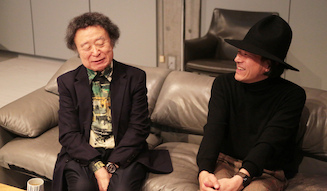
SukezaneOf course, that's true. It's not something you can prepare for.
ShinoyamaThat's why I believe shooting with today's cameras for today's times is the best approach. Once shot, I can view it on my computer and immediately send it to the editorial designer via email. Printing is also digitized now. Some younger generations might prefer the feel of film, but I disagree. It's about the present moment!
SukezaneAt your shoots, you always say, 'Isn't this democratic?' as you all select the photos on the computer together. I am truly impressed and admire that approach. That method is also something only possible with digital technology.
ShinoyamaYes. Nowadays, we all look at them together and decide.
SukezaneAre there any new ideas bubbling up within you yet?
ShinoyamaYes, they are indeed bubbling up, but that's a secret for now. For the next work, please ask the 'era' (laughs).
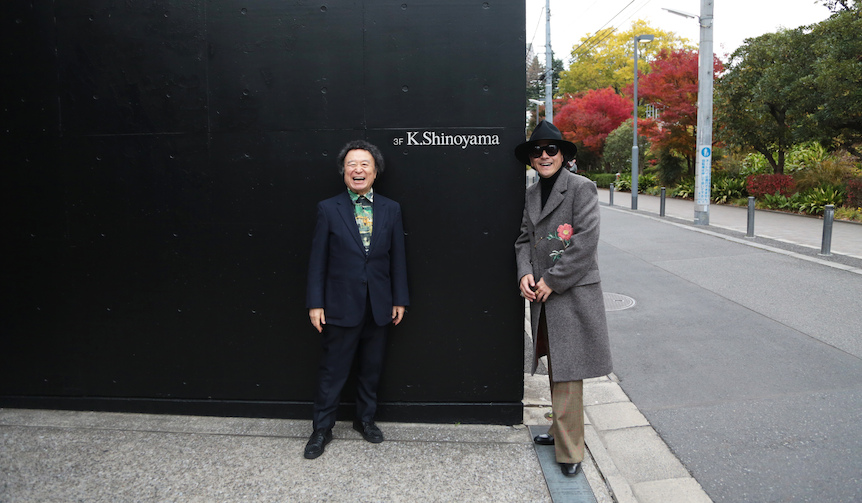
Kishin Shinoyama
Born in Tokyo in 1940. Began his career as a photographer while studying at the Department of Photography, College of Art, Nihon University. After working at an advertising production company, he became a freelancer in 1968 and has since produced numerous acclaimed works. For nearly 50 years, he has remained at the forefront of photographic expression, and his continuous pursuit of new challenges continues to earn him praise both domestically and internationally. He has been shooting covers and lead features for Asahi Camera since 1995. The January 2018 issue of Asahi Camera (published by Asahi Shimbun Publications, ¥900), featuring 'House of Innocence,' is now on sale. The DVD BOOK 'House of Innocence' (Shogakukan) is scheduled for release in February 2018.
www.shinoyama.net

'House of Pleasure'
By Kishin Shinoyama, Kodansha, ¥3500

'LOVE DOLL × SHINOYAMA KISHIN'
By Kishin Shinoyama, Shogakukan, ¥3900
A short film of 'INNOCENCE: House of Innocence' is also available.