Feature: A Journey to Meet the Forest Spirit – Chapter 1: Accommodations, Nature, and Culture of Gifu's Tono Region
Feature: A Journey to Meet the Forest Gods – Gifu's Tono Region
Chapter 1: Why Do Forests Exist?
The People Who Protect Hinoki (1)
Since the 14th century, the Tono region has been cultivating timber for the periodic rebuilding of Ise Jingu Shrine. The Tono hinoki, renowned as the pinnacle of construction timber, originates from Nakatsugawa City in Gifu Prefecture. Forestry here adheres to traditions passed down through generations, with timber primarily used for construction. However, new initiatives are emerging to adapt to the times, such as woodworking for interiors and a variety of products born from hinoki.
Photographs by JAMANDFIX
Text by KASE Tomoshige (OPENERS)
Greeted by a Giant Sawara Tree
It takes about 1 hour and 40 minutes by Shinkansen from Tokyo to Nagoya, and then another 50 minutes by limited express train to reach Nakatsugawa. The "Tono region" in southeastern Gifu is not far from Tokyo at all. The essence of this journey can be summarized in a word: the forests and culture of the Tono region. We begin our exploration with the "forests."
The "Kiso hinoki" began its reforestation in the mid-Edo period. It is undoubtedly the hinoki timber that has brought the forests of the Tono region to prominence. Originally, these were "reserve forests" established for the renovation of Ise Jingu Shrine, and they have supplied timber for modern shrines and temples, as well as the central pillars of castles. Thus, it became a renowned hinoki-producing area, and continues to ship high-quality hinoki nationwide for residential construction.
From Tsukechi Gorge in northern Nakatsugawa City, we travel about 30 minutes further into the mountains to reach the target Jingu Reserve Forest. Although there is a forest road, the area is quite remote. Guiding us through the Jingu Reserve Forest is Mr. Atsushi Naiki, the head of the Kashimo Forestry Cooperative. The Naiki family is a branch of a lineage of hereditary forest guardians in Kashimo, and Mr. Naiki is the ninth generation. He carried a sickle, perhaps for clearing undergrowth.
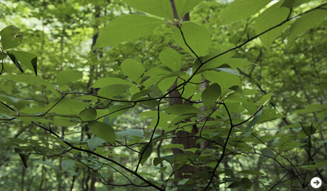
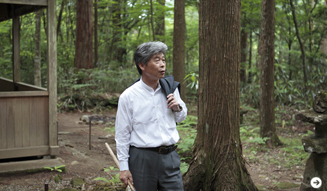
Led by Mr. Naiki, we venture into the mountains. Those who enjoy hiking might understand, but the Jingu Reserve Forest in Tsukechi is a forest "tended by human hands." That is, the undergrowth has been cleared, and the paths are well-trodden.
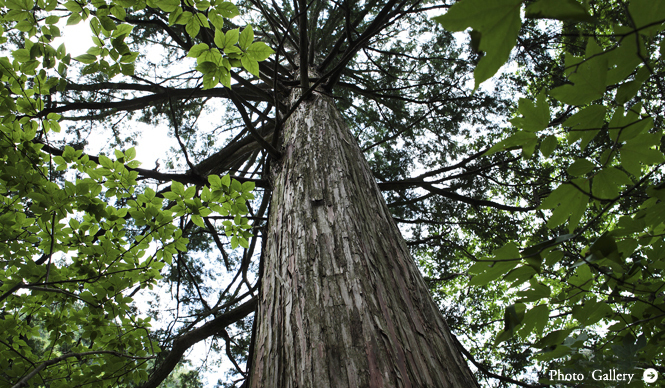
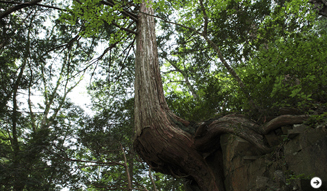
On the way down to the Tsukechi River, we encountered a giant sawara tree with a forked trunk. "This one is about 500 years old," says Mr. Naiki. To be able to see such a massive tree just a five-minute walk from the forest road is remarkable. If one were to search for such a giant tree near Tokyo, one would have to venture deep into the Tanzawa mountains, and perhaps they no longer exist in Okutama. Seeing this sawara tree, one can immediately understand how this forest has been managed and protected by human hands for so long.
Tales from the Forest Guardian
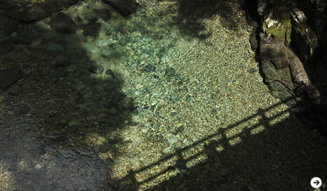
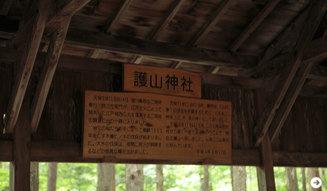
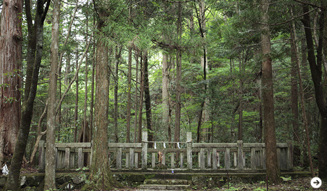
We cross the Tsukechi River, which flows with clear, cold water, and ascend a steep, long iron staircase. Breathing heavily, we follow Mr. Naiki and arrive at the site of a shrine after about 10 minutes. This is not a shrine in the town, but a space cleared in the mountains with a torii gate and a simple covered sanctuary. A wooden plaque reads "Goryo Shrine," with its history written on it.
"This shrine was built during the renovation of the West Ward of Edo Castle in 1839. It is said that many trees were felled for the renovation, and numerous injuries occurred, making it difficult to transport the timber. Therefore, a shrine was built here to appease the anger of the mountain gods."
Also, in the 1950s, a 25-meter hinoki tree was cut for the "central pillar" of Himeji Castle, a national treasure. That giant tree split in two during the felling. Ultimately, the split hinoki was joined to become the "central pillar."—Such anecdotes echo and fade in the mountains.
Mr. Naiki's voice, speaking calmly, seeped into my ears. I couldn't tell if it was the blood of a forest guardian or the sincerity of his work, but it resonated differently from the fluent explanations of a trained guide (which is not to say they are bad). I want to note how it reached me.
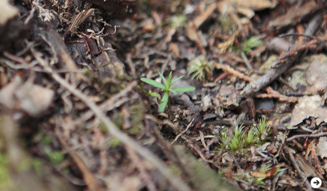
"Initially, there was only hinoki here (in these mountains). Later, sugi was planted. Now they grow mixed together. Ah, look, many sprouts have emerged. Do you know how to distinguish hinoki from sugi? Young hinoki leaves grow in pairs, while young sugi leaves grow in threes."
Feature: A Journey to Meet the Forest Gods – Gifu's Tono Region
Chapter 1: Why Do Forests Exist?
The People Who Protect Hinoki (2)
Surprisingly Affordable Prices
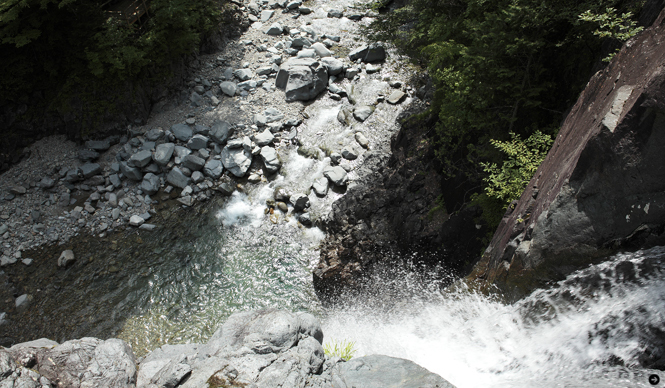
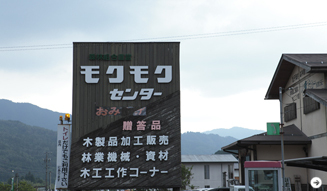
After leaving the Jingu Reserve Forest, we visited Takadaru Falls and returned to Kashimo in the northern part of the Tono region. Accompanied by Mr. Naiki, we headed to the "Mokumoku Center." The "Mokumoku Center" is a sales outlet for woodworking products made from hinoki and sugi from Kashimo's forests, and it also houses a workshop that accepts custom orders.
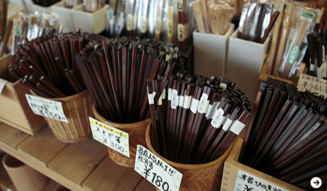
The "Mokumoku Center" displays a wide array of wooden items such as chopsticks, rice paddles, rice containers, bathtubs, stools, trays, and bowls. You will be surprised by the abundance of products and their unexpectedly low prices. Chopsticks can be purchased for around 100 yen. Moving to larger items, a hinoki縁台 (engawa bench) about one meter long, with its refreshing hinoki scent, costs around 9,000 yen. It's perfect for enjoying a drink on your porch as the season warms up.
We were given a tour of the workshop by Mr. Hideki Naiki from the Kashimo Forestry Cooperative's Processing and Sales Department. Although he shares the same surname as the cooperative head, they are not related. It's a common surname in this region, so we'll refer to him as Hideki to distinguish him.
"We receive quite a few orders from locals. For example, this is something we made because a nursery school wanted chairs. They're good because they can be stacked like this."
The first thing Hideki showed us were hinoki chairs for nursery school children. They are solidly built and feature the soft touch characteristic of hinoki. Parents with toddlers aged two to three would undoubtedly find their simple charm irresistible. The selling price is estimated to be around 5,000 yen. In a city interior shop, the price would be double, or perhaps even three to four times as much, and that wouldn't be an exaggeration.
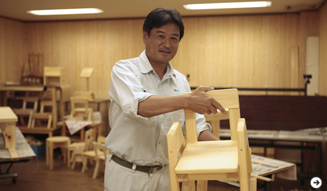
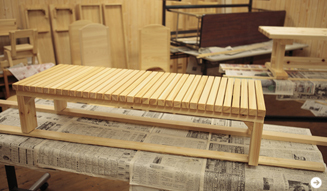
"Orders for custom-made dining tables and chairs are the most common. We receive all sorts of requests, and our job is to bring them to life. That's the rewarding part of this work."
Hideki speaks with such enthusiasm, surrounded by unfinished chairs and tables of various designs and sizes. This means they can accommodate a wide range of custom orders. If you desire a unique chair or table, we highly recommend visiting the "Mokumoku Center."
The Potential of Hinoki Oil
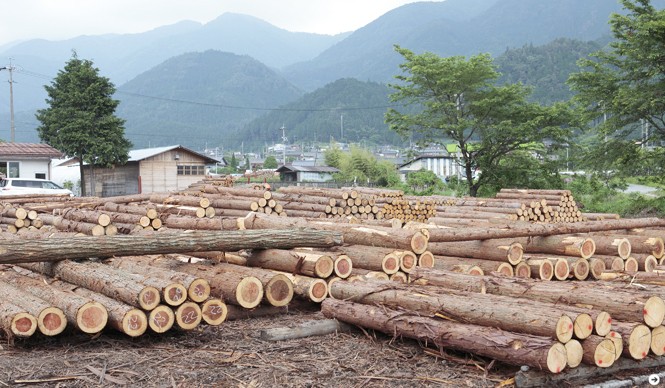
Across the river from the "Mokumoku Center" is the timber yard of the Kashimo Forestry Cooperative. The sight of stacked hinoki and sugi logs is magnificent. Mr. Naiki and Hideki guided us through the area.
"Please look at the cut ends of the hinoki and sugi. The sugi has a red center, while the hinoki is pink. Lately, the prices for both hinoki and sugi haven't been rising, making things quite difficult," says Mr. Naiki. Timber prices are, of course, subject to market fluctuations, and prices change annually, but hinoki and sugi are not trading at high prices nationwide.
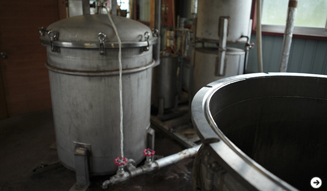
"For that reason, or perhaps not entirely for that reason, this is what we are doing now," said Mr. Naiki, showing us a hinoki oil distillation apparatus. "To separate the hinoki leaves into water and oil, we first heat them in this boiler. Gas is produced for about the first 30 minutes, and we're trying to find a way to make a product out of this gas as well."
This gas is absorbed into zeolite, a porous mineral. For example, if fruits are stored with this zeolite, their freshness can be maintained for a considerable period.
"We haven't reached the stage of full product commercialization yet. In the first place, it takes 100 kilograms of hinoki leaves to produce just 300cc of hinoki oil. And since we can process a maximum of 500 kilograms per day, the maximum daily output is only about 1.5 liters. Currently, the production cost is extremely high, at 50,000 yen per liter."—"If we could commercialize the gas and water produced during extraction, the final hinoki oil would also become more affordable."
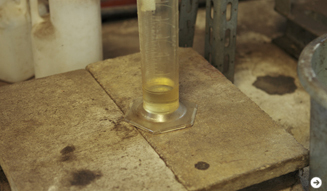
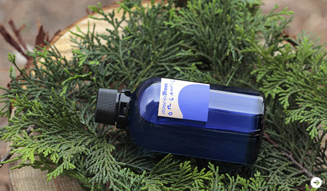
This hinoki oil, in its unrefined state, is quite potent. I coughed quite a bit after carelessly taking a sniff. It's a sharp aroma, truly the essence of the forest condensed. Currently, Kashimo produces several products such as bath oils, but a new product has recently been released. It is the "Foot Massage Oil" developed by the non-profit organization More Trees. Kashimo-produced hinoki oil is one of its ingredients, characterized by its smooth, non-greasy feel. A portion of the sales contributes to forest conservation efforts in various regions, in partnership with More Trees.
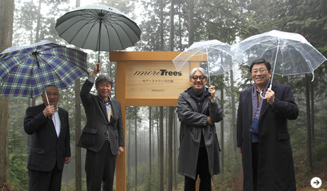
We conclude the first part of our journey through the forests of Gifu's Tono region here. The things created by the people who protect the forests and live in them are gradually spreading into the world in new forms. The beginning of this journey was filled with such an atmosphere and anticipation, we must state.
Mokumoku Center
4872-5 Kashimo, Nakatsugawa City, Gifu Prefecture
Tel. 0573-79-3333
http://www.fa-kashimo.jp/mokumoku.html
More Trees Design
1-9-11 Sendagaya, Shibuya-ku, Tokyo, Francia Gaienmae 103
Tel. 03-5770-3969
http://shop.more-trees-design.jp/

Gifu Prefectural Tourism Division
Tel. 058-272-8393
http://www.kankou-gifu.jp/(Official Website of the Gifu Prefectural Tourism Federation)