Mitsuhiko Imase x Yoshitaka Haba Talk Show | New BMW GRAN TURISMO at BMW Studio ONE 03
Chapter 10 Talk Show “Nature”
4th Talk Show: “Culture” – Mitsuhiko Imimori x Munetaka Haba 03
──You mentioned paper cutting, and it turns out Mr. Imimori is a master of it, even publishing books on the subject. He's going to give us a demonstration today. When did you start doing paper cutting?
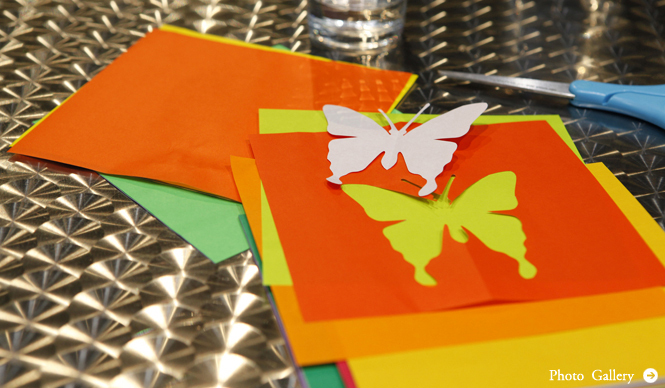
(Mr. Imimori picks up scissors and origami paper, and begins cutting.)
ImimoriI did it from first grade to fifth grade. Then there was a 30-year break. One day, I made Christmas decorations for my child, and they were so delighted. They never praise my photos, but they were moved by this. So I restarted, and I've been doing it for nearly 10 years again. Ah, these scissors aren't very good (laughs).
ImimoriThere, it's done.
(Mr. Imimori unveils a beautiful paper-cut butterfly, to applause from the audience.)
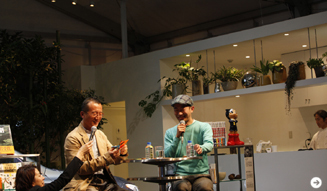
BMW Studio ONE | Mr. Imimori demonstrates paper cutting
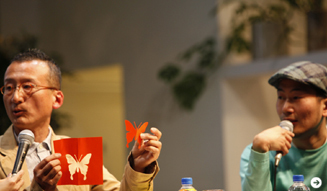
BMW Studio ONE | "Karasu-ageha" butterfly completed in no time
──Wow, that's incredible. It almost makes one feel discouraged. How can you be so good at everything?
HabaYes, I was also surprised when I first saw Mr. Imimori's paper cutting book. I didn't realize he did more than just photography.
ImimoriBut I think it's the origin of my photography. It's about the pursuit of form. You have to observe the subject closely and see it in three dimensions, so I think it's very similar to photography. Also, I can only convey what I've seen myself, so the motifs for my paper cutting are also things I've seen. By the way, my paper cuts aren't just "butterflies." They're "something-ageha" or "something-shijimi." This one I just made is a "karasu-ageha." I can make 200 different kinds of butterflies alone.
HabaWow, that's amazing. In that case, could you make an "Oomurasaki"?
ImimoriLeave it to me, huh? Haha.

BMW Studio ONE | Photographer Mitsuhiko Imimori
──Looking at your photographs, Mr. Imimori, whether it's of rice paddies or insects, or even your paper cuttings, one can feel your curiosity and your desire to share what you love.
ImimoriYes. For me, it's a natural history curiosity. I see it as a proposal for a way of seeing things, from the perspective of a naturalist who continuously observes the same place with a broad, natural history viewpoint. That's how I see it myself.
HabaThat's a very important point. I also only recommend books I've read myself. The reason I do this job is a kind of desire to share things that have moved me with others. It's not about memorizing organized information given by others like learning multiplication tables, but about expanding one's interest through personal observation and research. I think that's the joy of knowing things. How you encounter the unknown is what's important. Such expansion can't be calculated; it's a luxury.
ImimoriEncounters are important when it comes to books.
HabaIndeed. Nowadays, the way we acquire knowledge feels like smelt fishing – information quickly caught online tends to be fragmented, and the gaps between those caught pieces often don't connect. But ideally, when you gain some information, it's not just about knowing it and stopping there; it's about whether you can map those connections in your mind that's important.
──It's like a mental landscape, isn't it? When traveling, there are journeys where you empty your mind and discover various things. This is similar.
HabaYes, it's not like visiting here, there, and somewhere else, and then leaving proof like a stamp rally.
 4th Talk Show: “Culture” – Mitsuhiko Imimori x Munetaka Haba 01
 4th Talk Show: “Culture” – Mitsuhiko Imimori x Munetaka Haba 02
 4th Talk Show: “Culture” – Mitsuhiko Imimori x Munetaka Haba 03
 4th Talk Show: “Culture” – Mitsuhiko Imimori x Munetaka Haba 04
Inquiries | BMW Customer Support 0120-55-3578 (Open year-round, 9:00-20:00)