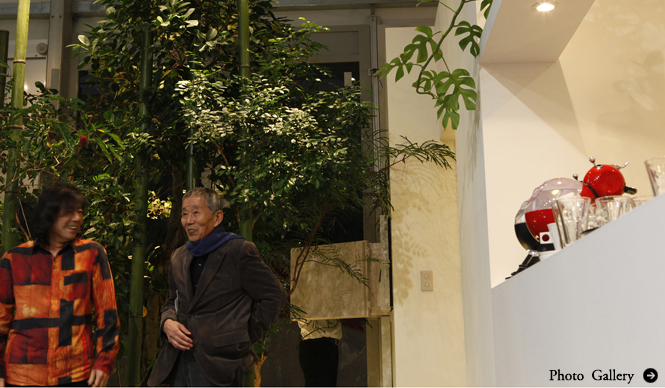
Jin Tatsumura & Tomoaki Ide Talk Show | New BMW GRAN TURISMO @ BMW Studio ONE
Chapter 8 Talk Show “Ecology”
2nd Talk Show: “Ecology” - Jin Tatsumura x Yuuaki Ide
At BMW Studio ONE, a limited-time space open until February 28th in Jingumae, Tokyo, talk shows are held every Friday with opinion leaders from various fields, themed around “Sustainable Ways of Living.” The guest for the second session on February 5th was film director Jin Tatsumura and sound space composer Yuuaki Ide. Focusing on their respective fields of film and music, they discussed “sustainability.”
Summary by OPENERSPhotos by Kenta Yoshizawa
“Good evening, I’m your moderator, Robert Harris. Today, under the theme ‘Ecology – The World of Order and Harmony in Sound and Image,’ we have invited film director Jin Tatsumura and sound space composer Yuuaki Ide. Mr. Tatsumura has prepared various visual elements, and Mr. Ide has brought us an abundance of sounds, making for a very rich program. I imagine you both might be a little tired after such an enthusiastic discussion in the staff room earlier…”
Tatsumura & Ide(Laughter)
“First, regarding Mr. Tatsumura’s life’s work, the documentary film ‘Gaia Symphony,’ one of its central themes is how the Earth, as a living entity, can maintain balance and sustain itself, isn’t it?”
Tatsumura“Yes, but rather, the main theme is about the ‘people’ who live in such a way.”
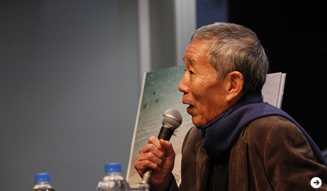
BMW Studio ONE | Film Director Jin Tatsumura
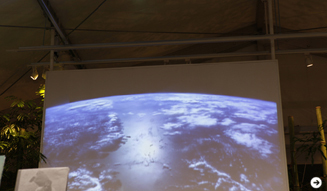
BMW Studio ONE | Tatsumura's film "Gaia Symphony"
“When watching the films, there seems to be a common thread among the interviewees. People like free diver Jacques Mayol, photographer Michio Hoshino, and Okinawan woodblock print artist Rikunen Naka – they are all individuals with strong personalities, yet they possess a childlike gaze and have such wonderful expressions, don’t they?”
Tatsumura“Indeed, they are generally serious and complex individuals, but as the filming progresses, what I’ve always wanted to convey emerges more and more, and they become vibrant. I conduct the interviews in a way that allows them to enjoy the process. It’s a challenging process, but it’s fascinating, and it’s wonderful because everyone ends up smiling. I consider it a truly beautiful thing.”
“So, how these unique individuals connect with the Earth becomes a major theme of ‘Gaia Symphony,’ correct?”
Tatsumura“The interviewees come from various countries, but you can clearly see that as they share their experiences, they are all trying to convey the same message. It’s the idea that their way of life and their achievements, while certainly the result of their own efforts, are not solely due to their own power, but rather they are ‘allowed to do them.’ This stems from the understanding that we are all part of a larger living entity, the Earth, and that we are not just ‘living,’ but ‘being lived.’ This isn’t a special realization, but a fundamental truth. All the ‘Gaia’ interviewees share this sense, and while they may not express it directly, that feeling comes across. I believe this is what resonates with so many people.”
“You mentioned ‘being lived.’ Mr. Ide, what are your thoughts on this?”
Ide“The 2005 Expo, themed around environment and sustainability, also provided an opportunity to contemplate ‘being alive’ through sound production. I spent a year recording the sounds within nearly 300 trees, and I felt that listening to these sounds could lead to a renewed recognition of what it means ‘to be alive.’ Furthermore, while humans gain life energy from the environment and food, I believe we also need spiritual energy to the same extent.”
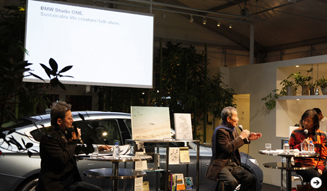
BMW Studio ONE | Robert Harris, Jin Tatsumura, and Yuuaki Ide
“This relates to ‘love,’ which we receive from parents, friends, music, and so on. However, much of this is given to us. Recognizing this fosters a sense of ‘gratitude,’ which naturally leads to the desire and action to ‘give.’ When we act, even though we are giving, we feel the joy of being given to, like receiving a gift. I believe this is the origin and mechanism of sustainability. We are currently in a period of great change, and I think ‘how we give’ will be a key theme moving forward.”
“You attempted this at the Flower Expo, didn’t you?”
Ide“Yes, at the Flower Expo, we produced the sound for a massive flower garden, about two baseball fields in size, with the theme ‘Music that Delights Flowers.’ It began with the proposal to make it an expo based on the idea of giving something to the flowers, rather than receiving something from them. How do we know if the flowers are delighted? It’s because the surrounding ‘atmosphere’ feels more vibrant and pure. However, if we play overly sentimental music, it’s clear they react negatively. In this way, music has the effect of creating an ‘atmosphere.’ Curiously, most people can sense this ‘atmosphere.’ Japanese people, in particular, are adept at sensing ‘the mood,’ and I believe Japan can show the world an example of ‘sustainability’ stemming from this. We should probably come up with a good Japanese term for it.”
“Perhaps ‘sustainability’ or ‘longevity’? Let’s think about it.”
Ide“Furthermore, music has the effect of restoring physical and mental rhythms. Illness, in essence, is a disruption of human rhythm – a faltering gait, irregular breathing. The most significant effect of music is to regulate bodily rhythms and harmonize the mind. As an example, I practice something called ‘Hissatsu Uranori Imagination Walk,’ where ‘uranori’ refers to the ‘afterbeat,’ a rhythm that is half a beat off from the usual. Simply walking to this ‘uranori’ rhythm can make you feel invigorated. Moreover, music and scenery can spark your own unique, cinematic imagination. I conducted clinical research on music therapy for about three years at a major cancer center in the United States, and the keyword was ‘imagination,’ which proved to have profoundly positive effects on both mind and body. I highly recommend trying it when you’re feeling down.”
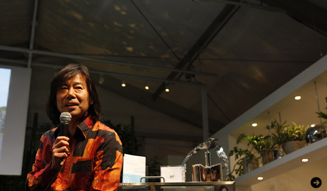
BMW Studio ONE | Ide discussing "atmosphere"
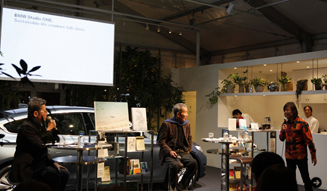
BMW Studio ONE | Ide demonstrating the "uranori" rhythm
Tatsumura“That’s fascinating. It’s the same when I edit films. In that sense, it’s all ‘uranori.’ Filmmaking is a collaboration with music, so I’m quite particular about the music, but simply cutting to the beat of the music feels incredibly jarring. When I focus on the timing that feels right, aligning with the actors’ words or expressions, all my edits become ‘uranori edits.’ This creates a kind of space, allowing things to flow smoothly. That’s what ‘uranori’ is all about, isn’t it?”
Ide“Precisely.”
Tatsumura“From a biological perspective, ‘sustainability’ is likely about this as well. By trying to go right, then left, up, then down, faster, then slower, we intuitively develop a sense of what to avoid and what feels wonderful. This, I believe, is how our natural healing abilities are nurtured.”
“Going straight isn’t necessarily bad, but it’s simply about reaching the destination quickly and easily. While the human desire for material convenience is natural to some extent, a living organism itself never proceeds in a perfectly straight line.”
“Perhaps becoming too fixated on that leads to stress.”
Tatsumura“It’s not about one being better than the other; both are valid. However, living solely in a straight line causes us to lose the rhythms inherent to our nature. In this sense, ‘sustainability’ is also linked to the fundamental movements and rhythms of nature, and it arises naturally when we experience a feeling of ‘pleasantness.’”
“I was thinking it was time to wrap up, but those were wonderful closing remarks. May I consider that our conclusion? (Laughter)”
“Both of you, having experienced the world, approach things from a broad perspective, and I felt a spirit of tackling present issues positively with what we can do now. I’m so glad to have heard your insights. Mr. Tatsumura, Mr. Ide, thank you so much for today.”
Tatsumura & Ide“Thank you very much.”
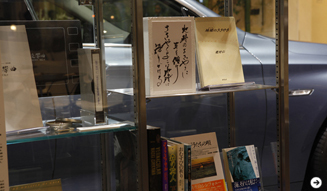
BMW Studio ONE | Jin Tatsumura's handwritten message
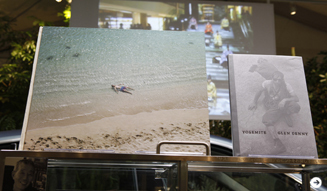
BMW Studio ONE | Book director Motonori Haba's book selection
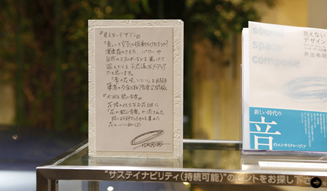
BMW Studio ONE | Yuuaki Ide's handwritten message
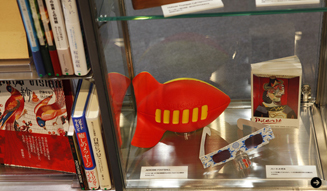
BMW Studio ONE | Ide's fun, toy-box-like luggage
Inquiries: BMW Customer Support 0120-55-3578 (Open year-round, 9:00-20:00)