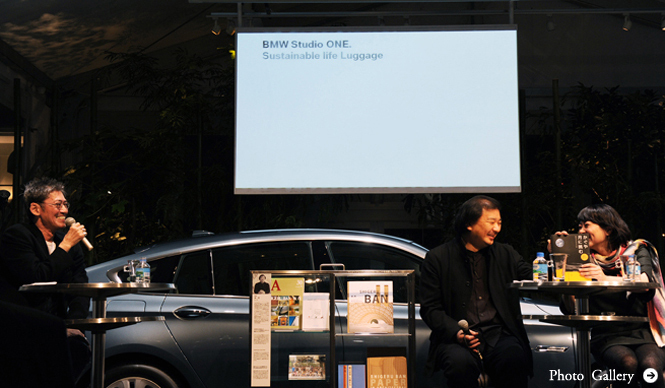
Chapter 7 Talk Show Shigeru Ban & Yuri Nomura | New BMW GRAN TURISMO @ BMW Studio ONE
Chapter 7 Talk Show "LIFE"
Talk Show Vol. 1: "LIFE" Shigeru Ban & Yumiko Nomura
BMW Studio ONE, which opened in Jingumae, Tokyo, on January 30, 2010, will host a variety of events for about a month until February 28, under the theme of "Sustainable Lifestyles for the Future." Every Friday, a talk show will be held inviting opinion leaders from various fields to discuss "sustainability." The first guest on January 29 was architect Shigeru Ban and food director Yumiko Nomura. A wonderful dialogue unfolded, moderated by Robert Harris.
Summary by Wakako MiyakePhotos by Kenta Yoshizawa
—Today's keyword is "LIFE." We have invited architect Shigeru Ban and food director Yumiko Nomura to discuss sustainable living through food and housing. Mr. Ban, did you always want to be an architect from a young age?
BanWhen I was a child, there were always carpenters working on renovations at home, so at first, I wanted to be a carpenter. I also enjoyed picking up wood scraps and making things. That gradually shifted to wanting to be an architect.
—Ms. Nomura? Did you always want to work in food?
NomuraNot really. However, my mother ran an etiquette and hospitality class, and I think I naturally gravitated towards my current path by watching her.
—It seems both of your family environments had an influence.
BanYes. My mother was also a fashion designer, so that might have had an influence too.
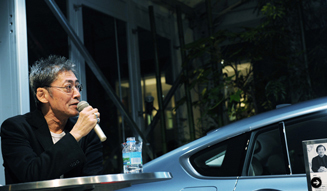
BMW Studio ONE | Moderator Robert Harris
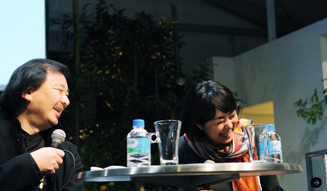
BMW Studio ONE | The two, in perfect sync as if they had known each other for years
—You both studied abroad, didn't you? Mr. Ban in America, and Ms. Nomura in London.
BanWhile one can certainly study sufficiently in Japan, the most important aspect of architectural study is to see good architecture. America has the world's most remarkable examples of modern architecture, particularly from the post-war era to the 1980s. Also, the architectural systems there are well-developed, so I went to America.
NomuraI wanted to go abroad to an English-speaking country. From Britain, one can easily travel to Paris or Belgium, so I chose the UK (laughs). At that time, renowned chefs were opening restaurants almost every week, so there was much to learn. I was also asked a tremendous amount about Japan, so I had to study hard. Going abroad also allowed me to see Japan from a broader perspective, which was beneficial.
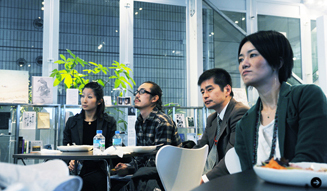
BMW Studio ONE | Guests
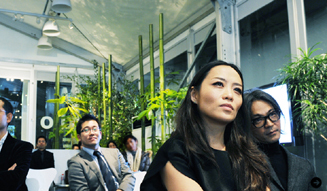
BMW Studio ONE | Guests
—Now, regarding architecture and sustainability, Mr. Ban, do you consider sustainability when you design?
BanBy chance, I've been experimenting with creating architecture from recycled paper since the late 1980s, so I'm often labeled as sustainable or ecological. However, I didn't start with environmental concerns in mind, and I still don't actively think about it. I simply considered how to build structures without waste, using readily available materials without special techniques. It's just that these days, I've been given that kind of label, but I don't hold that consciousness. I'm simply doing it with the intention of valuing materials.
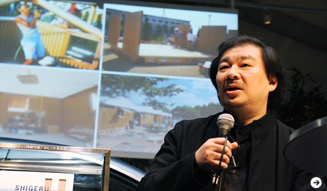
BMW Studio ONE | Temporary housing after the Great Hanshin-Awaji Earthquake
—Perhaps that sentiment naturally leads to a sustainable approach, which is why you are described that way. A slide is being shown now.
BanThis is the temporary housing from the Great Hanshin-Awaji Earthquake.
—Many Vietnamese refugees were affected during this disaster, weren't they?
BanYes. They were refugees who lived in Nagata Ward and were affected. They were entitled to government-provided temporary housing, but it was located in the suburbs. However, they worked in nearby factories, and if they moved to the suburbs, they wouldn't be able to commute and would lose their jobs. So, they started living in tents in a nearby park, but they were being pressured to leave by the surrounding community who feared it would become a slum. Therefore, I thought that if it were hygienic and visually appealing, the community might accept it, so I built temporary housing called "Paper Log Houses" using paper tubes and beer crates.
—When did you start going to disaster areas to do something?
BanWhat shocked me when I started my career as an architect was that architects weren't contributing much to society. Historically, architects have worked for the privileged class, such as the wealthy and powerful. Since political and financial power are not visible, they have used architects to create monuments to display them. This is still the case today. While many doctors and lawyers work for the socially vulnerable, there are few architects who do. At that time, I thought it was too late to enter medical school, and I wanted to use the architectural skills I had learned to contribute to society in some way. That's when I started. My first project was building temporary housing for Rwandan refugees under the guidance of the UNHCR headquarters in 1994.
—You bring your students to disaster areas, don't you?
BanWhen building temporary housing as volunteers, students participate for free, but it's more important for them to see things with their own eyes at the actual site than through school education. During the Sichuan earthquake in China, we collaborated with a local architecture school to build a school in one month. There was considerable anti-Japanese sentiment in that area, and people were hostile, wondering what the Japanese were doing there. But as we worked together, that gradually diminished. When we left, we were all hugging and crying. I believe it's essential for Japanese people to immerse themselves in various cultures like that. I think it's better to nurture people than to create things, and my role is to nurture the next generation. Perhaps that is what is sustainable.
—Ms. Nomura? Food sustains life, but what are your thoughts on the relationship between food and sustainability?
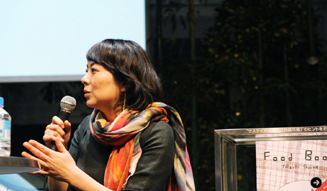
BMW Studio ONE | Yumiko Nomura
NomuraHaving an appetite means having the will to live, doesn't it? I always hope that both I and those around me have an appetite. It's the source of everything, isn't it? I feel incredibly fortunate to be able to make a living through cooking, but as I've gotten older, I've started to wonder what I can truly do, and I sometimes feel that perhaps I can't do anything significant. So, I try to do my best. When someone eats my cooking, it inevitably affects something within them, whether it's their spirit or their physical well-being.
Therefore, if they achieve something wonderful, I feel I've indirectly contributed, and I try to cherish that feeling every day. I hope that the act of eating with companions and conversing will never disappear, and I believe it certainly won't, no matter how much we evolve.
—The sustainable luggage on display is interesting. Ms. Nomura, you have water here.
NomuraYes, I thought of water as the source of life. Another item on display is the book "Challenging Kaguya-hime on the Moon." When Japan's satellite Kaguya was launched, we were able to see the Earth rise and set from the lunar surface for the first time. Watching the Earth ascend on the DVD, I thought, "What a beautiful planet." If I were on the moon, I'd want to visit Earth someday. Indeed, Earth is a water planet.
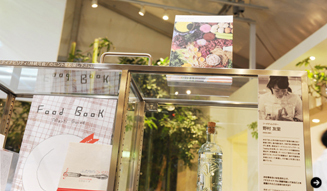
BMW Studio ONE | Ms. Nomura's luggage items
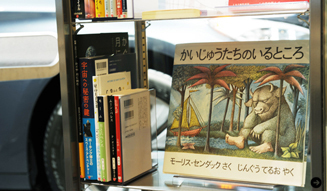
BMW Studio ONE | Ms. Nomura's luggage items
—Mr. Ban's display includes photos of students from your earlier talk and your own collected works. How about the act of writing?
BanI don't particularly enjoy writing, nor am I good at it. However, at Cooper Union, where I studied in America, a required course in architecture was poetry writing. The reason given was that poetry and architecture are very similar. You build a structure, add substance, and create a story. Once I understood that and tried it, I found I was quite good at it and received praise from the teacher (laughs).
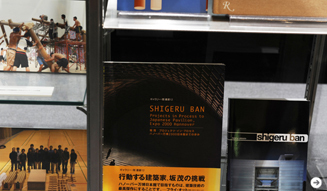
BMW Studio ONE | Mr. Ban's luggage items
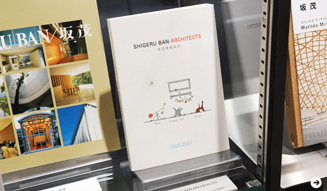
BMW Studio ONE | Mr. Ban's luggage items
—Ms. Nomura, you also have a sketchbook among your displayed items. How about writing?
NomuraI'm not particularly skilled at it, but I use a sketchbook because it helps me organize the vague thoughts in my head by writing them down.
BanAre you writing down ideas for your cooking?
NomuraYes. I draw pictures or write words to capture sensations, colors, and combinations.
—Your respective sustainable items are also very intriguing. Neither of you consciously strives to be sustainable, yet your lifestyles and approaches to work ultimately lead to sustainability. That was very interesting. Thank you very much for today.
Inquiries | BMW Customer Support
0120-55-3578 (Open daily 9:00-20:00)