Chapter 6 Interview Mitsuhiko Imori | New BMW GRAN TURISMO @ BMW Studio ONE
Chapter 6 Talks About Sustainability|Interview with IMAMORI Mitsuhiko
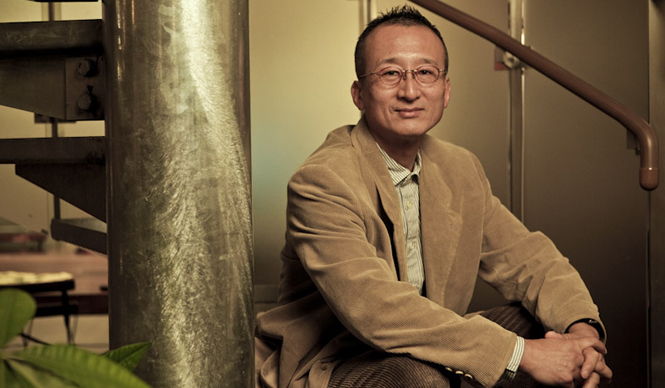
IMAMORI Mitsuhiko | Learning Sustainability from Satoyama
Text by EIZABURO TOYAMAPhotos by TAKAHIRO IGARASHI / JamandfixWith cooperation from LAS CHICAS / Yokohama no Makiyasan
Interacting with Living Things

I've loved living things since I was a child, and I encountered them up close in my hometown of Otsu, Shiga Prefecture. However, the living things I envision don't exist in pristine nature. They were all found in places connected to people. I caught crucian carp in rice paddies and streams, and rhinoceros beetles were in the shrine grounds. I often wonder if there's any place in Japan where nature continues to thrive without any human presence.
I photograph insects, landscapes, and people. This is because I want to express how humans should interact with nature through life itself. Conversely, it's about how living things interact with us. I became a photographer not to observe nature, but to engage with it.
Nature Cultivated by Humans
I believe a sustainable lifestyle is a fundamental way of human existence. Satoyama, or traditional rural landscapes, are a prime example of this. It has been 20 years since I established my office in a satoyama called 'Mogino Kuni.' In my view, satoyama means a space where humans and living beings coexist, representing Japan's traditional agricultural environment. It's commonly thought that human intervention destroys nature, right? However, this wasn't the case with Japan's traditional rice-farming culture.
In the past, fallen leaves were used as fertilizer, so when creating rice paddies, we also had to create artificial forests, meaning coppice woodlands. To cultivate one tan (about 0.1 hectare) of rice paddy, three to four times that area of forest had to be maintained. In this way, small forests were created, leading to the formation of wetlands like rice paddies, and grasslands such as embankments and paddy ridges. By creating a miniature natural environment, a multitude of living creatures flocked to the satoyama. This system was built over thousands of years. The current problem is that humans are becoming disconnected from nature. If rice paddies and coppice woodlands are left unattended, the vitality of living things diminishes. All organisms influence each other, and if even one element is missing, the system collapses.
The Importance of Continuity
Until now, society has strived to create new things. We've pursued novelty, and change has been perceived as a good thing. However, from a biological perspective, the same cycles must repeat every year. We would be in trouble if the same flowers didn't bloom every spring. When I consider this, it feels like only humans are chasing after the new.
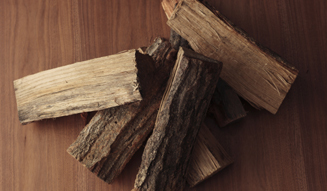
Firewood from Quercus and Nara Oaks
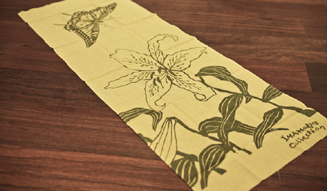
Tenugui (hand towel)
Skillfully 'Using' Nature
The firewood I chose for the 'Sustainable Life Luggage' is what I use in my office's wood-burning stove. Coppice woodlands must also be periodically felled and utilized; otherwise, biodiversity will decline. The cycle of felling, known as 'bog-u-kōshin' (regeneration of the forest base), operates on an 18-year cycle for a single coppice woodland. Maintaining this system fosters biodiversity. Many people still believe that simply having nature is enough, but neglect is perhaps the greatest offense. It's difficult to understand because it's the opposite of concepts like nature parks, but in reality, to be sustainable, we must actively utilize nature.
Another luggage item is the tenugui. The pattern on this one is something I made using paper cutting. It was a craft I was passionate about as a child, and when I started making them again after having children, my body remembered it better than I expected (laughs). Since then, I've continued it as a form of hand exercise. Things you were good at in childhood might surprisingly be sustainable.
Contact: BMW Customer Support 0120-55-3578 (Open daily 9:00-20:00)