May 14, 2015
more trees meeting 2009 | "more trees" - Past and Future
more trees meeting 2009
The Past and Future of "more trees"
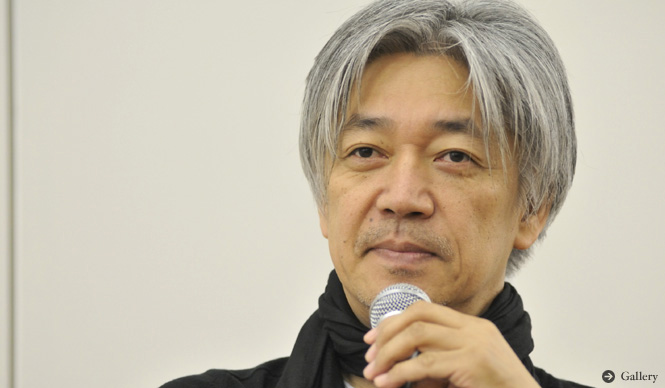
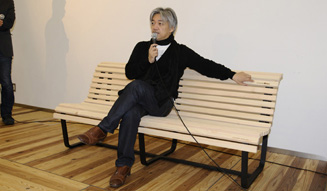
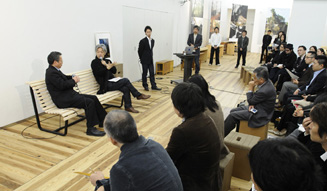
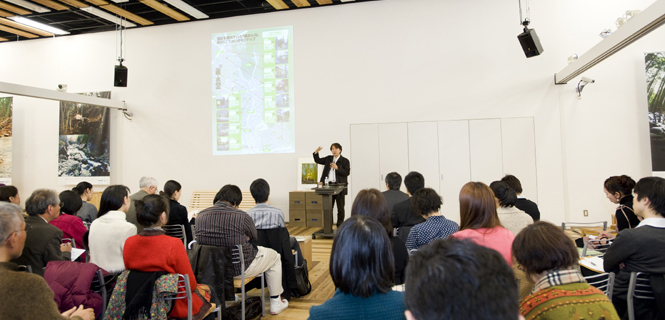
On January 29, 2009, an event called the "more trees meeting" was held at the "Minato City Eco-Plaza" in Minato Ward, Tokyo.Ryuichi Sakamotoreported on the activities of "more trees," which was launched in 2007 under his leadership.more treesSpeakers included Mr. Sakamoto, supporters, and related individuals.
Photos: Nobuo Iida, Fumiya Kato
A Year of Growth
The idea behind "more trees," to address environmental issues through forest creation, was first announced in May 2007. Initiated by prominent figures such as Haruomi Hosono, Ryuichi Sakamoto, Yukihiro Takahashi,Koichi Kamoshidaand Shinichi Nakazawa, the organization "more trees" was formally established in July of the same year as a limited liability intermediary organization, attracting numerous supporters from various fields.
The full scope of this plan, aiming to reduce carbon dioxide (CO2) through forestation, was revealed several months later on November 30th. At the "Ryuichi Sakamoto's more trees Meeting" held during the "Minato Forest and Water Conference 2007" at the Akasaka Civic Center, Mr. Sakamoto, the representative, discussed the concept of the initiative and the announcement of the first domestic forest regeneration project.
Then, just over a year after Representative Sakamoto's "kick-off declaration," on January 29, 2009, an activity report meeting titled "more trees Meeting" was held as part of the "Minato Forest and Water Conference."
Participating in this meeting, it became clear that although "more trees" had only been active for a little over a year and a few months—mere saplings in the lifespan of a tree—its growth during that period had been remarkable, steadily extending its reach.
Forest Regeneration Projects Progress Steadily
The first "more trees" forest, established in November 2007 in Yusuhara Town, Kochi Prefecture, is a project to develop a 58.4-hectare forest, roughly the size of Shinjuku Gyoen, over three years. The thinning rate has reached approximately 30%, and goods made from thinned cedar from the area, detailed later, are already on sale.
The second forest, established in August 2008 in Nakatosa Town, also in Kochi, spans 70.23 hectares and is undergoing development primarily focused on cypress trees.
In both forests within the Shimanto River basin, thinning and other forest management activities are steadily progressing. At the report meeting, before-and-after photos were shown, highlighting the abundance of light that reached the forest floor after thinning. It goes without saying that the forest floor was bathed in light.
The third forest is planned to be established overseas. Preparations are currently underway for a project on approximately 150 hectares of land in Quirino Province, located a nine-hour drive north of Manila, the capital of the Philippines, with plans to develop agroforestry (fruit tree planting) and other initiatives.
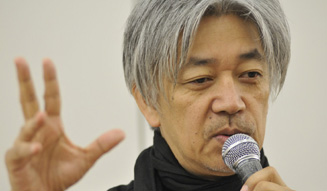
Representative Sakamoto, who gave a greeting at the activity report meeting, commented, "The second forest was completed much faster than we anticipated. I eagerly await the realization of the forest in the Philippines." Forest creation is the cornerstone of "more trees" activities. The smooth start is good news.
Promoting Carbon Offsetting
Alongside forest creation, "more trees" has also begun offering carbon offsetting services. This concept, which offsets CO2 emissions from human activities through measures like tree planting and green energy, has been implemented in various ways, including the recording and manufacturing of Representative Sakamoto's CD "koko," the broadcast of radio programs, and "Carbon Offset Tours in Shimanto River" (utilizing All Nippon Airways flights for the tour) with actress Tamami Yoshimoto as navigator.
Furthermore, carbon offsetting is also applied to goods produced by "more trees." While paper certificates are often issued as proof of offsetting, "more trees" takes a unique approach by incorporating a special mark, offset amount, and serial number directly onto the items themselves, such as T-shirts and badges, effectively turning the product into a certificate.
The message, "By producing this T-shirt, we have reduced X kilograms of CO2 in the ●● forest," is worn by people living urban lives as they go out into the city. This aligns perfectly with "more trees'" concept of "circulation between cities and forests."
To ensure the continuous practice of forest creation, funding must be allocated to these activities. It is unfair for only those directly involved in forestry to bear this financial burden. As urban dwellers, we all benefit from the forest's bounty in various ways, even from afar.
The degradation of Japan's artificial forests stems from this imbalanced economic cycle. In fact, the solution to the significant challenge of global warming, not just for domestic forests but for humanity as a whole, may lie in rectifying this economic imbalance.
A Growing Array of "more trees" Items
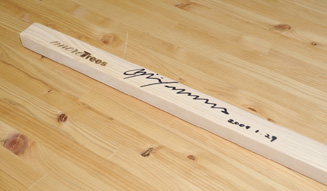
"more trees" has been consistently launching a variety of items. The "Wooden USB Memory" utilizes thinned cedar from the first forest in Yusuhara Town, with a system in place where 10% of sales are donated to forest creation.
In collaboration with Isetan, "more trees" also produced wooden items. Additionally, popular figures made from recycled materials, "BE@RBRICK," and T-shirts made from organic materials from an ecological perspective were also released.
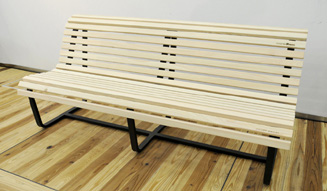
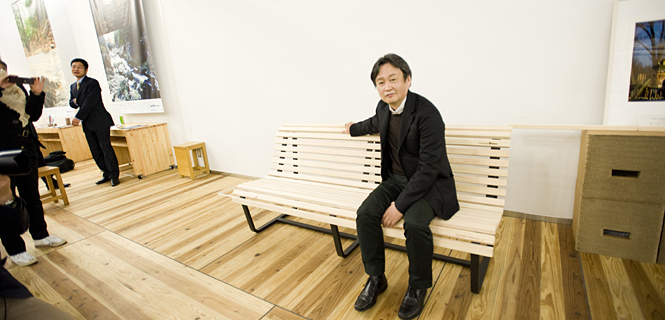
New wooden items are set to join this collection. These are benches, designed by the world-renowned product designer Naoto Fukasawa, which are sure to attract significant attention.
As previously reported in our magazine, Mr. Fukasawa visited Kochi in August 2008 with Representative Sakamoto. The idea he presented then, to create benches from thinned wood, has quickly materialized, albeit in prototype form.
The Future of "more trees"
Indeed, many individuals involved in creative fields, such as designers and musicians, resonate with the philosophy of "more trees" and express a desire to take action.
"I never expected the trend of creating design products from thinned wood to develop so quickly," stated Masaaki Ikeda, the vice representative of "more trees." In response, Representative Sakamoto remarked, "Designers are often at the forefront of mass-produced goods, and many feel a sense of guilt about their environmental impact. I felt the same way when creating CDs, which is why I started incorporating carbon offsetting."
At the end of the report meeting, Representative Sakamoto said, "When I explain 'more trees,' everyone, regardless of who they are, shows sympathy. I believe this is because everyone feels a sense of urgency about the global environment."
However, behind that sense of urgency, there must be hope. This is likely why "more trees" is beginning to gather a large number of supporters, both corporate and individual.
No one believes that solving environmental problems is easy. It is also clear that forest creation activities do not yield immediate results. While the first year of "more trees" has concluded, it was a crucial chapter leading to the next, and it marks the beginning of a long-term endeavor that will continue from here on.
Talk Show by Two Supporters
Following the "more trees" report session in the first half, a talk live event featuring cultural anthropologist Shinichi Nakazawa and designer Naoto Fukasawa was held from 5:00 PM, with each speaking for two hours.
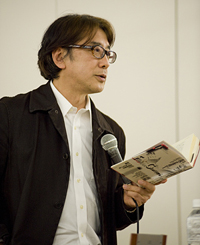
Mr. Nakazawa explored the relationship between water and forests in Minato Ward from an ethnographic perspective. His engaging discourse, weaving together topics such as the contradictions inherent in ecological issues, human cognitive revolution, and the mechanisms of financial crises, drawing on keywords from his writings and thinkers like Guattari and Marx, deeply impressed the large audience.
Designer Mr. Fukasawa introduced the "bench," one of the "more trees" products he designed. He elaborated on the design philosophy behind the bench, intended for public use, allowing anyone to participate in "more trees'" activities simply by sitting on it. He also discussed his own interpretation of the word "ecology."
With its activities expanding both domestically and internationally, we look forward to the continued development of "more trees'" clear initiatives and tangible ecological actions.
Eco-Plaza
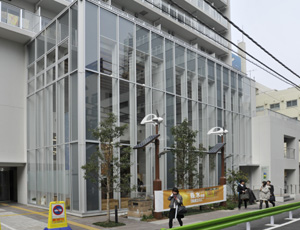
The Minato City Eco-Plaza, where "more trees" merchandise is sold and details about Minato City's ecological activities can be found. It also hosts various other events.
1-13-1 Hamamatsucho, Minato-ku
Tel. 03-5404-7764
www.eco-plaza.net
Related Article | Kochi Prefecture, Shimanto: On-site Report of "more trees Forest"