May 14, 2015
Ryuichi Sakamoto's "more trees" Initiative Finally Launches!
Ryuichi Sakamoto's "more trees" Initiative Finally Launches!
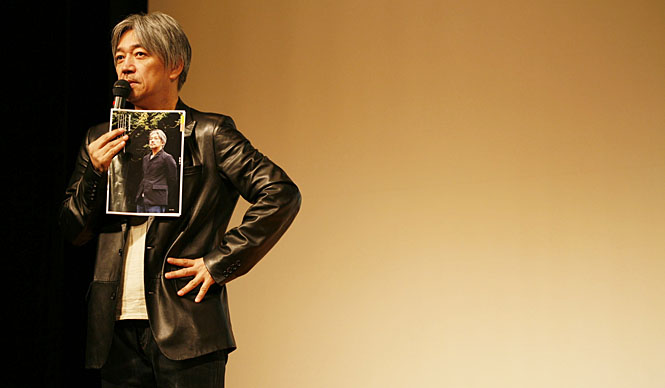
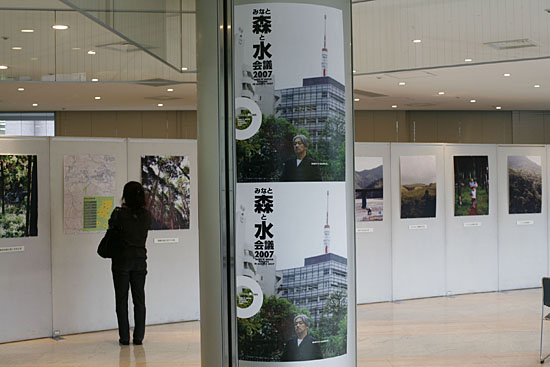
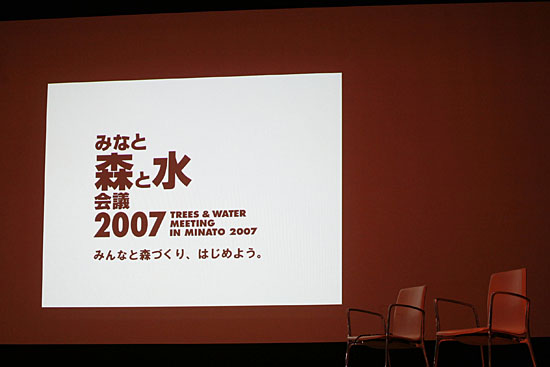
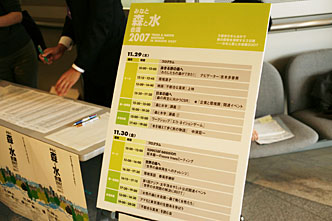
With the aim of becoming a platform for tree-planting and forest-building activities, and garnering support from prominent figures across various fields,Ryuichi Sakamotolaunched "more trees". On November 30th (Friday), its full scope was revealed at the "Ryuichi Sakamoto's more trees Meeting" held within the "Minato Forest and Water Conference 2007" at the Akasaka Civic Center.
OPENERS will support more trees' tree-planting and forest-building initiatives while contemplating future environmental issues.
First, we will present Sakamoto's keynote speech from the "Ryuichi Sakamoto's more trees Meeting."
Report by Makoto Kaji (This Magazine)Photo by JAMANDFIX
A Thought: "What Will Happen If We Continue Down This Path?"
This year marks the 10th anniversary of the adoption of the Kyoto Protocol on December 17, 1997, which set ambitious goals for preventing global warming. I don't need to tell you that you all keenly feel the effects of global warming yourselves.
I began to feel the effects of global warming in the late 90s, around '97 or '98, and started to wonder, "What will happen if we continue down this path?"
The Earth's atmosphere contains carbon dioxide (CO2) and other gases known as greenhouse gases. These accumulate and cause global warming. Too little of them is problematic, as it causes the Earth to cool, and too much is also problematic.
The Earth is ingeniously designed to seek balance over long periods. However, for the past 200 years or so, the CO2 emitted by humans has increased, leading to warming. The IPCC (Intergovernmental Panel on Climate Change, http://www.ipcc.ch/) reports state, and a recent official consensus has emerged, that this phenomenon is almost certainly caused by human activities.
This is All We Can Do
As long as we are alive and breathing, we naturally emit CO2.
The Earth maintained a balance through the absorption of CO2 and the production of oxygen by oceans and terrestrial plants. However, this balance has been disrupted. Terrestrial vegetation, particularly large forests and rainforests, is being lost at an accelerating rate, reducing the plants that should absorb CO2. Meanwhile, human CO2 emissions continue to rise.
Furthermore, the ocean's capacity remains largely unchanged, and the amount of CO2 it absorbs has also remained relatively constant. However, a more alarming report has recently emerged: the oceans are beginning to cease absorbing CO2.
Broadly speaking, while the land and sea have each absorbed similar amounts of CO2, the ocean's absorption capacity is also decreasing. More concerningly, reports suggest that the CO2 accumulated in the oceans may begin to overflow as they reach saturation point.
Reducing CO2 emissions is linked to energy conservation, but that alone is not enough. Since we cannot increase the ocean's CO2 absorption capacity, the only thing we can do is increase terrestrial vegetation. And that is something we can do, isn't it?
I believe this is the only way forward: conserving energy and increasing forests.
The Average American Emits 20 Tons of CO2 Annually
I assume those of you here are already making efforts to conserve energy. For the past two or three years, I've been purchasing electricity from wind power facilities. Moving forward, the concept of "carbon offsetting" will become increasingly important.
Living beings emit CO2 simply by existing. Moreover, those of us who enjoy convenient lifestyles inadvertently emit CO2 through our everyday actions.
Apparently, the average American emits 20 tons of CO2 per year. An Indian emits about 1 ton. This clearly illustrates how lifestyle choices impact emission levels.
The average Japanese person emits around 10 tons, placing us somewhere in the middle. Although we may feel we live quite luxuriously, we emit half as much as Americans. This highlights how much they emit.
If you emit a lot, you should strive to offset those emissions and reach a net-zero balance. This is something we should all endeavor to do in our daily lives, and it requires cooperation.
Actions Possible Without Changing Lifestyles
We who live in cities have no forests nearby. Therefore, we must establish networks with areas that do have forests. But how can individuals achieve this connection?
There are various ways to practice "carbon offsetting."
I live in New York, and people often say, "You fly so much, aren't you burdening the planet?" (laughs). But nowadays, in this convenient world, there are services that can calculate the CO2 emissions from a round trip between New York and Tokyo—which is over 5 tons—and offset them to net zero. There are ways to solve this with money, even without planting trees.
When we talk about the environment, it doesn't necessarily mean we have to revert to a Jomon-period lifestyle or live in ascetic poverty. Life would be unbearable if we had to sacrifice all our pleasures and live frugally. It's okay to drive a supercar once in a while, perhaps once a year. The key is to measure those emissions and offset them to achieve a net-zero balance.
Former Prime Minister Shinzo Abe spoke of a 50% reduction by 2050, but my feeling is, "Will that be enough?" "Isn't it urgent to accelerate this timeline?"
Looking at the IPCC reports, I feel the sense of crisis is escalating. Therefore, I want to move forward with an accelerated timeline.
Next time, we will present a dialogue between more trees supporter Takami Yoshimoto and a professor.
more trees Website
http://www.more-trees.org/