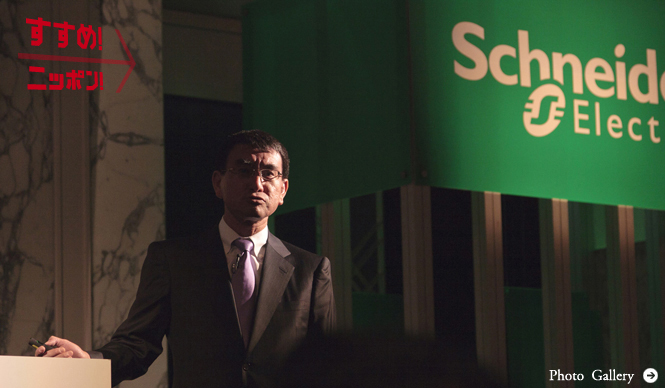
Taro Kono Proposes: Separation of Power Transmission and Distribution, and Abolition of the Comprehensive Cost System
Japan's Energy Policy
Taro Kono's Proposal: Unbundling Power Transmission and Distribution, Abolishing the Comprehensive Cost System
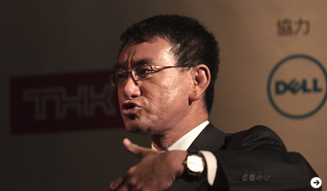
On October 11th, Schneider Electric, a French electrical equipment manufacturer, held a forum themed around maximizing energy utilization. Taro Kono, a member of the Liberal Democratic Party, took the stage to advocate for the necessity of an energy policy shift.
Text by OPENERS
Photos by Seiichi Saito
From Nuclear to Renewable Energy and Energy Conservation
Kono is known as an "anti-nuclear advocate," a rare stance within the LDP, a party that has historically promoted nuclear power. He has repeatedly criticized past nuclear policies, not only in the Diet but also at private sector forums like this one.
He began by addressing the inefficiency inherent in the nuclear power generation system.
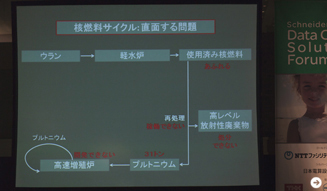
"One issue is that the fast breeder reactor, which was initially expected to be developed by the 1980s, has been postponed until 2050 due to the Monju accident. Another is the disposal of ever-increasing volumes of high-level radioactive waste. It must be buried deep underground, hundreds of meters below the surface, and monitored for radioactivity for 100 to 200 years. We need about 20 years for boring surveys to find a location resistant to volcanic activity, earthquakes, and groundwater, and even before that, at least five years for literature surveys. The government says it will decide on a disposal site in 2028, but to do so, they should have started the surveys back in 2003."
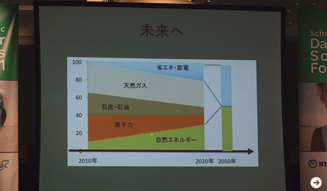
So, how can this problem be solved? Kono's vision is to ultimately meet 100% of Japan's electricity demand through energy conservation and renewable energy. To achieve this, he asserts, it is necessary to unbundle power transmission and distribution and abolish the comprehensive cost system.
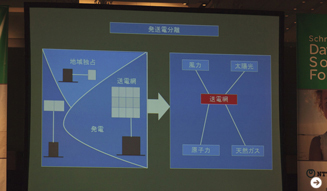
"This means allowing power generation companies fair access to the transmission grid, which has been monopolized by specific electric power companies, enabling consumers to choose their electricity provider. In Japan, peak electricity demand occurs only for a few hours on summer afternoons in August. If we raise electricity prices during those peak times, factories will shut down, leading to energy savings, and companies with their own generation facilities could even sell electricity. Unbundling transmission and distribution is crucial for revitalizing such market mechanisms," he explained.
Another issue is what is known as the comprehensive cost system.
"A local magazine in Hokkaido surveyed the average salaries of companies there and found that while Hokkaido Gas employees earned in the 6 million yen range, Hokkaido Electric Power employees earned in the 8 million yen range. Hokkaido Electric is said to be one of the smaller power companies, so salaries across the industry are quite high. These personnel costs are all covered by the electricity bills paid by consumers. The same applies to the enormous advertising expenses, like those featuring Denko-chan."
"Furthermore, it's problematic that companies are generally allowed to add a 3% profit margin on top of their fixed asset costs. For example, generating 1 million kW requires an investment of 500 billion yen for a nuclear power plant and 50 billion yen for a gas plant. Under the comprehensive cost system, 3% of the fixed assets becomes profit, so power companies have favored the 500 billion yen nuclear plants. This is also why electricity prices in Japan are more than double those in South Korea and Taiwan, which do not use the comprehensive cost system."
By separating transmission and distribution and abolishing this comprehensive cost system, competition in the electricity market will be driven by market principles. Kono believes that creating such a situation is crucial.
"Even the LDP, which is responsible for past energy policies, has started discussions on energy policy from scratch. I believe the public should also take an interest and work towards realizing an energy policy that benefits everyone."