
March 2, 2015
Junji Tanigawa | Series, Part 3: "Kansei -Japan Design Exhibition-"
Part 3: "Kansei -Japan Design Exhibition-" (1)
Is there a space you'd like to see again? When asked that, the memory of that particular space always comes to mind. It was the exhibition "Kansei -Japan Design Exhibition-" held in Paris in 2008. Now is precisely the time to reimagine it. More than that, I want the people of Japan to experience that spatial encounter. It was a rare program that allowed us to embody the fascination and depth of Japanese craftsmanship in a remarkably simple and stylish spatial design.
Text by TANIGAWA Junji
Photographs by MATSUI Koichiro
The exhibition was structured into three zones: "Future Kansei," "Historical Kansei," and "Present Kansei." The exhibition space, comprising three symmetrically arranged rooms, was utilized to construct the narrative. The "Historical Kansei" exhibition was presented in the magnificent Renaissance-style central exhibition hall, the "nef." Here, Japanese sensibilities were expressed lyrically through an installation-based spatial approach. The exhibition room on the west side of the building was designated for "Present Kansei" product displays. The aim was to allow visitors to perceive the "kansei" woven into various objects through the products themselves. The east wing housed the "Future Kansei" zone, featuring approaches that hinted at future craftsmanship, including technological displays, traditional techniques, the latest printing technologies, and graphic design. Live demonstrations and workshops drew considerable attention, with many people pausing to observe and listen.


The entire venue eschewed a fixed route, adopting a fluid circulation design that allowed visitors to move freely. The space was conceived as a prose-like environment, encouraging a consistent impression and understanding regardless of the entry point. Curated products were arranged according to Japanese terms such as "kagerou" (heat haze) and "motenashi" (hospitality). This poetic expression, avoiding excessive explanation, was greatly appreciated and embraced by the French, who value language.
Kansei -Japan Design Exhibition-
This exhibition, based on the "Initiative for the Creation of Kansei Value" formulated by the Ministry of Economy, Trade and Industry, showcased excellent Japanese products and services that appeal to the senses. The exhibition was held from December 12-21, 2008 (10 days) at the Musée des Arts Décoratifs, Louvre Palace, as part of the "Kansei -Japan Design Exhibition-" design fair commemorating the 150th anniversary of Franco-Japanese exchange, with overall production by the Design Association.
Dates: December 12 (Fri) - 21 (Sun), 2008
Venue: LES ARTS DECORATIFS (Musée des Arts Décoratifs, Louvre Palace)
Organizers: Ministry of Economy, Trade and Industry (METI), Japan External Trade Organization (JETRO)
Co-organizer: LES ARTS DECORATIFS (Musée des Arts Décoratifs, Louvre Palace)
General Producer: Kenji Kawasaki (Chairman, Design Association)
Art Director: Katsumi Asaba
Calligrapher: Souun Takeda
Curators: Kazuya Shimokawa (Editor-in-Chief, Nikkei Design), Noboru Endo (Editor)
Supervisors: Manabu Akaike, Toshiyuki Kita, Hiroshi Naito, Akio Hirano
Spatial Creative Director: Junji Tanikawa (JTQ)
Object Design: Daisuke Hirose
Lighting Designer: Akari Liisa Ishii
Video Production: teamLab Inc.
Part 3: "Kansei -Japan Design Exhibition-" (2)
Encountering the Beautiful Skylight
This exhibition, held to commemorate the 150th anniversary of Franco-Japanese exchange, took place at the Musée des Arts Décoratifs in the Louvre Palace. I first visited the venue with the relevant parties eight months before the exhibition's opening, in April 2008. The main exhibition hall, the nef, was hosting a Napoleon exhibition. It was a day the museum was closed to the public. In this building, with over 800 years of history, there was no sign of people; only the cleaning staff and I were present. The hall was eerily silent, adorned with Napoleon's personal belongings, and his throne was displayed at the far end. Having the Louvre to myself in such silence was an experience where time seemed to stand still.
As is often the case, the initial impression and atmosphere of a site profoundly influence the final outcome. One absorbs all the information that will likely be encountered there – the wind and scents in the air, the bustle of the city, the murmur of people – the "atmosphere." It is often during these moments that a grand spatial image begins to form.
Typically, exhibition venues lack windows. To minimize environmental fluctuations, natural light is blocked, and instead, artificial lighting is used to create a deliberately controlled ambiance. However, this place was different. It possessed a truly beautiful skylight. The interior transformed dramatically with the changing sunlight throughout the day. The walls, adorned with Renaissance decor unchanged for centuries, shifted moment by moment. This magnificent Western historical tapestry, where nature and human aesthetics intertwined through the passage of "time," was a testament to European culture's artistic achievements, born from human intellect.
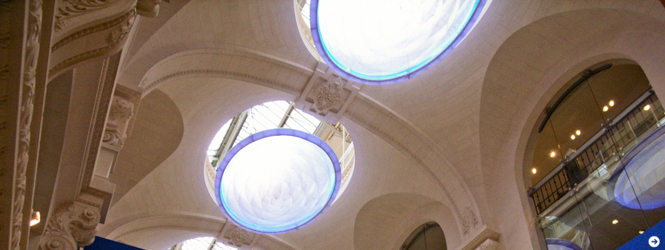
Expressing "Ma - Interstitial Space" Infused with Japanese Sensibilities
Faced with this intensely powerful space, I had no idea how to imbue it with "Japaneseness." I spent several more hours there, occasionally glancing at the cleaning staff. It was a quiet afternoon on a closed day, with soft Parisian sunlight filtering in. Hours of dialogue with the space. Napoleon's throne, bathed in sunlight, was beautiful. I wanted to utilize this sunlight.—The idea that the Louvre offered was remarkably simple: a spatial composition that embraced the falling sunlight. The interplay of light and shadow woven by time. A world of "In'ei Raisan" (In Praise of Shadows). I wanted to express "Ma - interstitial space" infused with Japanese sensibilities within the venue. "A Garden. A Garden of Kansei." The intention solidified naturally at that moment.
The central exhibition hall, the nef, at the Musée des Arts Décoratifs in the Louvre Palace is the very crystallization of Parisian Renaissance culture. It is an exceptionally magnificent and opulent space. One could describe it as a space that is itself a gorgeous frame. This is perhaps a more accessible way to put it. Consequently, it presents an appearance far removed from the typical Japanese atmosphere or the aesthetic of "wabi-sabi." I sought a method to harmonize with this space naturally, without creating a sense of dissonance.
Normally, elements that are difficult to integrate are either eliminated or concealed. This might involve hiding them behind walls or controlling the lighting, employing techniques to minimize their visibility and erase their impact. But here, it was different. The space was filled with sunlight from the superb skylight. Elimination was never an option from the outset. What could connect the space with a consistent tension, transcending both Japanese and Western elements? It was then that I noticed the "shadows" within the scenery I had been observing. Shadows whose color and shape changed as the sunlight shifted. The contrast between the immutable architecture and the mutable shadows was a truly grand production bestowed by the universe.
Part 3: "Kansei -Japan Design Exhibition-" (3)
What Japanese Symbol Could Stand Against the Renaissance Style?
Considering the culture and history of Japan, as well as the theme and exhibits of this exhibition, the image of freely wandering through an imaginary garden woven by the shade of trees felt incredibly comfortable. It was a way of seeing that allowed one to perceive what needed to be seen and be aware of what needed attention. I focused on spatializing the unique codes of Japanese communication, such as "iki" (chic) and "yabo" (unsophisticated), "a" and "un" (complementary opposites). Light and shadow. Stillness and motion. The resonance and harmony created by the contrast of Japanese elements. A space where one could experience these dualities firsthand was gradually taking shape.
I wanted to place a Japanese symbol in the center that could rival the Renaissance style. Considering the contrast with the traditional European stone architecture, I decided to erect a single tree as a Japanese element. This marked the birth of a symbolic tree, weaving together cutting-edge technology and historical perspective. The design was entrusted to architect Daisuke Hirose.
The symbol, named "Tree of Kansei," is inspired by the "matsu-bame" motif used in traditional Japanese stage backdrops. Drawing references from "terimukuri" (※) found in the architecture of temples and shrines, and Ogata Korin's "Red and White Plum Blossoms" screen, its form was derived using algorithmic calculations via computer. It is a representation of a pine tree formed by combining nine identical pieces, their angles and rotations alone creating the shape.
※ Terimukuri: A Japanese architectural design created by combining two curves, "teri" (concave) and "mukuri" (convex).
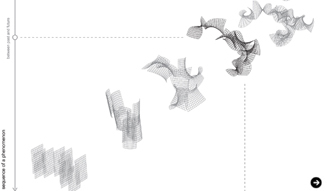

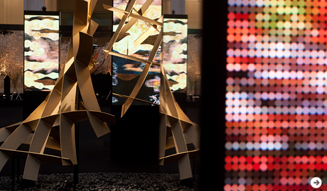
This piece, with its complex twists reminiscent of potato chips, is a completely planar structure formed by interlocking eleven flat boards in a cross-hatch pattern; when disassembled, it becomes entirely flat. This piece possesses a fascinating characteristic: by altering the way the pieces are combined, it can form waves or mountains that evoke a distinctly Japanese aesthetic, and do so in three dimensions. Much like Hokusai's "Thirty-six Views of Mount Fuji."
The creation of this tree allowed for a richer interaction with the sunlight streaming from the ceiling. The gentle light illuminated the shadows of the Renaissance, overlaid with the dappled shadows of the Japanese tree. By layering shadows upon shadows, a natural sense of rhythm emerged. The shadows shifted with time, revealing entirely different expressions depending on the hour. These ever-changing variations became the major axis of the space, harmonizing the rhythm of the place.
Part 3: "Kansei -Japan Design Exhibition-" (4)
The Digital Folding Screen: Creating Dualistic Ambiance
Next, I introduced a structure that served both to convey messages and display products: the "digital folding screen." Video pylons composed of LED screens greeted visitors. Viewed from the entrance, the front was designated side A, and the side seen when looking back from the rear of the venue was side B. These monolith-like structures incorporated different functions on each face. The contrast between "image" and "word" created a dualistic ambiance with distinct nuances in the space. Side A featured "Hana to Shi" (Flowers and Corpses), a video installation created by teamLab, led by Toshiko Inoko. Side B presented twelve Japanese words expressing "kansei," with products embodying their meanings.
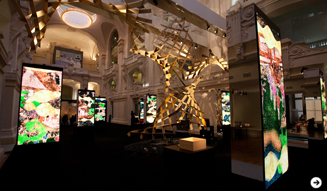

According to the artist, Inoko, this work is "a pictorial expression that flattens a virtual three-dimensional space created on a computer, exploring the spatial perception of our ancestors and reinterpreting it." In a sense, both sides are the "front." The "dynamic" world created by the experimental video space. The "static" world born from the combination of words and objects. There is no boundary between these two worlds; the space presents entirely different expressions depending on the visitor's perspective and mindset. The design aimed for a space akin to the Ryoan-ji rock garden. The challenge was to harmonize the energies of different contents spatially, strengthening the vector of understanding and realization in the non-verbal realm. I strived to create a sense of intuitive agreement that transcended language.
That Spatial Experience, Once More
The spatial expression created by the "Tree of Kansei" and the "digital folding screen" offered a departure from the minimalist, monochrome Japonisme that Parisians had previously associated with Japan. It was elegant yet pop, magnificent yet simple. The key color was gold. Genji, the protagonist of "The Tale of Genji," seemed to dance amidst the gold-leafed visuals and the tree. As visitors walked forward, a dynamic CG scroll painting instantly transported them from their everyday reality into a world far removed. Looking back, a static world unfolded across their field of vision. A world of beautiful words and objects enveloped them quietly. It exuded a gorgeous yet pure atmosphere. The resonance of Buddhist chanting seemed to echo subtly within the museum. The world of "Kansei," evoking the longed-for "Zipangu," materialized concretely before the eyes of Parisians at that moment.
Today, Japanese manufacturing is entering a new phase. Products that seem difficult to differentiate are mass-produced in neighboring countries. In the race for a balance between price and adequate performance, Japanese manufacturing is struggling. Now, Japan needs new perspectives and wisdom. Our future, as a nation with the longest history and an exceptional sense of craftsmanship in the world. I want the next generation to feel this as their own. Creativity begins not with thinking, but with feeling. I hope to foster an "uncontrollable passion that sparks the desire to start something," nurtured by excitement and anticipation. It is when contemplating such things that I recall this project as an "exhibition I want everyone to see again." Tracing memories that become vaguer each year, I embark on a delightful mental stroll. I wish to materialize this "Garden of Kansei" somewhere, someday, once more.