April 23, 2015
Feature: A Journey to Meet the Forest Spirit – Chapter 3: Gifu Prefecture's "Wellness Tourism"
Feature: A Journey to Meet the Forest Gods – Gifu Prefecture's "Wellness Tourism" – The Tono Region
Chapter 3: Cultural Succession and a Return to the Forest
The Cycle of Life (1)
Local amateur performances in Gifu are known as "Ji-Kabuki" (local Kabuki), with 29 preservation societies active, the most in Japan. The Tono area alone is home to about half of these, with 15 groups, and seven old and new theaters still stand, regularly hosting performances and serving as active venues. Staging Ji-Kabuki requires significant time and money, yet the local people continue their activities through mutual cooperation and support.
Photographs by JAMANDFIXText by KASE Tomoshige (OPENERS)
The Origins of Ji-Kabuki
This short series reports on the nature and culture of Gifu's Tono region. The third and final installment begins with "Ji-Kabuki." In 2007, Gifu Prefecture launched the "Hida-Mino Jiman Movement – Gifu's Treasures Certification Project" to promote new regional resources. In 2009, "The Ji-Kabuki and Theaters of the Tono Region" were certified as the highest-tier "Gifu's Treasures."
Ji-Kabuki is said to have originated during the Genroku era (1688–1703) of the Edo period, a time when playwright Chikamatsu Monzaemon and actor Ichikawa Danjuro I were active. Kabuki, which flourished in Edo and Osaka at the time, spread to the provinces through traveling troupes.
The Tono region, a crossroads of major routes including the Nakasendo, was a place where people, goods, and culture easily flowed in from urban centers. This history likely contributed to Kabuki taking root here. Furthermore, the region has a long history of forestry (see Chapter 1 of this feature). With abundant timber and skilled labor for construction, rural stages were built, often within shrine grounds. Eventually, local residents, no longer content with just watching, began learning the arts from the actors and performing themselves.
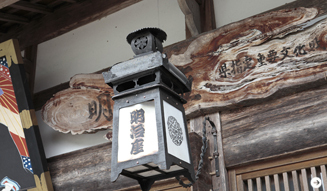
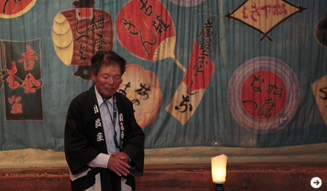
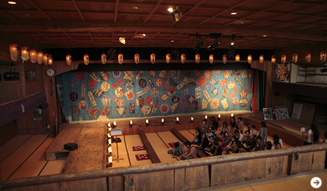
We head to the "Meijiza" theater in Kashimo, Nakatsugawa City, the largest among the theaters in Nakatsugawa, Ena, and Mizunami cities. With its gabled roof and three attached lean-to sheds, it is a designated Important Tangible Folk Cultural Property of Gifu Prefecture. Stepping inside, one is transported back in time, yet it remains an active theater.
The Culture of Actors Bearing the Costs
Meijiza is a wooden theater completed in 1894, featuring a revolving stage, main and temporary hanamichi (runways), and a "suppon" trapdoor for actor entrances. The first floor is a tatami-matted seating area, gently sloped towards the stage for better viewing from the rear. The second floor consists of box seats.
The first things that catch the eye are a distinctive "Musume Hikimaku" (curtain for young women) among the draw curtains, and a heavy, solid beam. The "Musume Hikimaku" was a gift from the village girls when Meijiza was built. It's a stylish design on blue fabric, featuring strips of paper, maple motifs, and embroidered names and theater crests. The beam is made of a fir tree estimated to be 400 years old. In the Edo period, cypress was highly valued, as indicated by the saying, "One cypress, one head." Perhaps as a legacy of this, no cypress was used in the construction of Meijiza, a community entertainment facility.
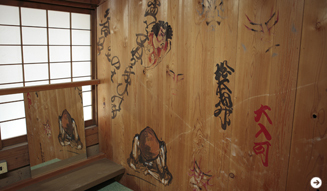
The dressing room, or actor's waiting area, is surprisingly adorned with graffiti from various eras and by different actors on its wooden walls. This is apparently a unique custom of Ji-Kabuki. The signature of Ryuichi Sakamoto, who visited Meijiza in March of this year, was also visible. Afterwards, we ventured beneath the stage to the "naraka" (understage area) where the revolving stage is operated. The mechanism is massive and still moved by human power.
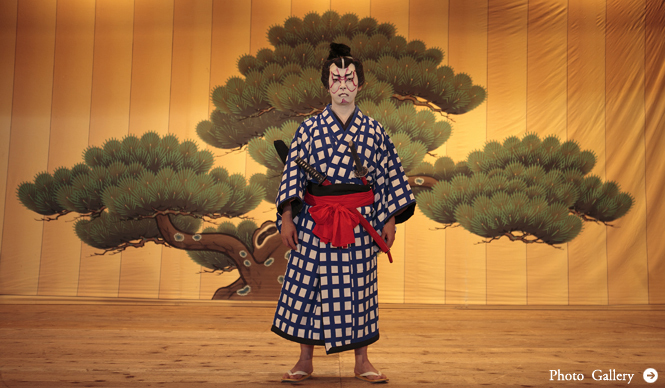
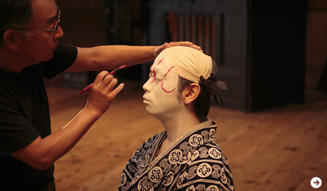
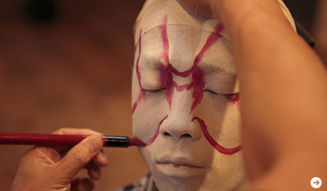
While it's generally known that actors apply their own makeup in Kabuki, in Tono's Ji-Kabuki, there is a professional called a "Kao-shi" (face painter). This artisan can apply makeup to over 50 people in a single day. We had the opportunity to observe the makeup and costume application. Mr. Shigeyoshi Yoshida, secretary-general of the Tono Kabuki Preservation Society and holder of the fourth-generation Nakamura Tsushichi name as a choreographer, demonstrated.
"Kumadori (makeup lines) trace the natural lines of the face," Yoshida explained. "It's to express strength, but since everyone's facial lines are different, we draw them to suit the individual." While the base coat is applied quickly, the kumadori surprisingly takes a long time. This is likely because it greatly affects the actor's appearance, so it is applied with great care.
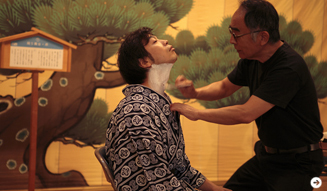
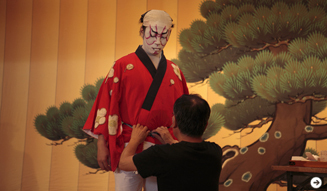
Next is the costume fitting. Today's role is Umemaru, a character in the "Aragoto" (heroic, righteous role) style. "Dressing is quite difficult and requires understanding the story of the play," Yoshida explained as he dressed the model. "For example, if there's a scene where the character removes their shoulder covering on stage, we dress them in a way that makes it easy to do so." Some of the costumes and wigs are from the Meiji period, and they are carefully maintained and repaired for continued use.
In about 30 minutes, Umemaru was "complete." Although the model was an amateur, the makeup and costume fitting were superb. Posing under Yoshida's guidance, the model looked quite convincing. Yoshida described Tono's Ji-Kabuki as "something where actors bear their own costs to perform for the audience." He believes that despite the scoldings from masters, personal expenses, and potential embarrassment on stage, the allure of Ji-Kabuki surpasses these challenges. This includes the thrill of embodying a character and receiving applause, and the joy of collaborating with many people – choreographers, shamisen players, costume designers, makeup artists, set builders, and prop masters – to create a single performance. Those captivated by Ji-Kabuki continue their activities and pass down the culture through mutual support.
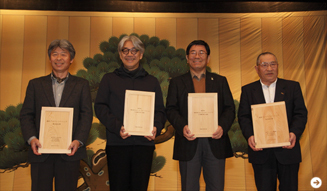
Meijiza hosts the annual "Kashimo Kabuki Performance" every September. This year's event, held on September 2nd, marks the 40th anniversary of the performance. Those interested are encouraged to experience Ji-Kabuki firsthand with their own eyes and ears.
Feature: A Journey to Meet the Forest Gods – Gifu Prefecture's "Wellness Tourism" – The Tono Region
Chapter 3: Cultural Succession and a Return to the Forest
The Cycle of Life (2)
Leaving Meijiza, we drive through the Kashimo district. Incidentally, food eaten while watching plays, like the "Nagataki" bento from Chapter 2, is called "Kabe-su" in the Tono region, an acronym for "Kashi" (sweets), "Bento," and "Sushi." We sampled the "sushi" part of this traditional term. It's a local "Hoba-zushi," made with vinegared rice topped with fish flakes and simmered butterbur, wrapped in a magnolia leaf. A serving of three pieces costs 630 yen. It's easy to eat and has a simple, rustic flavor.
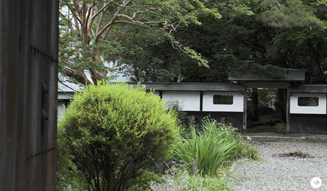
One must-visit spot in Kashimo is the "Daigyo Enmei Jizoson" (Great Cedar Longevity Jizo). Its historical significance dates back to 725 AD, but the colossal cedar tree itself is awe-inspiring. Known as the Kashimo Daigyo, it stands 37 meters tall with a base circumference of over 16 meters, estimated to be over 1,500 years old, and is designated a Natural Monument. This Jizo is revered not only locally but also throughout the prefecture and beyond as a guardian deity for longevity and safe childbirth. Not far from here is the main residence of the Naiki family, the hereditary forest guardians of Kashimo. In front of their large, historic house, where the family was appointed forest guardians by the Owari domain during the Edo period, stands a magnificent kaya tree. Although the residence is old and impressive, it is inhabited, so entry is prohibited and visitors should admire it from the outside.

After a 15-minute drive, we arrive at a forest managed through a project by Gifu Prefecture and the More Trees Association. It's a forest of Japanese cypress. Mr. Atsushi Naiki, head of the Kashimo Forest Cooperative, who guided us through the Jingu Biyorin (sacred forest for Ise Grand Shrine, see Chapter 1 report), provided an explanation. "In the past, we'd say one hectare was worth 100 million yen, and we'd cut down trees as soon as they grew thick. But that meant there would be nothing left for our sons to cut. So, we decided to manage this forest as a 'two-tiered forest.'"
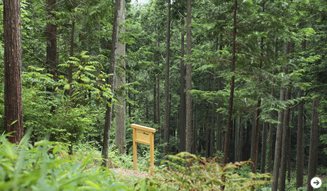
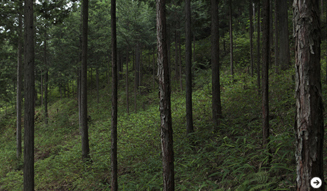
"By staggering the cypress growth over 30-year cycles, we can create a forest that provides income for every generation," he explained. "If we can get every generation involved, it will be easier to maintain. We hope this forest will become a model for forest management in Kashimo," Mr. Naiki added with a hopeful tone.
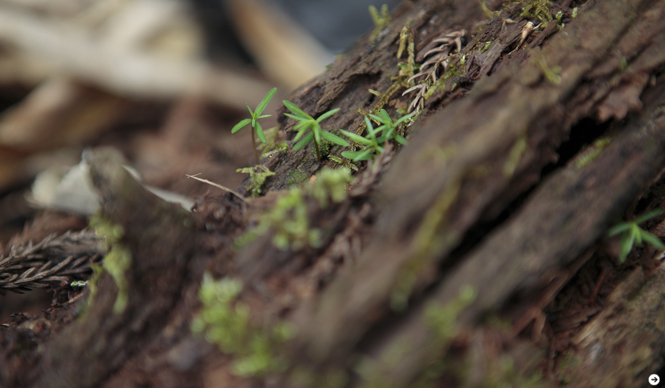
Looking back, all the subjects we covered in the Tono region were connected to the forest: the sacred forest for the Ise Grand Shrine's rebuilding, timber production for construction and crafts, products made from cypress oil, wild plants and mushrooms, beautiful rivers and ayu fish, inns serving cuisine made with these ingredients, and Ji-Kabuki... all originated from the forest, nurtured in this land, and continue to thrive. And now, those who preserve this tradition are simultaneously taking firm steps towards new forest development. Gifu Prefecture's "Wellness Tourism" initiative aims to heal and promote health through nature. The Tono region, as a place embodying this philosophy, is brimming with diverse hopes and possibilities. A visit here will undoubtedly allow one to understand its charm.
Meijiza Theater
4793-2 Kashimo, Nakatsugawa City, Gifu Prefecture
Tel. 0573-79-3611
Opening Hours: 10:00 AM – 4:00 PM
Closed: Mondays
http://meijiza.jp/

Gifu Prefectural Tourism Division
Tel. 058-272-8393
http://www.kankou-gifu.jp/(Gifu Prefectural Tourism Federation Official Website)